Introduction
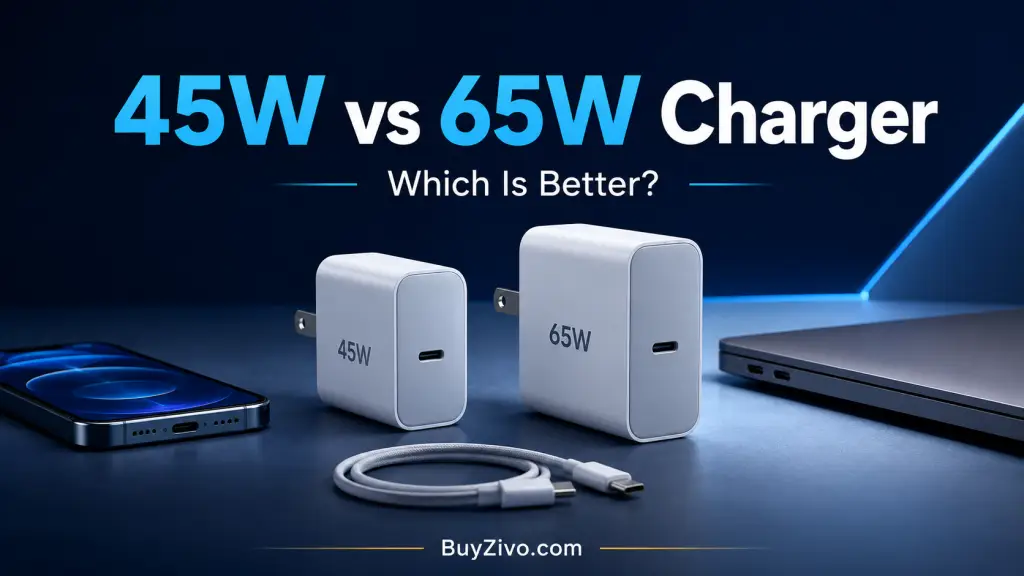
A 45W charger is usually enough for phones, tablets, handheld devices, and some lightweight USB-C laptops. A 65W charger is the better all-purpose choice if you also charge a laptop, want more performance under load, or plan to keep one charger for several devices.
The extra 20 watts will not force excessive power into a compatible phone. USB Power Delivery allows the charger and device to negotiate an appropriate power level. However, a 65W label does not guarantee better results: the charger must support the charging protocol and output profile your device expects.
45W vs 65W charger: quick verdict
Choose a 45W USB-C charger if:
- Your phone is the most demanding device you charge.
- You own a tablet or a low-power USB-C laptop.
- Small size and low weight are priorities.
- Your devices cannot use more than 45W.
- You have a compatible second charger for your laptop.
Choose a 65W USB-C charger if:
- You regularly charge a USB-C laptop.
- You want one charger for your phone, tablet, and computer.
- Your laptop’s recommended adapter is around 60W or 65W.
- You use the laptop while it is charging.
- You want additional wattage headroom for future devices.
For most buyers seeking one versatile charger, 65W is the more practical long-term choice. A 45W model remains sensible when portability and phone-focused charging matter more than laptop coverage.
45W vs 65W charger comparison
| Feature | 45W charger | 65W charger |
|---|---|---|
| Maximum advertised output | 45W | 65W |
| Best suited to | Phones, tablets, light laptops | Phones, tablets, many mainstream laptops |
| Phone charging advantage | Supports compatible high-power phones | Usually no faster if the phone caps below 65W |
| Laptop use | Model-dependent; may charge slowly under load | Better coverage and more usable headroom |
| Portability | Often smaller and lighter | Usually slightly larger, although design varies |
| Multiport performance | Limited power to divide | More useful when charging two devices |
| Cable considerations | Some 45W phone modes require a 5A e-marked cable | A certified 60W cable can carry up to 60W; full 65W requires a higher-rated cable |
| Best buying reason | Compact charger for mobile devices | One charger for a wider collection of devices |
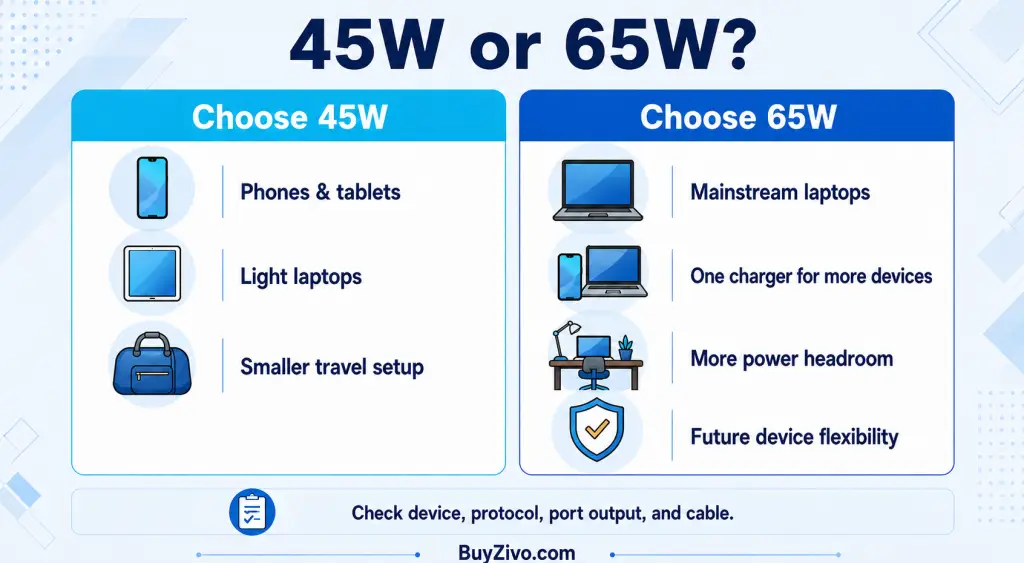
Charger size, efficiency, port count, and supported profiles vary by model. Wattage by itself cannot establish which physical charger is smaller or better built.
What does charger wattage actually mean?
Watts measure electrical power. A charger marked 65W can provide up to 65W under a supported output profile, while a 45W unit tops out at 45W.
That number is a capacity, not a constant delivery rate. A 65W USB-C charger does not continuously send 65W to every connected device. With a standards-compliant USB Power Delivery connection, the charger advertises supported power profiles and the device requests one it can use.
This has two important consequences:
- A 20W or 30W phone can normally use a compatible 65W USB-C PD charger without drawing the charger’s full capacity.
- A 65W laptop connected to a 45W charger may charge more slowly, stop gaining battery during demanding work, or display a low-power-adapter warning.
Apple, for example, says a USB-C Mac can use a USB-C power adapter with higher or lower wattage than the model’s recommended adapter. Apple also recommends at least the specified minimum wattage for the best charging experience. See Apple’s USB-C Mac power-adapter guidance.
Is a 65W charger faster than a 45W charger?
Only when the connected device can request more than 45W, and the complete charging setup supports it.
A 65W laptop may gain a meaningful advantage from a compatible 65W charger. A phone limited to 25W, 30W, or 45W will not suddenly charge at 65W. Its charging controller sets the limit, and charging power normally reduces as the battery fills or its temperature rises.
The advertised wattage is therefore only the first compatibility check. You must also consider:
- USB Power Delivery support
- PPS support where required
- Available voltage and current profiles
- Output from the port being used
- Cable current and power rating
- The device’s own charging limit
- Temperature and battery state
This is why two chargers carrying the same wattage can behave differently with the same phone.
When a 45W charger makes more sense
You primarily charge a phone
A capable 45W charger already exceeds what many phones require. Even phones that advertise high-speed charging may need a specific protocol rather than simply a higher wattage number.
Recent Google charging guidance recommends a PPS adapter rated at 30W or more for supported Pixel phones. Google’s official 45W adapter, for example, supports USB PD 3.1 PPS and publishes fixed and programmable output profiles rather than relying on “45W” as the only specification. See the Google 45W charger specifications.
Apple states that compatible iPhones can fast-charge with an 18W-or-higher USB-C PD adapter, with requirements varying by model and setup. A 65W laptop charger can be used, but its extra capacity will not necessarily improve iPhone charging speed. See Apple’s iPhone fast-charging requirements.
Your Samsung phone supports 45W charging
A compatible Samsung phone may require more than a charger marked “45W.” Samsung specifies a 45W adapter plus a 5A e-marked cable for its 45W Super Fast Charging 2.0 setup. A generic 45W charger without the required PPS behavior or cable may fall back to a lower rate. Samsung explains these requirements in its Galaxy charging guidance.
This is a clear example of why USB-C charger wattage and real compatibility are not interchangeable.

Portability matters most
A 45W charger can be a sensible travel option when it only needs to power a phone, tablet, earbuds, camera, or handheld console. It may also be less expensive than a comparable 65W model.
Do not assume every 45W charger is smaller, though. Plug design, thermal engineering, port count, and enclosure shape all affect size. Compare published dimensions and weight for the exact models under consideration.
Your laptop has modest power requirements
Some thin, fanless, or low-power laptops can run from a 45W USB-C adapter. Check the laptop manufacturer’s recommended wattage rather than judging by the USB-C connector alone.
A 45W charger is less attractive if the laptop normally ships with a 60W, 65W, or higher adapter. It may work, but “works” does not necessarily mean it will maintain performance and charge the battery during a demanding workload.

When a 65W charger is worth buying
You charge a mainstream USB-C laptop
This is the strongest reason to choose 65W. Many portable laptops are designed around an adapter in this general power class, although requirements vary substantially.
A laptop with a higher recommended wattage can sometimes accept 65W at a reduced rate. It may also limit performance or slowly lose battery charge while rendering video, gaming, compiling code, or driving external accessories.
Check the laptop’s original adapter or official specifications before purchasing. If the manufacturer calls for substantially more than 65W, neither option in this comparison is ideal.
You want one charger for several device types
A good 65W USB-C PD charger can cover a phone, tablet, and many laptops without carrying separate power adapters. Its main advantage is flexibility, not necessarily faster phone charging.
This makes 65W particularly useful for:
- Commuters carrying a laptop and phone
- Frequent travelers
- Hybrid workers
- Students using USB-C laptops
- Buyers replacing several single-purpose adapters
You charge two devices at once
A multiport charger’s headline wattage is normally its total maximum capacity, not the output simultaneously available from every port.
For example, a 65W dual-port charger may deliver close to its maximum through one port when used alone, then redistribute power when a second device is connected. The laptop might consequently receive less than 65W.
Before buying a multiport model, check:
- Maximum output of each individual port
- Power allocation with two or more ports occupied
- Whether plugging in another device interrupts and renegotiates charging
- Which port supports PPS
- Whether the required cable is included
A well-documented allocation table is more useful than a large “65W” printed on the front of the charger.
You want useful headroom
A 65W charger gives you room to add a laptop later, replace a low-power tablet, or use a higher-demand portable device. That flexibility can justify the modest increase in size or price.
It is not unlimited future-proofing. Performance laptops, workstations, and some fast-charging devices may require 100W, 140W, or a proprietary charging system.
USB PD and PPS matter more than the logo on the box
USB Power Delivery is the standard that enables compatible USB-C devices and chargers to negotiate power. PPS, or Programmable Power Supply, adds finer voltage and current adjustment within supported ranges.
USB-IF states that certified USB fast chargers supporting PPS remain backward-compatible with USB Type-C and USB Power Delivery devices. The connected hardware still needs PPS support to use that feature. See the USB-IF explanation of certified fast charging.
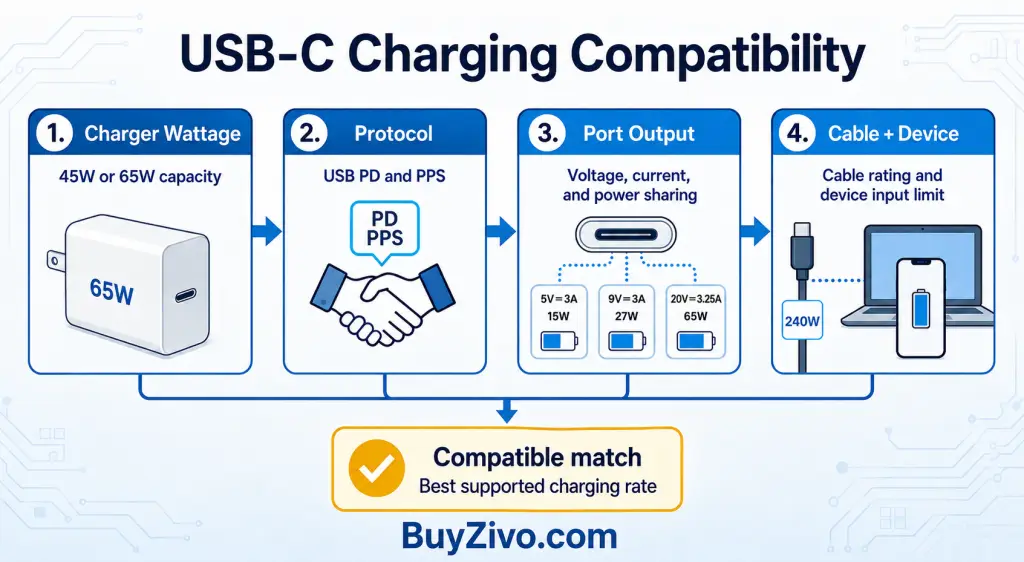
For a general laptop charger, look for:
- USB-C Power Delivery
- A 20V output profile
- Sufficient wattage from one port
- Clear port-allocation specifications
For a compatible Samsung or Google phone, also check:
- PPS support
- The required PPS voltage and current range
- Cable requirements
- Manufacturer-specific charging guidance
“PD compatible” does not automatically mean every proprietary or PPS-based fast-charging mode will operate at its maximum rate.
Do you need a different USB-C cable?
Possibly.
USB-IF’s current consumer cable program identifies certified USB-C-to-USB-C cables with 60W or 240W power markings. A certified 60W cable is suitable for a 45W charger, but it cannot carry the full 65W output. To obtain more than 60W under current USB-IF branding, choose a properly rated 240W cable. See the USB-IF cable and connector guidance.
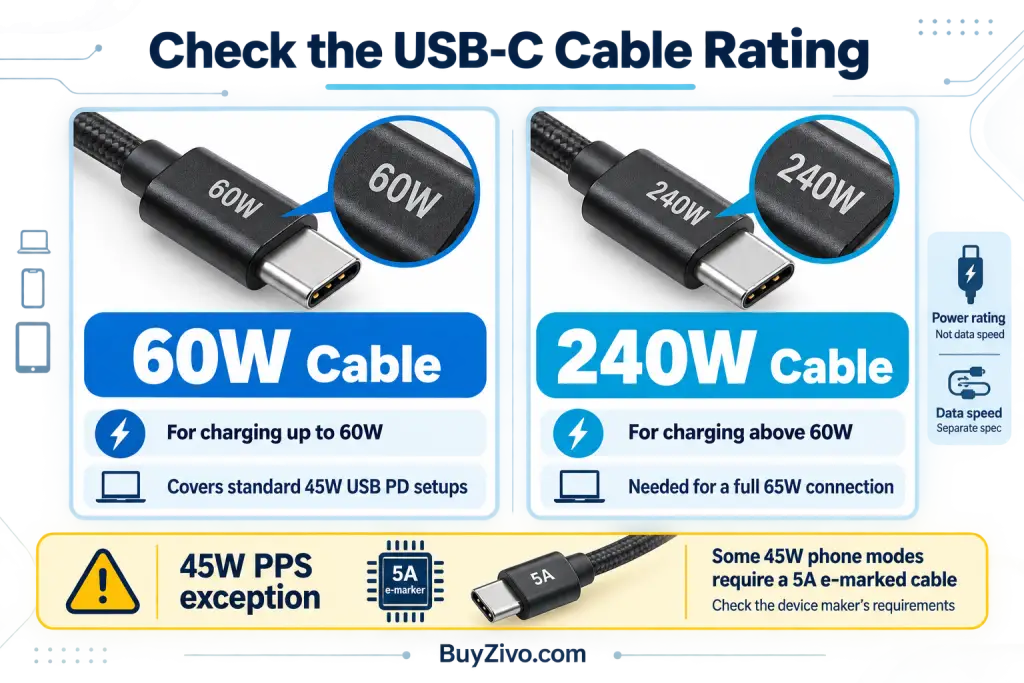


There is a second issue for certain 45W phone-charging systems. Samsung’s 45W implementation can require a 5A e-marked cable because it uses more current at a lower programmable voltage. A cable being suitable for one 45W setup does not prove that it supports every 45W charging mode.
Check the cable for:
- A stated power rating
- USB-IF certification where available
- 5A/e-marker support when required
- USB-C connectors at both ends
- Data-speed support if the cable will also transfer files or drive a display
Charging wattage does not reveal data performance. A cable can support high charging power but only basic USB 2.0 data speeds.
For a fuller explanation, see >> USB-C Cable Specifications Guide <<
Is a 65W charger safe for a phone?
A compliant 65W USB-C PD charger is generally designed to negotiate a supported power level with the phone. The phone does not draw 65W simply because that capacity is available.
The more important safety question is whether the charger is genuine, competently designed, and appropriately evaluated—not whether it is rated at 45W or 65W.
Look for:
- A known manufacturer with traceable support
- Accurate input and output markings
- Applicable regional safety certification
- USB-IF certification where available
- A verifiable model number
- A meaningful warranty
- No damaged casing, loose pins, or abnormal operation
Certification is not the same as a manufacturer merely printing a logo. UL has published notices concerning chargers carrying counterfeit or unauthorized UL marks, illustrating why buyers should verify questionable claims rather than trusting packaging alone. USB-IF also maintains a certified product search for products that passed its compliance program.
A charger becoming mildly warm under load is not automatically evidence of danger. Stop using it if you notice physical damage, persistent sparking, smoke, a burning smell, severe deformation, or unusually high heat.
Common buying mistakes
Buying wattage without checking protocols
A 65W charger lacking the required PPS profile may charge a compatible Samsung or Pixel phone more slowly than a properly specified 45W model.
Assuming every USB-C laptop accepts 45W
USB-C describes the connector, not the laptop’s complete power requirement. Consult the device manufacturer.
Ignoring multiport power sharing
A “65W” charger might provide much less to the laptop once a phone occupies its second port.
Reusing an unsuitable cable
The cable can restrict available current or power. A 60W cable also cannot deliver a full 65W connection.
Paying more to charge a phone at the same speed
If the phone cannot use more than 45W, moving to 65W may add versatility without reducing its charging time.
Treating GaN as proof of quality
Gallium nitride technology can help manufacturers build compact, efficient power supplies, but the term “GaN” does not establish safety, protocol support, durability, or honest output ratings. Judge the complete product and its documentation.
Which charger should you buy?
Buy a 45W charger when your highest-demand device is a compatible phone, tablet, or low-power computer, and you value a compact travel setup.
Buy a 65W charger when you charge a laptop, want one adapter for multiple device types, or need enough headroom to avoid replacing the charger after your next device upgrade.
Before ordering either one, confirm four details:
- Your device’s recommended charger wattage
- Required USB PD or PPS profiles
- Maximum output from the intended port
- The power and current rating of your USB-C cable
If all four match, either wattage can be a good purchase. If they do not, the larger number on the box will not fix the incompatibility.
Frequently asked questions
What should buyers know about 45W vs 65W chargers?
A 45W charger is usually best for phones, tablets, and light USB-C devices, while 65W provides better laptop compatibility and more headroom. Check USB PD/PPS profiles, per-port output, and cable ratings because wattage alone does not guarantee maximum charging speed.
Will a 65W charger damage a 45W phone?
A standards-compliant USB-C PD charger and compatible phone negotiate power, so the charger’s 65W capacity is not automatically delivered to the phone. Use reputable, properly certified equipment and a suitable cable.
Can I charge a 65W laptop with a 45W charger?
Some USB-C laptops will accept it, but charging may be slower. Under heavy use, the battery may charge very slowly or continue to discharge. Follow the laptop manufacturer’s recommended wattage for reliable operation.
Is 45W enough for a laptop?
It depends on the laptop. Some low-power models work well at 45W; many mainstream laptops recommend approximately 60W or 65W, and performance-focused machines may need considerably more.
Is a 65W charger faster for an iPhone?
Not necessarily. Apple requires a compatible USB-C PD adapter for fast charging, but the iPhone controls how much power it accepts. A 65W adapter mainly adds compatibility with higher-power devices.
Does a 65W charger need a 100W or 240W cable?
To receive more than 60W under current USB-IF cable ratings, use a properly rated 240W cable. A previously marketed, compliant 100W 5A cable may also support 65W, but for a new purchase, the current 240W marking is clearer.u003cbru003e
Should I buy a single-port or multiport charger?
Choose a single-port model for predictable maximum output and a multiport model for convenience. With a multiport charger, verify its output distribution when all intended ports are occupied.
Final verdict
A 45W charger is the focused choice; a 65W charger is the versatile choice.
For phone-only or lightweight travel use, 45W can meet the requirement without paying for unused capacity. For a mixed collection that includes a USB-C laptop, 65W offers the better balance of portability, compatibility, and useful headroom.
Do not decide by wattage alone. The better charger is the one whose USB PD/PPS profiles, per-port output, cable, and safety documentation match your devices.
Learn more in >>Complete Mobile Charger Buying Guide<< or compare current options in >>Best USB-C Chargers<<