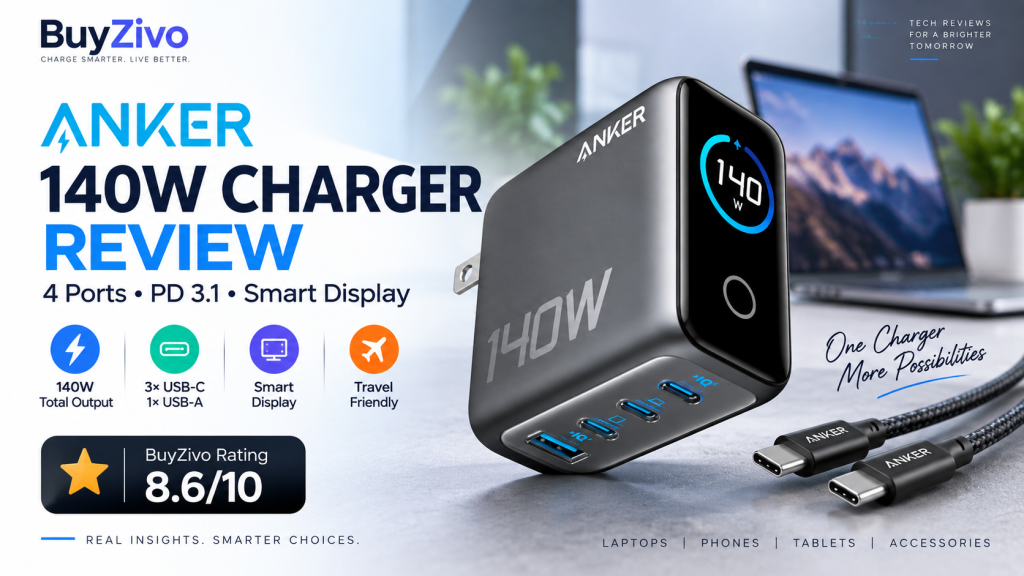
The Anker 140W Charger review is aimed at a specific problem: carrying enough charging power for a laptop while still having ports available for a phone, tablet, earbuds, watch, or another everyday device.
Officially named the Anker Charger (140W, 4-Port, PD 3.1) with USB-C Cable, it provides three USB-C ports, one USB-A port, a built-in color display, and up to 140W of total output.
This is a research-based BuyZivo review. We did not independently laboratory-test the charger, measure its temperature, verify conversion efficiency, or record charging times. Our assessment is based on Anker’s published specifications, support documentation, power-distribution data, warranty information, and comparison with current alternatives.
The key buying question is therefore not simply whether the charger “has 140W.” It does. The more useful question is how much of that power reaches each device once you start using several ports simultaneously.
Design and Build Quality
The charger measures approximately 2.72 × 2.72 × 1.42 inches (69 × 69 × 36 mm). That makes it reasonably compact considering the output and four-port configuration, although it is not an ultralight phone charger.
Its wall-mounted design keeps the charging setup simpler than carrying a desktop charging station and separate AC cable. The broad body also gives Anker enough front-facing space for three USB-C ports, USB-A, and the display.
That display is one of the product’s most useful differentiators. Instead of forcing users to guess how power is being distributed, the charger can show charging information while devices are connected.
This matters more on a multi-port charger than it does on a basic single-port adapter because output can change considerably as devices are added or removed.
There is one specification inconsistency worth noting. Different current Anker pages have reported different weights for this product or its packaged configuration. Because of that discrepancy, BuyZivo is not using an exact weight as a decisive part of the verdict.
The current US listing includes a USB-C cable, but buyers purchasing through Amazon or another seller should verify package contents because regional and seller-specific bundles can change.
Ports and Rated Charging Capabilities
There are four charging ports:
- USB-C1
- USB-C2
- USB-C3
- USB-A
USB-C1 and USB-C2 are the high-power ports. Each is officially rated for up to 140W when used by itself.
USB-C3 is rated for up to 40W, while USB-A can provide up to 33W under supported conditions.
That immediately makes the charger more versatile than a simple 140W laptop brick. You can use either of the two primary USB-C ports for a high-power laptop rather than having only one designated high-output connector.
But the 140W number needs context.
This is a 140W-total charger. It is not capable of supplying 140W independently from each USB-C port at the same time.
That distinction becomes critical when evaluating it for multi-device setups.
Single-Device Performance
When only USB-C1 or USB-C2 is connected, Anker rates the port for:
9V/3A, 15V/3A, 20V/5A, or 28V/5A, with a maximum of 140W.
The 28V/5A profile is what allows USB Power Delivery Extended Power Range-class charging at the 140W level.
For a compatible high-power laptop, that means the charger has enough rated output to replace many large first-party USB-C power adapters.
But the charger does not decide how much power a laptop consumes. USB-C charging is negotiated between the charger, cable, and connected device.
A laptop limited to 65W will not suddenly consume 140W. Likewise, a machine designed around a proprietary connector or charging protocol may not obtain its maximum advertised charging rate from a standard USB-C PD charger.
Phones and tablets behave similarly: the device requests the charging profile it supports.
That makes 140W primarily useful for demanding laptops and other high-power USB-C hardware rather than for making ordinary smartphones charge at 140W.
Multi-Device Power Distribution
Power sharing is arguably the most important part of this Anker 140W charger review.
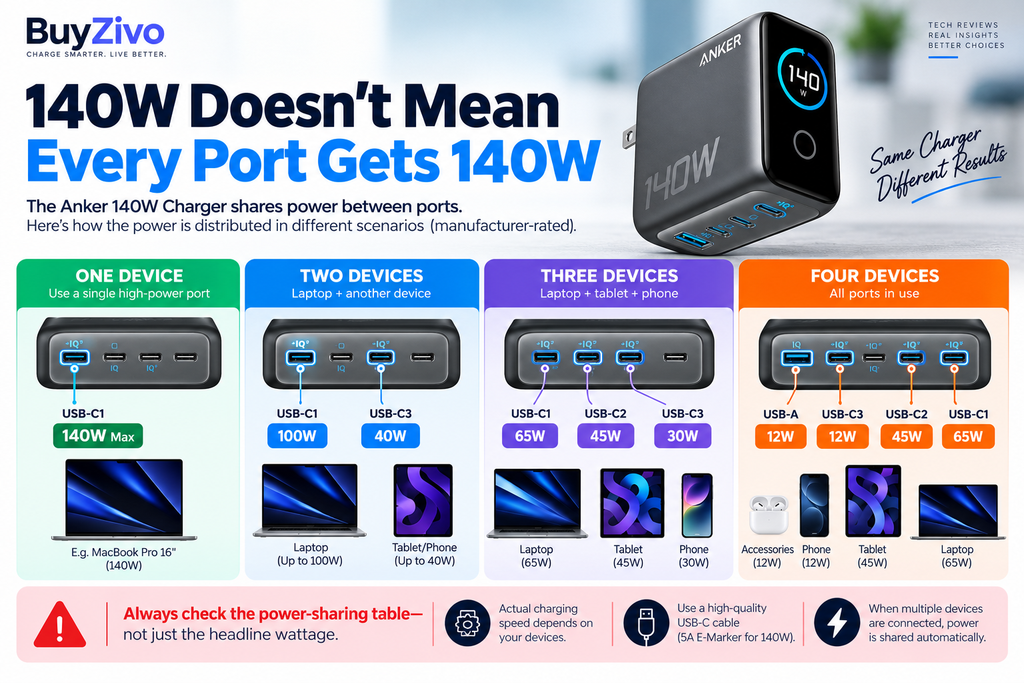
With USB-C1 and USB-C2 occupied, Anker specifies:
70W + 70W
That configuration can be useful for two laptops or a laptop-plus-tablet setup, but neither port retains its 140W single-device ceiling.
Using USB-C1 or USB-C2 together with USB-C3 gives:
100W + 40W
That is one of the charger’s most practical configurations. A laptop can receive up to 100W while a phone, tablet, or another device receives up to 40W.
Pairing one primary USB-C port with USB-A provides:
100W + 33W
Three-device charging changes the distribution again.
USB-C1 + USB-C2 + USB-C3 is rated at:
65W + 45W + 30W
The corresponding USB-C1 + USB-C2 + USB-A configuration is:
65W + 45W + 30W
And when all four ports are occupied, Anker specifies:
65W + 45W + 12W + 12W
This is the charger’s biggest practical limitation.
A 140W-capable laptop may receive only 65W in the four-device configuration. That can still be enough for many thin-and-light laptops, but it may charge a high-performance laptop more slowly or struggle to increase battery level rapidly during a heavy workload.
The lesson is simple: buy based on the power-sharing table, not just the 140W printed on the product page.
Read another post about:
>> Best USB-C Power Banks for Fast Charging
>> Best USB-C Cables for Fast Charging
>> Best 20,000mAh Power Banks for Travel
Compatibility and Cable Requirements
The charger is designed around widely used USB charging standards and Anker lists protocols including USB Power Delivery and PPS support.
For Apple users, the high-output USB-C ports make sense for USB-C MacBook models, iPads, and modern USB-C iPhones. Actual charging speed remains device-dependent.
Samsung users can also benefit from PPS support, although maximum phone charging behavior depends on the particular Galaxy model and its charging requirements.
Google Pixel devices and other USB-PD smartphones should negotiate compatible USB-C charging profiles rather than simply taking the maximum available charger output.
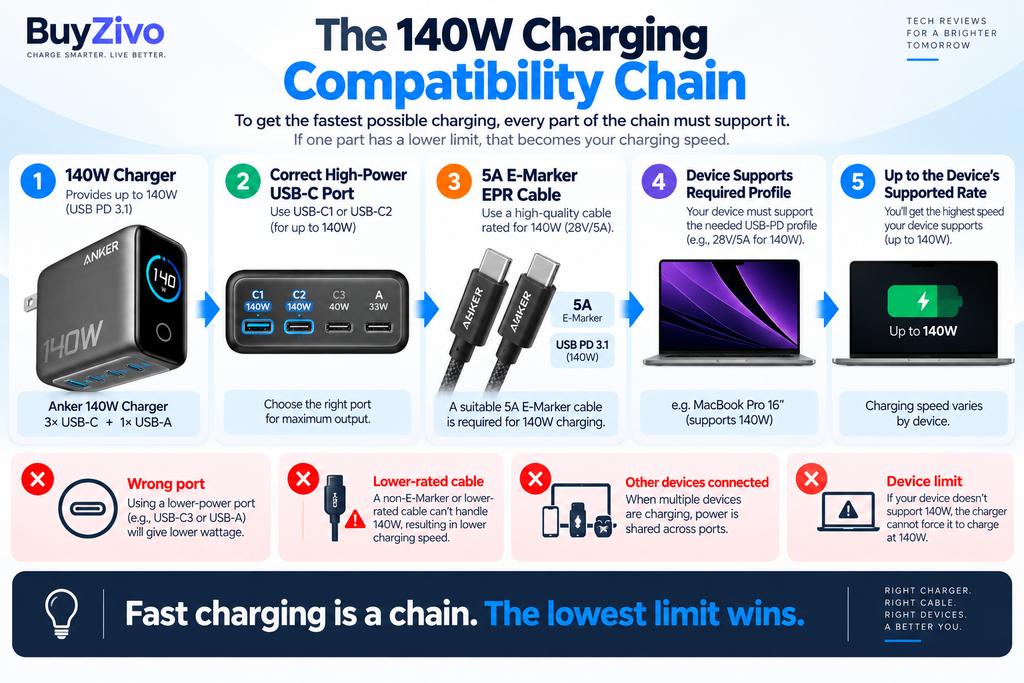
Cable choice becomes especially important above 60W.
To reach high-current USB-C charging levels—and particularly 100W or 140W—you need an appropriately rated USB-C cable with the necessary electronic identification. For a 140W PD 3.1 setup, using a suitable 5A E-Marker cable rated for the required Extended Power Range is the sensible approach.
A 140W charger paired with an inadequate cable will not produce a 140W charging system.
Think of the compatibility chain as:
Charger → Port → Cable → Device
The maximum practical charging speed is limited by the weakest or lowest-rated part of that chain.
Heat, Safety and Sustained Use
High-output GaN chargers can become warm during demanding operation, so temperature behavior needs more nuance than simply calling a charger “cool” or “safe.”
Anker states that this model uses temperature-related protection and notes that under extended high-temperature conditions the charger can automatically reduce its output to prevent damage.
That is a protection mechanism, but it also means users should understand that peak wattage is not necessarily guaranteed indefinitely under every ambient temperature and load combination.
BuyZivo has not independently measured the charger’s surface temperature, internal temperature, thermal throttling point, efficiency, or sustained 140W performance.
Accordingly, we do not use Anker’s protection claims as evidence of independently verified thermal performance.
Our September 23, 2026 research did not identify an A2697-specific US CPSC recall. Recall status can change, so it should be checked again during future major article updates.
Users should also avoid covering the charger during operation and should use appropriately rated cables and properly functioning outlets.
Portability and Everyday Usability
For travel, the value proposition is straightforward: this one charger can potentially replace several separate adapters.
A typical setup might include:
- laptop
- phone
- tablet
- earbuds or smartwatch
The 100–240V input range also makes the charger suitable for use across common international mains voltages, although travelers may still require a physical plug adapter depending on the destination.
The tradeoff is size and weight.
A four-port 140W charger is naturally more substantial than a compact 30W or 45W phone charger. Someone traveling with only a phone and tablet would gain little from carrying this much capacity.
Laptop users are more likely to appreciate the compromise.
The onboard display is particularly useful in everyday use because it gives some visibility into what the charger is doing. When a laptop unexpectedly drops from a high-power mode after another device is connected, the display can make the change easier to understand.
Final Buying Advice
The Anker 140W 4-Port Charger is worth considering when its documented power-sharing limits match your devices. This verdict is based on published specifications, not measured charging performance or a hands-on test score.
Its strongest feature is not simply the headline 140W output. It is the combination of two individually 140W-capable USB-C ports, another 40W USB-C connection, USB-A support, detailed multi-device power allocation, and a useful onboard display.
Buy it if you regularly carry a USB-C laptop and several smaller devices and want to consolidate their chargers.
It is especially attractive when your normal setup involves one high-power laptop plus a phone or tablet, because the documented 100W + 40W distribution can be more useful in real life than the maximum single-port figure.
Skip it if you expect your laptop to retain 140W while three additional devices charge. It cannot do that. Four-port use reduces the documented distribution to 65W + 45W + 12W + 12W.
And if you want a smaller all-USB-C charger with higher total capacity, Anker’s newer 160W Prime model deserves consideration.
For the right multi-device setup, however, the Anker 140W Charger offers a well-balanced combination of laptop-class power, port flexibility, and unusually transparent charging information.
Sources and Model Verification
Check the official Anker 140W four-port product page for published output combinations and package details. The A2697 user guide is the model-specific reference for setup and operation. Match the model number and regional plug before ordering; a different Anker 140W product may have different ports or allocation rules.