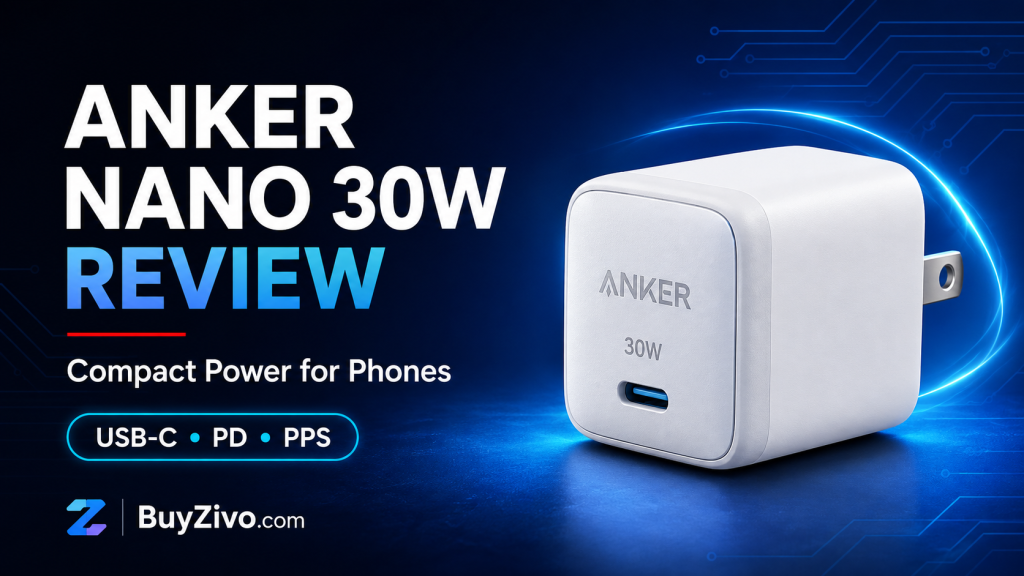
The Anker Nano 30W Charger reviewed here is the US model A2147, currently called the Anker Nano Charger (30W) and previously sold as the Anker 511 Charger (Nano 3, 30W). It is a one-port USB-C wall adapter aimed primarily at phone users who want more power and broader protocol support than a basic 20W charger without carrying a larger laptop adapter.
This is a research-based review. BuyZivo evaluated official specifications, support material, device-maker guidance, warranty references, current alternatives, and Anker’s recall page. We did not independently measure charging time, temperature, efficiency, or long-term durability.
The core buying question is simple: does its combination of 30W output, USB Power Delivery, PPS support, and compact dimensions justify choosing it over a basic 20W adapter or a more flexible 45W multi-device charger? For one-phone charging, the answer is usually yes. For multiple devices or higher-powered laptops, its limitations are more important than its small size.
Design and Build Quality
The A2147 measures 1.12 × 1.12 × 1.39 inches, according to Anker’s US product page. Its narrow, nearly square front profile is one of its clearest advantages. It occupies less bag space than many older 30W adapters and should fit more comfortably between neighboring plugs on a crowded power strip.
The US version has folding AC prongs. Folding the blades into the charger helps prevent them from catching on cables or scratching other items inside a travel pouch. Buyers outside the United States should not assume the same design: Anker’s support documentation identifies the UK and EU versions as non-foldable.
There is no display, power meter, charge indicator, or physical control. That simplicity suits someone who wants to plug in one device and leave it charging, but it provides no direct way to see the negotiated wattage or current charging state.
Anker offers the charger in several colors, although availability may vary by seller. Official regional pages describe the package as including the charger and documentation, with no charging cable included. The exact US retail box should still be checked because bundles and seller-created packages can differ.
Anker does not clearly identify the exterior material in the reviewed US specifications. We therefore have not assigned a specific plastic or fire-resistance classification to the casing. Likewise, no verified official weight was available in the documentation used for this review.
Ports and Rated Charging Capabilities
The charger has one USB-C port and a maximum total output of 30W. Because there is only one port, “total output” and “single-port maximum” refer to the same 30W ceiling. There are no multi-port allocation rules to learn.
Its fixed output profiles are:
- 5V at 3A, up to 15W
- 9V at 3A, up to 27W
- 15V at 2A, up to 30W
- 20V at 1.5A, up to 30W
Anker also specifies two PPS ranges:
- 3.3V–11V at up to 3A
- 3.3V–16V at up to 2A
Both PPS ranges are limited to 30W. PPS, or Programmable Power Supply, allows a compatible phone and charger to adjust voltage in smaller steps than conventional fixed USB-PD profiles. It is particularly relevant to Samsung Galaxy and Google Pixel devices that use PPS for preferred fast-charging modes.
Anker describes the product as using PowerIQ 3.0 and being compatible with USB Power Delivery and PPS. Its support documentation also mentions Quick Charge compatibility. Buyers should still focus on the listed electrical profiles rather than assuming that every proprietary fast-charging system is supported.
A standard compliant 3A USB-C cable is sufficient for this charger’s 30W maximum. A 5A e-marked cable is not required merely to reach 30W. However, the connector must match the device: older Lightning-based iPhones need USB-C to Lightning, while USB-C iPhones, Android phones, tablets, and laptops normally need USB-C to USB-C.
Single-Device Performance
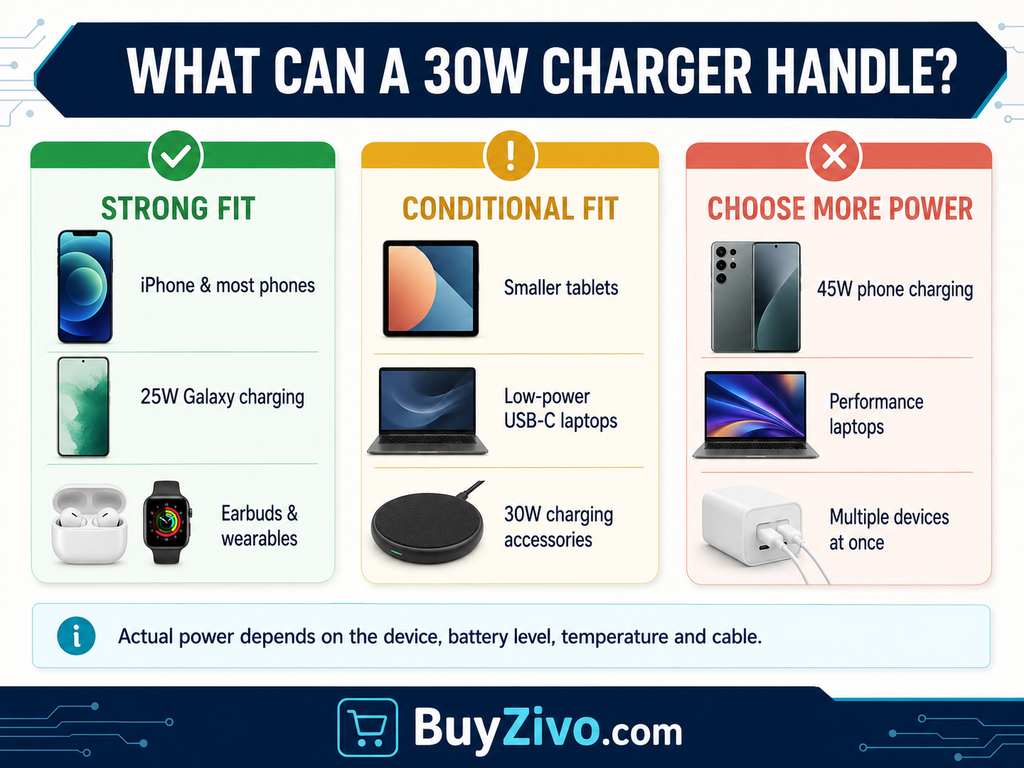
The A2147’s 30W rating is appropriate for many phones, wearables, smaller tablets, wireless-charging accessories, and other USB-C products. It does not force 30W into every connected device. USB-C charging involves negotiation, and the device draws from a compatible profile within its own supported limit.
Apple states that compatible iPhones can fast-charge using a suitable USB-PD adapter. For iPhone 12 and later, Apple specifies 20W or higher for its standard fast-charging guidance. That makes the A2147 suitable for many iPhones when paired with the right cable.
There is an important limitation for the newest higher-input iPhones. Apple’s updated guidance says certain models can use a 40W-or-higher adapter for their fastest wired result. The Anker A2147 will still charge compatible models, but its 30W ceiling prevents it from offering a 40W charging mode.
For Samsung, Anker states that the A2147 supports 25W Super Fast Charging. Its 3.3V–11V at 3A PPS range supports the type of programmable output required for many 25W Galaxy devices. It cannot deliver Samsung’s 45W Super Fast Charging 2.0 because neither its total wattage nor its current profiles reach that level.
Google advises Pixel owners that a 30W-or-higher PPS charger can support preferred charging behavior on compatible models. The A2147 meets that general wattage and protocol description. However, newer Pixels capable of charging above 30W will be limited by the adapter, and the exact result depends on the model, battery state, temperature, and cable.
Thirty watts can also power some low-demand USB-C laptops. That does not make the A2147 a universal laptop charger. A laptop designed around 45W, 65W, or higher input may charge slowly, show a low-power-adapter warning, or lose battery during demanding use. Laptop buyers should check the manufacturer’s recommended adapter wattage rather than relying only on USB-C connector compatibility.
Multi-Device Power Distribution
There is no multi-device power distribution because the charger has a single USB-C port. Connecting one device makes the full set of supported profiles available, subject to the connected device and cable.
This design avoids a common multi-port problem: wattage does not change when another cable is connected because a second cable cannot be connected. The downside is equally clear—you cannot charge a phone and smartwatch, earbuds, tablet, or power bank at the same time.
If you regularly carry two devices, a dual-port charger may reduce the total number of adapters in your bag. The Anker 323 Charger 33W, for example, adds USB-C and USB-A. However, it divides its power when both ports are used, with Anker specifying 20W from USB-C plus 12W from USB-A. The A2147 is the cleaner choice for maximum compactness and one-device charging; the 323 is more flexible.
Compatibility and Cable Requirements
Compatibility is one of the A2147’s stronger areas, provided its 30W limit is understood. USB-PD fixed profiles cover many Apple and general USB-C devices, while PPS broadens support for compatible Samsung and Google phones.
For Apple devices:
- Use USB-C to Lightning for Lightning-equipped iPhones.
- Use USB-C to USB-C for iPhone 15 and later and compatible iPads.
- Apple Watch charging requires the appropriate USB-C magnetic charging cable.
- A USB-C MagSafe charging accessory may work, but its own adapter requirements determine the available wireless output.
For Samsung Galaxy devices, use a USB-C-to-USB-C cable. The charger is a better match for 25W-class charging than for Galaxy models marketed with a 45W maximum.
For Google Pixel devices, use a compliant USB-C-to-USB-C cable. The adapter supports both PD and PPS, but models capable of exceeding 30W will not reach their full adapter-side potential.
The charger’s 100–240V, 50–60Hz AC input makes it usable across many international electrical systems. That does not make the US plug physically compatible worldwide. A suitable country-specific plug adapter may be required, and the adapter must be used within local electrical and safety requirements.
Heat, Safety and Sustained Use
Anker promotes ActiveShield 2.0, which it says monitors temperature more than three million times per day and adjusts operation as needed. This is a manufacturer-described protection feature, not evidence that the charger remains cool under every workload.
BuyZivo did not perform thermal imaging, surface-temperature measurements, sustained 30W load testing, teardown analysis, or electrical efficiency testing. We therefore cannot independently quantify its heat behavior or compare its internal component quality with competing chargers.
Some warmth during fast charging does not automatically indicate a defect. Charging power, ambient temperature, ventilation, device demand, and battery state can all affect operating temperature. Stop using the charger if the body becomes damaged, prongs loosen, charging becomes intermittent, or there is an unusual smell, discoloration, or excessive heat.
Anker’s US recall page listed several power-bank recalls when checked, but it did not list the A2147 charger. This should be treated as a dated check, not a permanent guarantee. Consumers should consult Anker’s current recall page before purchase or if a future safety notice is reported.
Official regional listings reference a 24-month warranty, but coverage can vary according to country, seller, proof of purchase, and product condition. Confirm that the Amazon seller is authorized and retain the invoice.
Read another post from BuyZivo:
>> Best 45W USB-C Chargers for Samsung Galaxy Phones
Portability and Everyday Usability
Portability is the main reason to choose this charger. It is small enough for a pocket, work bag, tech pouch, or carry-on, and the US folding prongs make it easier to pack.
Its 30W rating is also more versatile than a basic 20W adapter. It can serve as a phone charger, power a compatible wireless charger, recharge a small power bank, or provide light-duty power to certain tablets and laptops.
The one-port design is convenient at a desk where only a phone needs charging. It becomes restrictive during travel, when one outlet may need to serve a phone, watch, earbuds, and power bank. A dual-port or three-port charger is usually more practical in that situation.
Not including a cable is another real cost. Buyers replacing an older USB-A charger may also need a USB-C cable. Add that cable expense before comparing the A2147 with bundles that include one.
Price and Overall Value
Anker’s US store displayed the A2147 at $15.99 on September 2, 2026. That is a competitive price for a small charger with 30W output and PPS, but it should not be treated as permanent. Amazon pricing, coupons, bundles, color availability, and seller status can change independently.
The A2147 represents good value if you already own the correct cable and mainly charge one phone. It is harder to recommend when a 33W dual-port charger costs only slightly more or a discounted 45W model includes a cable.
Consider these alternatives:
- Anker 323 Charger 33W: Better if you need USB-C and USB-A ports, but dual-device output is divided.
- Anker Nano Charger 45W with USB-C cable: Better for newer high-input phones and small laptops, while also solving the missing-cable issue.
- Anker 715 Charger Nano II 65W: Better as a compact laptop charger, but larger and unnecessary for many phone-only users.
- Apple 20W USB-C Power Adapter: A straightforward first-party iPhone option, although it provides less output and lacks the A2147’s extra 30W headroom.
Final Buying Advice
The Anker Nano Charger 30W A2147 is worth considering for compact, single-device phone charging. Its published specifications include a small body, foldable US plug, USB-PD, PPS, and up to 30W output. This is a specification-based buying assessment, not a measured performance score.
Buy it if you normally charge one iPhone, Samsung Galaxy, Pixel, smaller tablet, or USB-C accessory at a time. It is especially attractive when you already own a suitable cable and want an adapter that takes up very little space.
Skip it if you need two ports, Samsung 45W charging, the fastest charging mode supported by a newer device requiring more than 30W, or dependable full-speed laptop charging. In those cases, paying more for a 45W–65W charger is the more practical long-term decision.
Sources and Model Verification
Use the official Anker Nano 30W A2147 product page and A2147 user manual to check the exact model and published charging specifications. Confirm the regional plug and seller bundle before ordering.