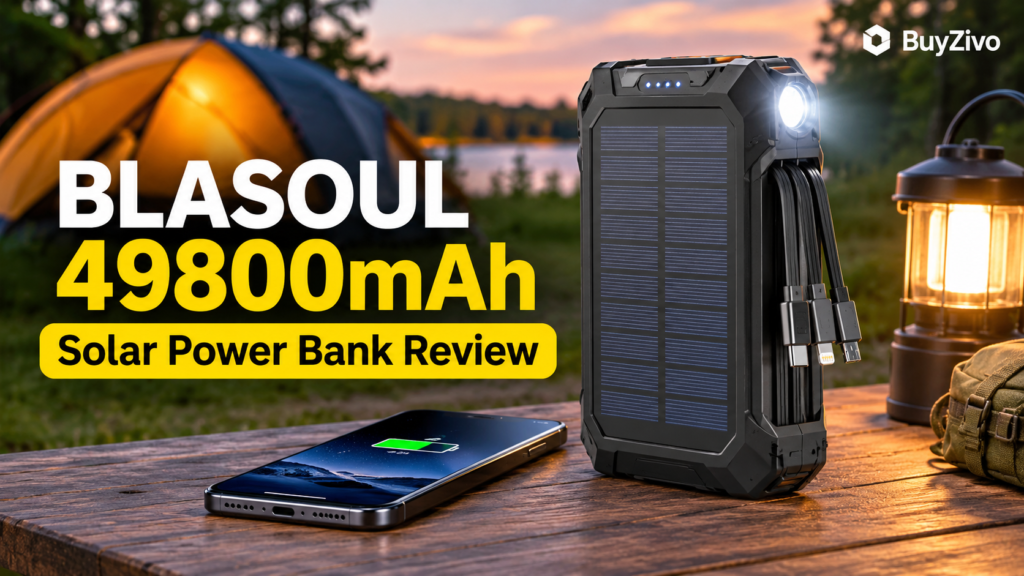
BLASOUL 49800mAh Solar Power Bank Review: Big Number, Bigger Questions
By Arif HossenUpdated 17/11/20266 views
BuyZivo participates in the Amazon Associates Program. We may earn a commission when you purchase through qualifying affiliate links, at no additional cost to you.
At a glance
Quick summary
Best for
Car camping, road trips and home storm kits, especially for people who want a flashlight and built-in cables in one unit.
Main recommendation
A reasonable backup charger to keep in the car or emergency kit. Skip it if you fly often, want fast wireless charging, or expect the solar panel to recharge it.
Important
The advertised 49,800 mAh works out to about 184 Wh, which is over the 160 Wh airline limit. That doesn’t fit the listed 490 g weight, so the real capacity is probably lower than the label. Check the Wh rating before flying with it.
Research basis
This review comes from the Amazon listing, similar-product buyer reports and published airline rules. It is not hands-on testing, and the price, warranty and wireless wattage couldn’t be verified.
BLASOUL 49800mAh Solar Power Bank Review: Is the Capacity Real?
A power bank advertising 49,800 mAh sounds like it could charge a phone for a week. It also sounds like something an airline gate agent might ask you about. The BLASOUL Solar Power Bank pairs that headline capacity with a flashlight, four built-in cables, a wireless pad and a small solar panel, and it targets campers, road-trippers and anyone building a storm kit.
This review is based on research, not bench testing. The main question is whether the specs add up to a charger you can rely on, and some of them don’t.
Quick Verdict
Overall assessment: A feature-packed emergency and camping charger with one capacity claim that deserves skepticism.
Best for: Car camping, road trips, home storm kits, and people who hate carrying cables.
Not ideal for: Air travel, daily pocket carry, and anyone counting on solar or wireless charging as a main way to charge.
Biggest advantage: Four built-in cables plus a flashlight in one unit.
Biggest drawback: The advertised capacity, weight and airline rules don’t line up.
Recommendation: Reasonable as a backup for the car or the emergency kit. Look elsewhere if you travel by air or want fast wireless charging.
Product Overview
The BLASOUL is a high-capacity power bank aimed at outdoor and emergency use. It is listed in Amazon’s portable power bank category, and the listing carries a “#1 New Release” badge in Cell Phone Portable Power Banks. That badge reflects recent sales momentum, not quality.
It belongs to a crowded family of 49800mAh solar banks. Others, such as the Yelomin model on Walmart, advertise similar capacity with a 5W wireless pad and 3 cables. Always check the exact brand and ASIN before comparing reviews.
Key Features
Fast wired charging. The listing advertises 22.5W fast charging through PD 3.0 and QC 3.0. That’s enough to charge most phones quickly, but not a laptop. One buyer on a similar listing said it charged slower than their other chargers on a Galaxy S22 and S25, which is worth knowing if speed matters most to you.
Built-in cables. Having cables attached means you aren’t hunting for one in a dark tent. Reviewers on similar units liked having lightning, USB, USB-C, and micro USB cables. Check which connector types this exact unit includes, since listings vary. Built-in cables are also a weak point: if one breaks, you lose that port.
Wireless charging pad. The pad is the least reliable feature in the reviews I found. Several buyers of similar banks reported weak or non-working wireless charging, including one saying it simply doesn’t work. Another said a phone case about 4 mm thick caused trouble. Treat it as a convenience, not a primary method.
Flashlight. Other listings describe a three-mode LED flashlight with steady, SOS, and strobe settings. Buyers consistently call it bright, which makes it useful for power outages.
Solar panel. Solar charging on banks this size is mostly an emergency trickle. One buyer on a similar unit left it in the sun for a full day with no charge gained. A panel this small can’t meaningfully refill a battery this large, so plan on wall or car charging.
Technical Specifications
Spec
Detail
Status
Brand
BLASOUL
Verified (Amazon listing)
Advertised capacity
49,800 mAh
Verified claim, physically doubtful
Fast charging
22.5W PD 3.0 / QC 3.0
Verified (listing)
Weight
490 g (about 1.08 lb)
Listed on Amazon; reviewers call it heavy
Dimensions
6.99″ L × 3.66″ W × 1.3″ thick
Listed on Amazon
Connectors
USB-A, USB-C, built-in cables
Verified in part
Wireless output
Reported as 15W Qi on similar listings
Not confirmed for this ASIN
Package contents
Reported as USB-C cable, manual, carabiner, storage bag
Not confirmed for this ASIN
Warranty
Not specified
Not found
Design and Build Quality
Official dimensions of 6.99 × 3.66 × 1.3 inches make it roughly the size of a thick paperback. Buyers of similar models describe the build as solid, with one noting it handled light rain and rough handling. I found no verified IP rating for this exact model, so don’t assume it is waterproof.
Weight is the common complaint. Reviewers of similar units call it kind of heavy, and it is better suited to a daypack or a car than a jeans pocket.
Setup and Ease of Use
There is little to set up. You charge the bank itself through USB-C, then plug devices into the built-in cables or place a phone on the pad. Buyers of similar units note a quirk: the wireless pad stays off until you activate it, which one reviewer found overly restrictive. Read the manual for the exact button sequence on your unit.
Performance and Practical Analysis
This section is analysis from verified specs and buyer reports, not firsthand testing.
The capacity math. Power banks are rated in milliamp-hours at the internal cell voltage, typically 3.7 V. At 49,800 mAh, that is about 184 Wh. A 490 g device holding 184 Wh would need exceptional energy density, which makes me suspect the real usable capacity is lower than the label. Some buyers report strong real-world endurance: one said they recharged a phone from 5% four times. That is consistent with a large battery, just not necessarily one that big. Without independent testing, I can’t tell you the real figure.
Why it matters for flying. U.S. rules treat 100 Wh or less as generally permitted, while 100–160 Wh requires airline approval, and anything over 160 Wh is prohibited. A bank truly rated at 184 Wh would be barred from passenger flights. A buyer on another listing said they carried one on a plane, but that doesn’t settle anything for yours. Airlines also look at the printed Wh label, so check the fine print on the back or bottom. If you fly often, buy a bank clearly marked under 100 Wh instead.
Realistic expectations. It should fully charge a phone several times, and its fast-charging port should handle a tablet. Expect the wireless pad and solar panel to be conveniences rather than strengths.
Pros and Cons
Pros
Very large advertised capacity for multi-day trips and outages
Four built-in cables mean fewer things to forget
22.5W fast charging on the wired ports
Bright flashlight with SOS mode
Carabiner and storage bag reported on similar listings
Cons
Capacity, weight, and flight rules don’t reconcile
Heavy for everyday carry
Wireless charging is weak or unreliable in multiple buyer reports
Solar charging is negligible in practice
Warranty terms and IP rating not found
Compatibility and Special Considerations
The bank works with most phones through USB-C or the built-in connectors. Wireless charging is described as Qi on similar listings, so Qi-compatible iPhones and Android phones should in principle work. Confirm on the Amazon page. Keep it in carry-on only if you fly, and check your airline’s current rule.
Price and Value
I couldn’t verify a current price, so I’m not quoting one. Amazon prices change often. For this category, value depends less on the cost per mAh than on whether the battery is as large as claimed. If you want a reliable emergency bank, a smaller one with a printed Wh rating may be the safer value.
Competitor Comparison
I did not verify specs for specific competitor models, so this compares product types.
Actual off-grid power: A larger solar panel or power station, since a small built-in panel won’t do the job.
Who Should Buy It
Car campers, road-trippers, and anyone assembling a hurricane or outage kit who wants one rugged unit with cables and a light.
Who Should Avoid It
Frequent flyers, anyone expecting fast wireless charging, and anyone who wants solar to genuinely recharge the bank.
Buying Recommendations
Check the Wh rating if it’s printed on the product or in the manual. Confirm the connector types included. Look for warranty terms on the listing, and read recent reviews for this exact ASIN, not similar-looking ones.
Final Verdict
The BLASOUL 49800mAh Solar Power Bank is worth considering as a heavy, convenient car or emergency charger, mostly because of its cables and flashlight. Its biggest compromise is capacity you can’t verify, which also complicates flying. Buy it for the glovebox or storm kit, and choose a clearly rated smaller bank for flights.
FAQs
Can I take it on a plane?
Possibly, but it depends on its true Wh rating, which I couldn’t verify. A 49,800 mAh rating converts to about 184 Wh, over the 160 Wh cap. Check the label and your airline.
Does the solar panel really charge it?
Not meaningfully. Buyer reports suggest it is an emergency trickle only.
Does wireless charging work?
Mixed reports on similar units, from weak to non-functional. Don’t rely on it.
How many charges will I get?
Buyers report several full phone charges, but I can’t confirm a specific number.
Is it waterproof?
I found no verified IP rating, so assume it isn’t.
Arif Hossen is the founder of BuyZivo. He researches and writes about mobile accessories, home appliances, and home accessories, with a focus on product features, compatibility, and buying trade-offs. His aim is to help readers choose products that fit their everyday needs.
To provide the best experiences, we use technologies like cookies to store and/or access device information. Consenting to these technologies will allow us to process data such as browsing behavior or unique IDs on this site. Not consenting or withdrawing consent, may adversely affect certain features and functions.
Functional
Always active
The technical storage or access is strictly necessary for the legitimate purpose of enabling the use of a specific service explicitly requested by the subscriber or user, or for the sole purpose of carrying out the transmission of a communication over an electronic communications network.
Preferences
The technical storage or access is necessary for the legitimate purpose of storing preferences that are not requested by the subscriber or user.
Statistics
The technical storage or access that is used exclusively for statistical purposes.The technical storage or access that is used exclusively for anonymous statistical purposes. Without a subpoena, voluntary compliance on the part of your Internet Service Provider, or additional records from a third party, information stored or retrieved for this purpose alone cannot usually be used to identify you.
Marketing
The technical storage or access is required to create user profiles to send advertising, or to track the user on a website or across several websites for similar marketing purposes.