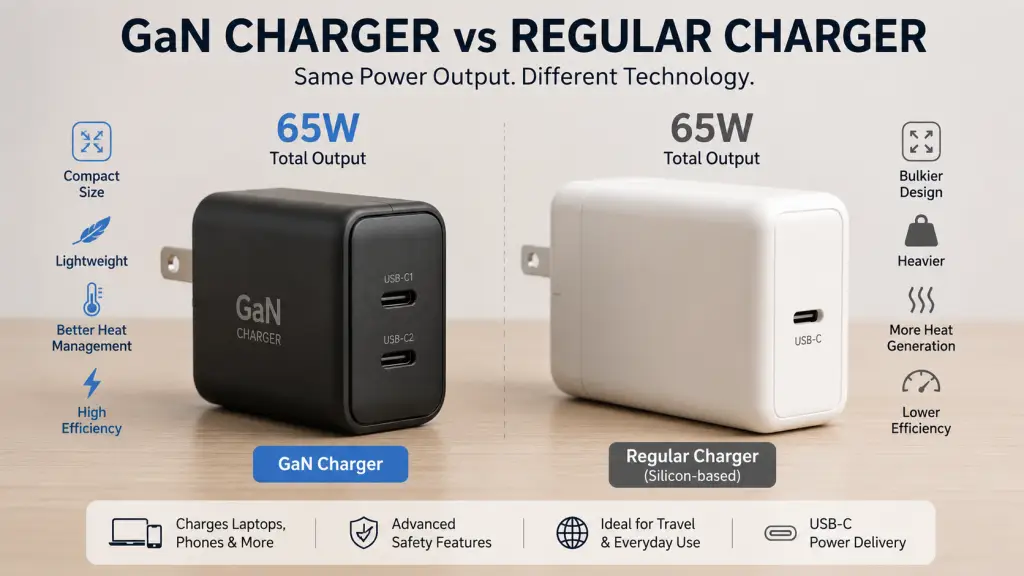
A GaN charger can deliver substantial power from a surprisingly small body. A regular charger may offer the same advertised wattage while being larger, heavier, or less convenient for travel.
However, that does not mean every GaN charger charges faster than every conventional charger.
The meaningful differences in a GaN charger vs regular charger comparison involve semiconductor technology, physical size, power density, port selection, charging protocols, thermal design, and price. Charging speed still depends on what the charger, cable, and connected device can negotiate together.
Based on semiconductor manufacturer documentation and USB-IF guidance, GaN technology can help manufacturers build smaller, high-output power adapters with lower switching losses. It does not automatically guarantee better compatibility, construction quality, or charging speed.
This comparison explains what the technology changes, what it does not change, and which type of charger makes more sense for your devices.
Quick Answer
A GaN charger uses gallium nitride power components in parts of its power-conversion circuitry. GaN components can operate efficiently at high switching frequencies, allowing manufacturers to reduce the size of some internal components and fit more power into a smaller charger.
A regular charger usually relies primarily on traditional silicon-based power components. It may be larger at the same wattage, but a well-designed regular charger can still be safe, reliable, efficient, and fully capable of fast charging.
Choose a GaN charger when portability, higher wattage, or charging several devices from one adapter matters. Choose a regular charger when you only need basic phone charging and want to keep the cost low.
What Is a GaN Charger?
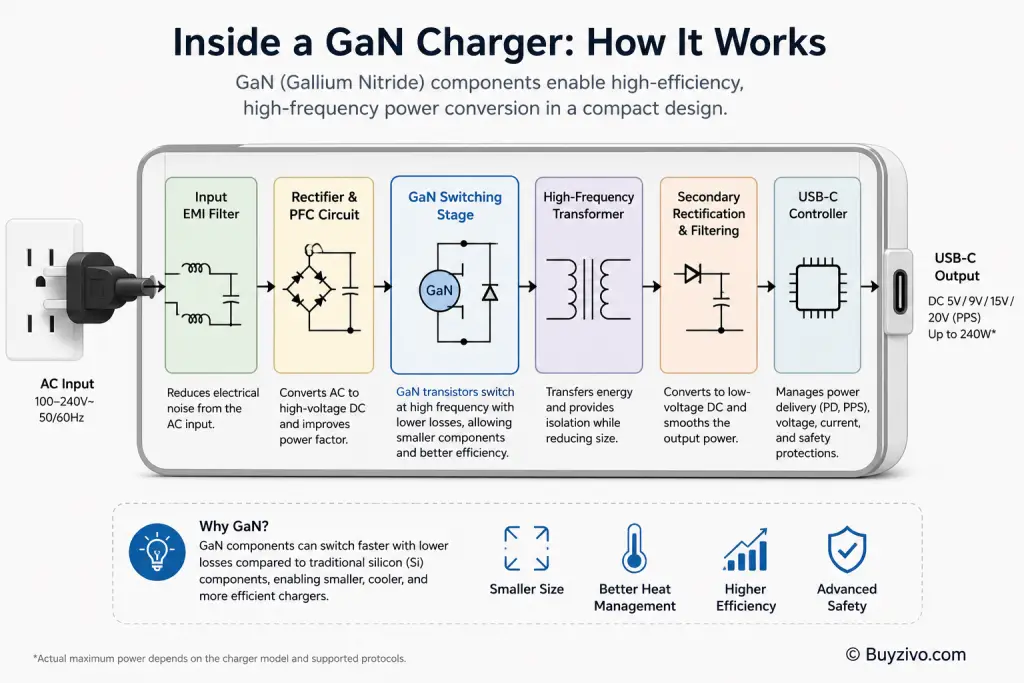
A GaN charger is a power adapter that uses gallium nitride semiconductor components instead of relying entirely on conventional silicon components for power switching.
Gallium nitride is a wide-bandgap semiconductor material. In charger designs, suitable GaN transistors can switch rapidly while keeping switching losses relatively low. Higher switching frequencies can allow designers to use smaller magnetic and passive components, helping reduce the overall charger size.
This is why GaN is frequently used in compact chargers rated for 45W, 65W, 100W, or more.
The technology can be found in:
- Single-port phone chargers
- Multi-port travel chargers
- USB-C laptop adapters
- Desktop charging stations
- Chargers combining USB-C and USB-A ports
GaN is only one part of the charger. The controller, transformer, capacitors, insulation, thermal management, ports, firmware, and protection systems also affect performance and safety.
What Is a Regular Charger?
In this comparison, a regular charger means an adapter built mainly with conventional silicon-based power-switching components.
Silicon chargers have been used for decades and remain common in phone, tablet, router, accessory, and laptop power supplies. The technology is mature, widely available, and often less expensive to manufacture.
A regular charger is not necessarily a slow charger. Silicon-based adapters can support:
- USB Power Delivery
- Programmable Power Supply
- Qualcomm Quick Charge
- Manufacturer-specific charging systems
- High-wattage laptop charging
The main limitation is that achieving higher output in a compact enclosure can be more challenging. A conventional charger delivering the same power as a well-designed GaN model may therefore be larger or heavier.
GaN Charger vs Regular Charger: Quick Comparison
| Comparison area | GaN charger | Regular silicon charger |
|---|---|---|
| Semiconductor technology | Uses GaN in key power-switching stages | Primarily uses silicon components |
| Physical size | Often smaller at comparable wattage | Often larger at comparable wattage |
| Weight | Frequently lighter | May be heavier |
| Charging speed | Depends on wattage and protocol | Depends on wattage and protocol |
| Power density | Typically offers greater potential | Usually lower at similar design levels |
| Heat and efficiency | Can reduce switching losses | Varies considerably by design |
| Multiple ports | Common in compact high-power models | Available, but may require a larger body |
| Price | Often costs more | Usually more affordable |
| Compatibility | Depends on supported protocols | Depends on supported protocols |
| Best suited to | Travel, laptops, multiple devices | Basic charging and budget-conscious users |
These are general tendencies rather than guarantees. Product design matters more than the semiconductor label alone.
Top On Sale Product Recommendations!
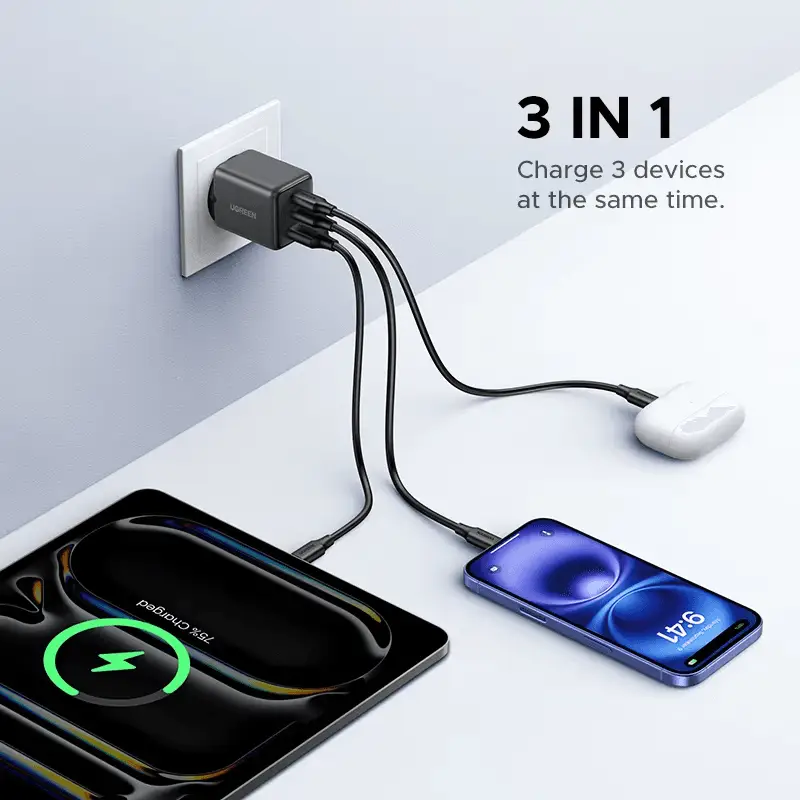
UGREEN 30W GaN Charger PD 3.0 QC4.0 USB C Charger For iPhone 17 16 15 Pro Samsung S25 Xiaomi Tablet iPad Air Pro Phone Charger
Does a GaN Charger Charge Faster?
Not automatically.
Suppose a 30W GaN charger and a 30W regular charger both support the charging standard required by your phone. In that situation, the phone may charge at approximately the same rate from either adapter.
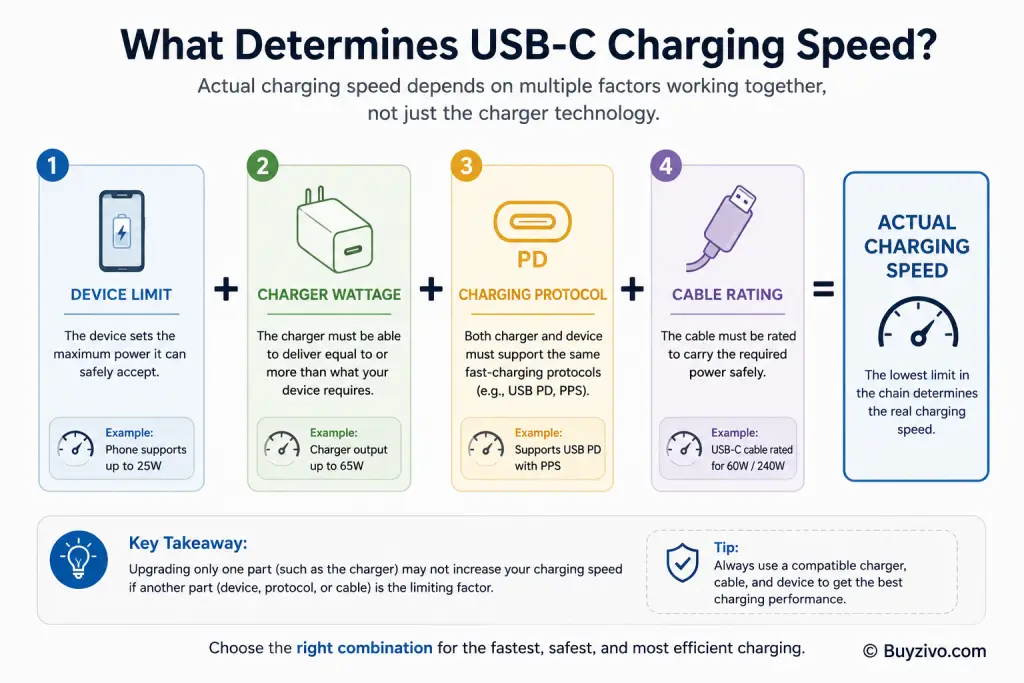
GaN makes it easier to package higher power into a smaller enclosure. It does not force a connected device to accept more power.
Actual charging speed depends on four main elements:
- The device’s maximum supported charging input
- The charger’s available output
- A charging protocol supported by both devices
- A cable capable of carrying the required power
For example, a phone that accepts a maximum of 25W will not charge at 65W simply because it is connected to a 65W GaN charger.
USB Power Delivery supports negotiated power delivery through USB-C, with the current USB-IF framework supporting applications up to 240W when all required components are compatible. [2] Higher USB-C power levels also require an appropriately rated cable.
Category winner: Tie
At the same wattage and with the same protocol support, neither technology has an automatic speed advantage.
Size, Weight, and Portability
This is where GaN usually provides its clearest practical advantage.
GaN components can support high-frequency power conversion with lower switching losses than traditional silicon solutions in suitable designs. Higher operating frequencies can allow components such as transformers, inductors, and capacitors to become smaller.
The result may be:
- A smaller charger body
- Less weight in a travel bag
- More ports in the same enclosure
- Higher output without a laptop-sized power brick
- Less obstruction around crowded wall outlets
The difference may be minor with a basic 20W phone charger. It becomes more noticeable when comparing 65W, 100W, or multi-port adapters.
Category winner: GaN charger
GaN is particularly useful when high output must fit into a portable design.
Efficiency and Heat
All chargers lose some energy while converting AC electricity from a wall socket into the DC power used by a device. Some of that loss becomes heat.
GaN technology can reduce power-switching losses and support higher-efficiency, higher-density designs. Infineon explains that GaN transistors can operate at higher switching frequencies while maintaining low losses, which can help reduce wasted energy and component size.
That does not mean a GaN charger will remain cold. A compact charger delivering 65W or 100W may feel warm because it is processing substantial power inside a small enclosure.
Similarly, a carefully engineered silicon charger may operate efficiently, while a poorly designed GaN charger may perform badly.
Consider heat performance as a property of the complete product, not only its semiconductor material.
Category winner: GaN charger, with conditions
GaN provides better design potential, but the manufacturer must use that potential properly.
Multi-Port and Multi-Device Charging
GaN chargers are especially attractive when you want one adapter for a phone, tablet, laptop, earbuds, or smartwatch.
Their high power density makes it practical to build chargers with two, three, or four ports without creating an excessively large body.
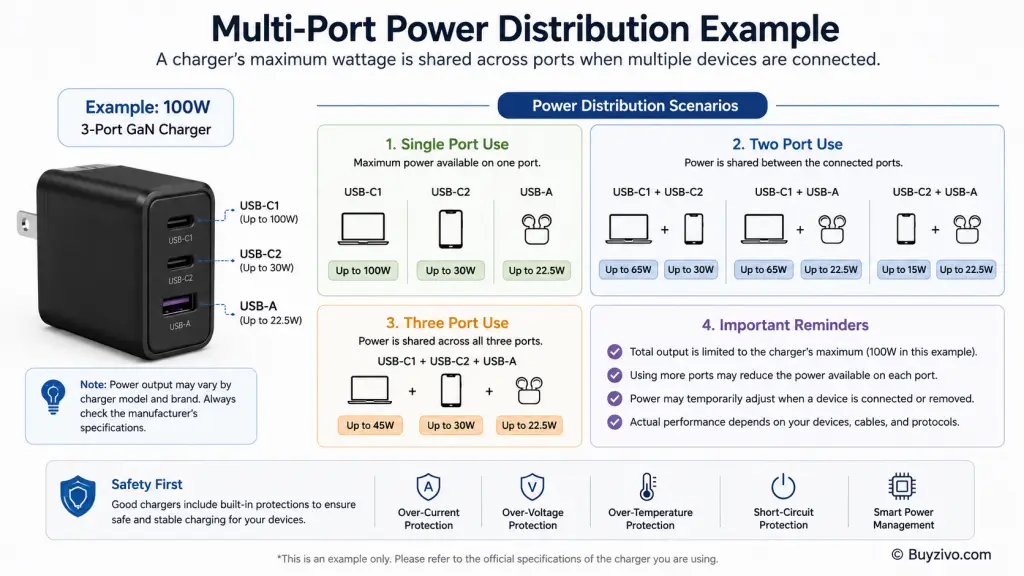
However, multi-port output labels require careful reading.
A charger advertised as “100W” may deliver:
- Up to 100W through one USB-C port when used alone
- Less power from that port when another device is connected
- A shared 100W total across all ports
- A specific power distribution such as 65W plus 30W
Some chargers temporarily interrupt or renegotiate power when a new device is connected. This is normal for many multi-port designs, but it may cause a connected screen, accessory, or laptop to briefly react.
Always check the manufacturer’s port-distribution chart rather than assuming every port can deliver the maximum advertised wattage simultaneously.
Category winner: GaN charger
GaN models usually provide more convenient high-power multi-port choices in compact sizes.
Compatibility: GaN Is Not the Charging Standard
One of the most common misunderstandings is treating GaN as a fast-charging protocol.
It is not.
GaN describes a semiconductor technology used inside the power adapter. Compatibility is controlled by standards and protocols such as:
- USB Power Delivery
- USB PD Programmable Power Supply
- Qualcomm Quick Charge
- Apple-compatible USB PD charging
- Brand-specific systems such as SuperVOOC or other proprietary protocols
USB-IF states that certified USB fast chargers supporting PPS require compatible chargers, devices, and connections to use that feature fully.
Before buying, check the charging specification of your phone, tablet, laptop, or handheld console.
Important compatibility questions
- Does the device support USB Power Delivery?
- Does it require PPS for its fastest charging mode?
- Does it rely on a proprietary charging protocol?
- What is its maximum input wattage?
- Does the charger support that output on the port you plan to use?
- Is the cable rated for the necessary power?
A high-output GaN charger may still charge an incompatible device slowly if they cannot agree on the correct protocol.
Category winner: Tie
Both GaN and regular chargers can offer excellent compatibility. Protocol support matters more than semiconductor type.
Safety and Reliability
GaN chargers can be safe, but GaN itself is not a safety certification.
A trustworthy charger should include appropriate protection against issues such as:
- Excessive current
- Excessive voltage
- Short circuits
- Abnormal temperatures
- Overload conditions
The exact protections and certification requirements vary by product and market.
Look for transparent specifications, manufacturer support, traceable model information, and recognized compliance markings relevant to your country. USB-IF also maintains a product search for products that have passed its compliance program and are authorized to use applicable USB certification logos.
Avoid relying on vague marketplace claims such as “certified safe” when no certification body, model number, or test record is identified.
Also inspect the physical design. A charger should fit securely in the outlet and should not have loose ports, cracked casing, bent pins, or signs of overheating.
Category winner: Tie
A reputable product can be safe regardless of whether it uses GaN or silicon. Product engineering and compliance are more important.
Price and Long-Term Value
GaN chargers often carry a higher purchase price than simple silicon chargers, although the difference varies by wattage, port count, brand, and region.
The premium may be worthwhile when a single charger can replace:
- A phone adapter
- A tablet adapter
- A separate laptop power brick
- An additional travel charger
A 65W or 100W multi-port GaN charger can therefore provide practical value even when its initial price is higher.
On the other hand, paying extra for GaN may not make sense if you only need a small 20W charger beside your bed.
Do not compare prices based on wattage alone. Compare:
- Number and type of ports
- Maximum single-port output
- Total output
- Power distribution
- Protocol support
- Plug design
- Included cable
- Warranty and customer support
Because retail prices and availability change, check the latest information at the retailer before purchasing.
Category winner: Regular charger for initial cost
Category winner: GaN charger for high-power travel convenience
Choose a GaN Charger If…
A GaN charger is likely the better option when:
- You regularly travel with a phone, tablet, and laptop.
- You want to replace several adapters with one unit.
- You need 45W, 65W, 100W, or higher output in a compact body.
- Your laptop supports USB-C Power Delivery charging.
- You need multiple USB-C ports.
- Your wall outlets or power strips have limited space.
- Portability is more important than the lowest purchase price.
A 65W multi-port GaN charger is often a sensible middle ground for people carrying a USB-C laptop and phone. Higher-powered models may be appropriate for more demanding laptops or several devices, provided their port distribution meets your needs.
Choose a Regular Charger If…
A regular silicon charger may be the more practical choice when:
- You charge only one phone or small accessory.
- You do not travel frequently.
- Charger size is not important.
- Your device uses a low charging wattage.
- You already have a reliable manufacturer-supplied adapter.
- You want the lowest reasonable cost.
- Your device requires a proprietary charger that third-party GaN models do not fully support.
Replacing a functional charger purely because it is not GaN may provide little benefit.
Common Buying Mistakes
Assuming GaN means faster charging
GaN can make a charger smaller and more power-dense, but charging speed is determined by negotiated wattage and protocol compatibility.
Buying far more wattage than necessary
Extra wattage can provide flexibility, but it will not force your device to charge beyond its supported limit.
Ignoring PPS support
Some Android devices need USB PD PPS to reach their intended fast-charging mode. A charger may support USB PD without supporting PPS.
Overlooking multi-port power sharing
The advertised wattage may apply only when one port is in use. Read the output table for two-port and three-port operation.
Using an unsuitable cable
The cable is part of the charging system. USB-IF uses 60W and 240W power-rating markings for compliant USB-C to USB-C cable categories.
Choosing an unknown model based only on a low price
A charger connects directly to mains electricity. Clear specifications, product traceability, warranty coverage, and credible compliance information should take priority over a small saving.
Expecting every proprietary fast-charging mode to work
Some phones require manufacturer-specific chargers and cables to achieve their highest advertised charging speeds. Confirm compatibility before purchasing a universal charger.
Practical Decision Framework
Use these five steps before choosing between a GaN charger and a regular charger.
1. List the devices you need to charge
Include phones, tablets, laptops, earbuds, watches, and gaming devices.
2. Check their charging requirements
Identify each device’s maximum charging wattage and required protocol.
3. Decide how many devices will charge simultaneously
This determines the number of ports and total output you need.
4. Read the charger’s output distribution
Confirm the power available from each port under the combinations you expect to use.
5. Decide how much portability matters
Choose GaN when smaller size and consolidated charging justify the extra cost. Choose a regular charger when basic, stationary charging is enough.
Final Verdict
There is no universal winner in the GaN charger vs regular charger comparison.
GaN is the better technology for fitting higher power and multiple ports into a compact adapter. It is particularly useful for travelers, laptop users, and people who want one charger for several devices.
A regular silicon charger remains a sensible option for basic phone charging, fixed locations, and tighter budgets. It can charge just as quickly as a GaN model when both offer the same compatible wattage and protocol.
For most buyers, the correct order of priorities is:
- Charging protocol compatibility
- Required wattage
- Port configuration and power distribution
- Product quality and compliance
- Size, weight, and price
- Semiconductor technology
Do not buy a charger only because “GaN” appears on the box. Buy it when its actual output, compatibility, ports, and physical size solve a real charging need.
Frequently Asked Questions
Are GaN chargers better than regular chargers?
GaN chargers are generally better for delivering high output from a smaller enclosure. They are not automatically better in compatibility, durability, safety, or charging speed. Those qualities depend on the complete product design.
Do GaN chargers charge phones faster?
Only when the GaN charger supports a higher compatible charging mode than the regular charger being compared, two chargers offering the same wattage and protocol should not be expected to differ dramatically because one uses GaN.
Are GaN chargers safe for phones?
A properly designed charger should supply only the power profile negotiated with the connected device. Safety still depends on product quality, protection systems, compliance, the cable, and the condition of the equipment.
Can I use a 100W GaN charger with a 20W phone?
Generally, a compatible USB charging system allows the phone to request only the power it supports. However, both products should follow compatible standards, and you should use an appropriate cable.
Is a GaN charger worth it for travel?
It can be. A multi-port GaN charger may replace several separate adapters while taking up less space. Check plug compatibility for your destination and remember that a plug adapter does not convert voltage.
Does GaN damage battery health?
There is no basis for assuming that GaN technology itself damages a battery. Battery charging is managed by the device and charging system. Heat, charging behavior, battery chemistry, device controls, and long-term usage patterns are more relevant than the charger’s semiconductor material alone.
Why does my GaN charger become warm?
Power conversion creates some heat, and compact high-output chargers concentrate that heat in a small body. Warmth alone does not prove a fault. Stop using a charger if it becomes abnormally hot, emits an odor, makes unusual sounds, shows discoloration, or has physical damage.
Can a GaN charger replace my laptop charger?
It may replace a laptop adapter when the laptop supports USB-C charging and the GaN charger provides the required USB PD output. Some laptops need proprietary connectors or more power than a particular charger can supply.
Conclusion
A GaN charger offers the greatest benefit when you need high output, several ports, and a small travel-friendly design. A regular charger is often all you need for straightforward, single-device charging.
Start with your device’s protocol and wattage requirements. Then compare port behavior, cable requirements, product quality, and size. That approach will help you choose a charger that performs properly rather than paying for a technology label you may not need.