Introduction
Power banks have become everyday essentials. Whether you’re traveling, commuting, working remotely, or simply spending a long day away from a wall outlet, having extra battery power can prevent unnecessary interruptions.
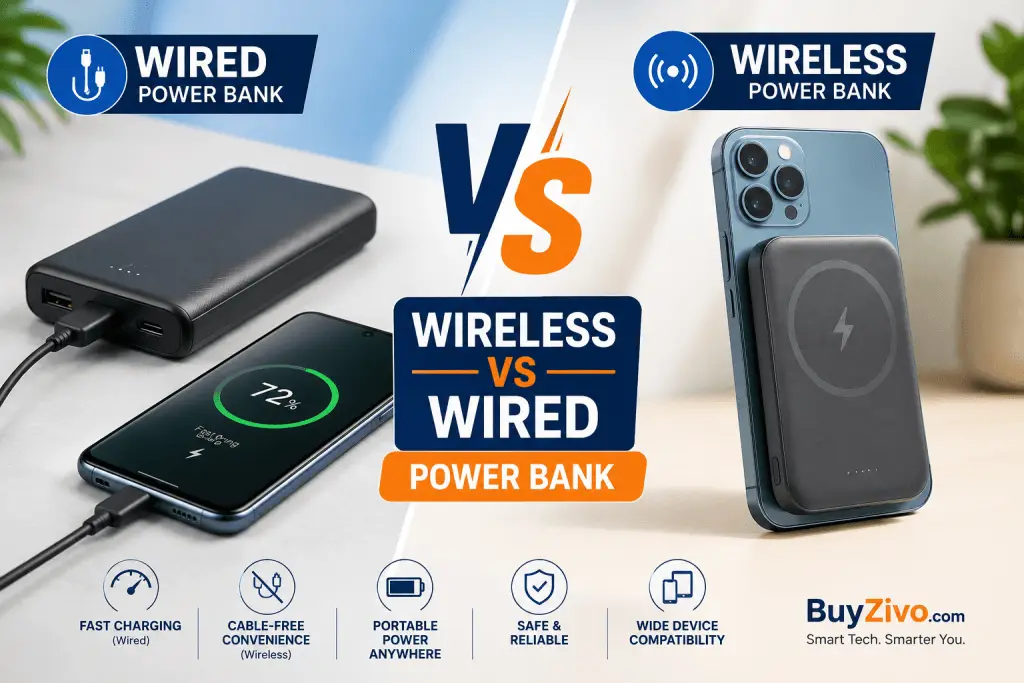
One question many buyers face is whether a wireless power bank or a wired power bank is the better choice.
At first glance, wireless charging seems more convenient. Just place your phone on the power bank or attach it magnetically if supported, and charging begins. Wired models, on the other hand, require a cable but usually offer faster charging and better energy efficiency.
So which one should you choose?
The answer depends on how you use your devices. Someone who values convenience may happily accept slower charging speeds. Another user who needs the fastest possible recharge before a meeting or flight will probably prefer a wired solution.
This guide compares wireless vs wired power bank options using practical buying criteria instead of marketing claims. You’ll learn how they differ in charging speed, efficiency, portability, compatibility, heat generation, and real-world usability. We’ll also explain where newer technologies like Qi2, MagSafe, and USB Power Delivery (USB PD) fit into the picture.
All technical information in this article is based on publicly available documentation from organizations such as the Wireless Power Consortium (Qi/Qi2), USB Implementers Forum (USB-IF), and manufacturer specifications where applicable.
Quick Answer
If your priority is fast charging, maximum efficiency, and universal compatibility, a wired USB-C power bank is usually the better choice.
If you prefer cable-free convenience and own a compatible smartphone, particularly a MagSafe or Qi2-supported device, a wireless power bank offers a cleaner and more convenient charging experience, although it generally charges more slowly and wastes more energy as heat.
Neither option is universally better. The right choice depends on your devices, charging habits, and daily routine.
Key Takeaways
| Feature | Wireless Power Bank | Wired Power Bank |
|---|---|---|
| Charging Speed | Slower | Faster |
| Energy Efficiency | Lower | Higher |
| Heat Generation | Higher | Lower |
| Convenience | Excellent | Good |
| Cable Required | No | Yes |
| Travel Friendliness | Excellent for casual use | Better for heavy use |
| Charging While Using Phone | Less comfortable | Easier |
| Best For | Everyday convenience | Fast charging and maximum performance |
What Is a Wireless Power Bank?
A wireless power bank stores electrical energy just like a traditional portable charger but transfers power to compatible devices without requiring a charging cable.
Instead of sending electricity through a USB cable, it uses inductive charging, where electrical energy is transferred between two coils positioned very close to each other.
Most wireless power banks today support the Qi wireless charging standard, while newer premium models increasingly support Qi2, introduced by the Wireless Power Consortium. Qi2 incorporates a magnetic alignment system based on Apple’s MagSafe technology to improve charging alignment and consistency. According to the Wireless Power Consortium, proper magnetic alignment can improve charging reliability and reduce energy loss compared with poorly aligned wireless charging.¹
Many wireless power banks also include USB-C ports, allowing them to function as wired chargers when higher charging speeds are needed.
Advantages
- No charging cable required
- Cleaner and more convenient experience
- Ideal for desks, commuting, and travel
- Fewer cables to carry
- Many models combine wired and wireless charging
Limitations
- Charging is generally slower
- More energy is lost as heat
- Precise alignment is important
- Magnetic attachment works best with compatible devices
- Usually costs more than similar-capacity wired models
What Is a Wired Power Bank?
A wired power bank transfers energy through a physical cable, typically using USB-C, although some models also include USB-A outputs.
Modern wired power banks frequently support fast-charging standards such as:
- USB Power Delivery (USB PD)
- Programmable Power Supply (PPS)
- Qualcomm Quick Charge (on selected models)
Unlike wireless charging, nearly all of the transferred energy travels directly through the cable, making wired charging significantly more efficient.
Many premium USB-C power banks can charge not only smartphones but also tablets, handheld gaming devices, cameras, and even certain laptops, provided both the power bank and device support compatible USB PD power levels.
Because less energy is wasted during transmission, wired charging generally produces less heat and delivers faster charging speeds than wireless charging.
Advantages
- Faster charging
- Higher energy efficiency
- Lower heat generation
- Better for high-capacity devices
- Wider compatibility
Limitations
- Requires carrying charging cables
- Cable wear can become an issue over time
- Less convenient for quick top-ups while moving
Wireless vs Wired Power Bank: Quick Comparison
Choosing between these two options isn’t simply a matter of speed versus convenience. Several practical factors influence the overall experience.
| Category | Wireless Power Bank | Wired Power Bank |
|---|---|---|
| Convenience | ★★★★★ | ★★★★☆ |
| Charging Speed | ★★☆☆☆ | ★★★★★ |
| Energy Efficiency | ★★☆☆☆ | ★★★★★ |
| Heat Control | ★★☆☆☆ | ★★★★☆ |
| Device Compatibility | ★★★★☆ | ★★★★★ |
| Travel Performance | ★★★★☆ | ★★★★★ |
| Cost Effectiveness | ★★★☆☆ | ★★★★★ |
At a glance, wired power banks lead in technical performance, while wireless models stand out for everyday convenience. In the next section, we’ll look more closely at one of the biggest differences between them: charging speed and real-world performance.
Charging Speed Comparison
For most buyers, charging speed is the biggest deciding factor in the wireless vs wired power bank debate.
If your goal is to recharge your phone as quickly as possible before leaving home, catching a flight, or heading into a meeting, a wired power bank almost always has the advantage.
Wireless charging has improved significantly over the past few years, especially with the introduction of Qi2. However, it still cannot consistently match the speed and efficiency of a good USB-C wired connection.
Why Wired Charging Is Faster
With a wired connection, electricity flows directly from the power bank to your device through a cable. This direct path minimizes energy loss and allows higher power delivery.
Many modern USB-C power banks support:
- 20W USB PD for iPhones
- 25W or 45W USB PD PPS for many Samsung Galaxy devices
- 30W to 65W USB PD for tablets and some laptops
- Up to 100W or more on certain high-capacity premium models designed for laptops
Keep in mind that the actual charging speed depends on three factors:
- Your device’s maximum supported charging speed
- The power bank’s output capability
- The charging cable’s specifications
If any one of these components is limited, the charging speed will also be limited.
How Fast Is Wireless Charging?
Wireless charging works differently.
Instead of sending electricity through a cable, the power bank transfers energy through electromagnetic induction between two coils.
This process naturally introduces more energy loss.
Most wireless power banks currently support charging outputs such as:
- 5W
- 7.5W (commonly for older iPhones)
- 10W
- 15W (Qi and Qi2 compatible devices)
Some manufacturers advertise higher wireless charging outputs, but actual performance depends on device compatibility, thermal management, and charging alignment. Unless both the charger and phone officially support those higher modes, users should not expect faster charging.
Real-World Charging Experience
Imagine your phone is at 20% battery before leaving for work.
With a quality USB-C wired power bank, you can often recover a substantial amount of battery during a short coffee break.
With wireless charging, you’ll usually gain less battery in the same amount of time because:
- Charging power is generally lower.
- More energy is lost as heat.
- Charging speed may slow further if the phone becomes warm.
This doesn’t make wireless charging bad—it simply serves a different purpose.
Many people use wireless charging for gradual top-ups throughout the day rather than rapid charging sessions.
Power Efficiency: Where Does the Energy Go?
Charging speed tells only part of the story.
Another important factor is efficiency, or how much of the stored energy inside the power bank actually reaches your phone.
This is one of the biggest technical differences between wireless and wired charging.
Wired Charging Is More Efficient
With a USB cable, relatively little energy is lost during transmission.
That means more of the power stored in the battery reaches your device.
For example, a 10,000mAh wired power bank generally delivers more usable energy than a 10,000mAh wireless-only model under similar conditions.
This is one reason why wired power banks often provide more complete phone recharges from the same battery capacity.
Wireless Charging Loses More Energy
Wireless charging must convert electricity into a magnetic field and then back into electricity inside the phone.
Every conversion introduces energy loss.
Additional factors can further reduce efficiency:
- Poor coil alignment
- Thick or metal phone cases
- Higher operating temperatures
- Movement while charging
- Dust or debris between charging surfaces
The Wireless Power Consortium introduced Qi2’s magnetic alignment system to reduce some of these losses by helping compatible devices maintain optimal positioning during charging.
Even so, wireless charging remains less efficient than a direct wired connection.
Heat Generation
Heat is another important difference that buyers often overlook.
Every charging method produces some heat, but excessive heat can reduce charging performance and may contribute to faster battery aging over time.
Why Wireless Charging Generates More Heat
Wireless charging transfers energy through magnetic fields rather than direct electrical contact.
Some energy is inevitably lost during this process, and much of that loss becomes heat.
If the phone is slightly misaligned or enclosed in a thick protective case, temperatures may increase further.
To protect the battery, many smartphones automatically reduce charging speed when they detect excessive heat.
As a result, charging may slow down during longer wireless sessions.
Wired Charging Also Produces Heat
Fast wired charging isn’t completely heat-free.
Higher charging wattages naturally generate warmth, especially during the early stage of charging.
However, because wired charging transfers energy more efficiently, less energy is wasted compared with wireless charging.
Modern smartphones also include battery management systems that automatically adjust charging speed and temperature to protect battery health.
Portability and Everyday Convenience
Technical performance isn’t everything.
Convenience is the main reason many people choose wireless power banks.
When Wireless Power Banks Feel Better
Wireless charging removes one small but surprisingly common frustration: carrying and connecting cables.
Instead of searching for the correct cable, you simply place the phone onto the charger—or magnetically attach it if both devices support MagSafe or Qi2.
This is especially useful when:
- Walking through airports
- Using public transportation
- Working in cafés
- Reading or watching videos
- Making short charging stops during the day
Magnetic wireless power banks are particularly convenient because they stay attached while you continue using the phone.
When Wired Power Banks Are More Practical
Despite requiring a cable, wired power banks often prove more practical for demanding situations.
Examples include:
- Charging multiple devices
- Long trips without access to electricity
- Camping
- Business travel
- Emergency backup power
Many wired models include two or more USB outputs, allowing users to charge multiple devices simultaneously.
Some also support pass-through charging or can recharge laptops, tablets, cameras, and handheld gaming devices—something most wireless power banks cannot do effectively.
Compatibility With Different Devices
Compatibility is another area where wired power banks generally have the edge.
A USB-C power bank can typically charge a wide range of devices, including:
- Smartphones
- Tablets
- Wireless earbuds
- Smartwatches (with the appropriate cable)
- Bluetooth speakers
- Cameras
- Portable gaming consoles
- USB-C laptops (if supported)
Wireless power banks, by contrast, only provide wireless charging for devices that support Qi or Qi2. Devices without wireless charging capability will still require a cable, even if the power bank offers wireless charging.
For many users, a hybrid model that supports both wired USB-C charging and Qi/Qi2 wireless charging offers the best balance of flexibility and convenience.
Battery Capacity and Real-World Performance
One of the most common misconceptions about power banks is that the advertised capacity tells you exactly how many times it can charge your phone.
In reality, usable capacity is more important than the number printed on the box.
Every power bank loses some energy during voltage conversion and charging. The amount of usable energy also depends on the charging method.
Because wired charging is generally more efficient than wireless charging, a wired power bank usually delivers more usable battery capacity from the same rated size.
For example, if you compare two quality 10,000mAh power banks from reputable brands:
- The wired model will typically transfer more of its stored energy to your phone.
- The wireless model will consume part of that energy during the wireless power transfer process, leaving less available for the device.
This doesn’t mean the wireless power bank has a smaller battery. It simply means more energy is lost during charging.
Wireless vs Wired Power Bank: Which Offers Better Value?
Price is another important factor.
Wireless charging hardware, magnetic alignment systems (such as Qi2 or MagSafe-compatible designs), and additional safety electronics generally increase manufacturing costs.
As a result:
- Wireless power banks often cost more than wired models with similar battery capacity.
- A wired power bank at the same price may offer a larger battery, faster charging, or additional USB ports.
If your budget is limited, a wired USB-C power bank usually provides better overall value.
If convenience is your highest priority, paying extra for wireless charging may be worthwhile.
Travel and Airline Considerations
Power banks are among the most common travel accessories, but airlines have specific rules regarding lithium batteries.
The good news is that airline rules generally apply to the battery itself, not whether it charges devices wirelessly or through a cable.
According to the U.S. Federal Aviation Administration (FAA) and many international airlines:
- Power banks must be carried in carry-on baggage.
- They should not be packed in checked luggage because they contain lithium-ion batteries.
- Capacity restrictions may apply for larger batteries, particularly those exceeding 100Wh. Batteries above certain limits may require airline approval or may not be permitted at all.
Before flying internationally, always check your airline’s latest baggage policy, as requirements can vary slightly.
For most travelers, a 10,000mAh or 20,000mAh power bank from a reputable manufacturer is suitable for everyday travel and falls well within common airline limits.
Wireless vs Wired Power Bank: Which One Should You Choose?
There isn’t a single winner for everyone.
The better option depends on how you use your devices.
Choose a Wireless Power Bank If…
A wireless power bank is likely the better fit if you:
- Prefer a cable-free charging experience.
- Own an iPhone with MagSafe or a Qi2-compatible device.
- Frequently top up your battery throughout the day.
- Want fewer cables in your bag.
- Value convenience more than maximum charging speed.
- Mainly charge smartphones rather than larger devices.
Wireless charging is especially appealing for commuters, office workers, students, and anyone who likes a clean, minimalist setup.
Choose a Wired Power Bank If…
A wired power bank is usually the better choice if you:
- Want the fastest possible charging.
- Frequently travel long distances.
- Charge multiple devices.
- Need to power tablets or laptops.
- Want better value for your money.
- Prefer maximum battery efficiency.
- Need dependable charging in emergencies.
For many people, a quality USB-C Power Delivery power bank remains the most practical all-around solution.
What About Hybrid Power Banks?
If your budget allows, consider a hybrid power bank that supports both wired and wireless charging.
These models typically include:
- USB-C Power Delivery
- Wireless Qi or Qi2 charging
- USB-A output (on some models)
- Multiple device charging
- Pass-through charging on selected models
Hybrid models give you flexibility.
You can use fast wired charging when you’re in a hurry and switch to wireless charging when convenience matters more.
For many buyers, this is the best long-term investment.
Common Buying Mistakes
Avoid these common mistakes when choosing a power bank.
Buying Based Only on Battery Capacity
A larger mAh rating doesn’t automatically mean better real-world performance.
Look at:
- Output power
- Charging standards
- Efficiency
- Build quality
- Safety certifications
Ignoring Fast-Charging Standards
A 30W power bank won’t charge your phone at 30W unless both devices support the same charging protocol.
Check compatibility with:
- USB Power Delivery (USB PD)
- PPS
- Quick Charge (where applicable)
Assuming Every Wireless Charger Supports Magnetic Attachment
Only compatible devices support magnetic alignment.
Some wireless power banks simply provide a flat charging surface without magnets.
Always verify compatibility before purchasing.
Buying Unknown Brands
Cheap power banks sometimes exaggerate battery capacity or lack proper safety protections.
Whenever possible, choose products from manufacturers that clearly publish specifications and comply with recognized safety standards.
Final Verdict
The answer to wireless vs wired power bank depends on what matters most to you.
If your priorities are charging speed, energy efficiency, compatibility, and value, a wired USB-C power bank is the stronger choice. It delivers faster charging, wastes less energy, and works with a wider range of devices.
If your priority is everyday convenience, especially for short charging sessions throughout the day, a wireless power bank offers a cleaner, cable-free experience. Newer Qi2-compatible models also improve alignment and charging consistency compared with earlier wireless chargers.
For many users, however, the most versatile option is a hybrid power bank that supports both wired USB-C charging and Qi/Qi2 wireless charging. It gives you the flexibility to choose speed when you need it and convenience when you don’t.
Before buying, compare the power bank’s charging standards, output wattage, battery capacity, safety features, and compatibility with your devices rather than relying on marketing claims alone.
Frequently Asked Questions
Is a wireless power bank slower than a wired power bank?
Yes. In most cases, wired charging is faster because it transfers power more efficiently with less energy lost as heat. Actual charging speed depends on the phone, power bank, charging standard, and cable quality.
Does wireless charging damage a phone’s battery?
There is no evidence that properly designed Qi or Qi2 wireless charging damages a healthy smartphone battery. However, wireless charging generally generates more heat than wired charging, and excessive heat over time can contribute to battery aging. Modern devices include battery management systems to help reduce this risk.
Can a wireless power bank also charge with a cable?
Many modern wireless power banks include USB-C ports that support wired charging. Check the manufacturer’s specifications to confirm available charging modes.
Is Qi2 better than standard Qi?
Qi2 introduces magnetic alignment that helps compatible devices maintain the correct charging position. This can improve charging consistency and reduce energy loss caused by poor alignment.
Which is better for travel?
Both work well for travel. If you need the fastest charging or want to charge multiple devices, a wired power bank is usually the better choice. If you prefer traveling with fewer cables, a wireless or hybrid power bank may be more convenient.