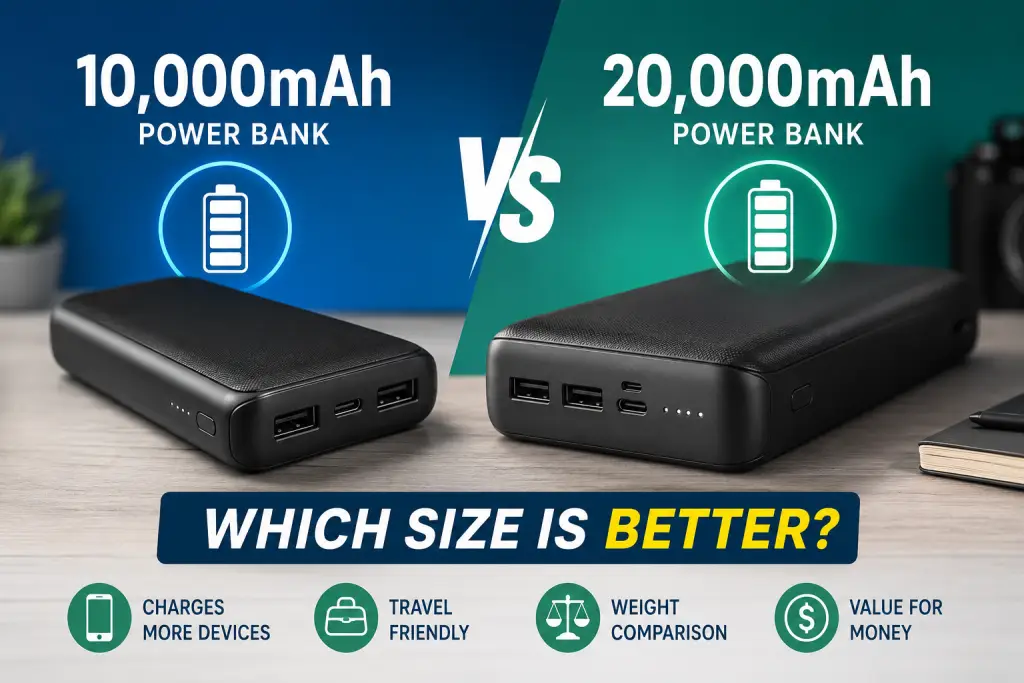
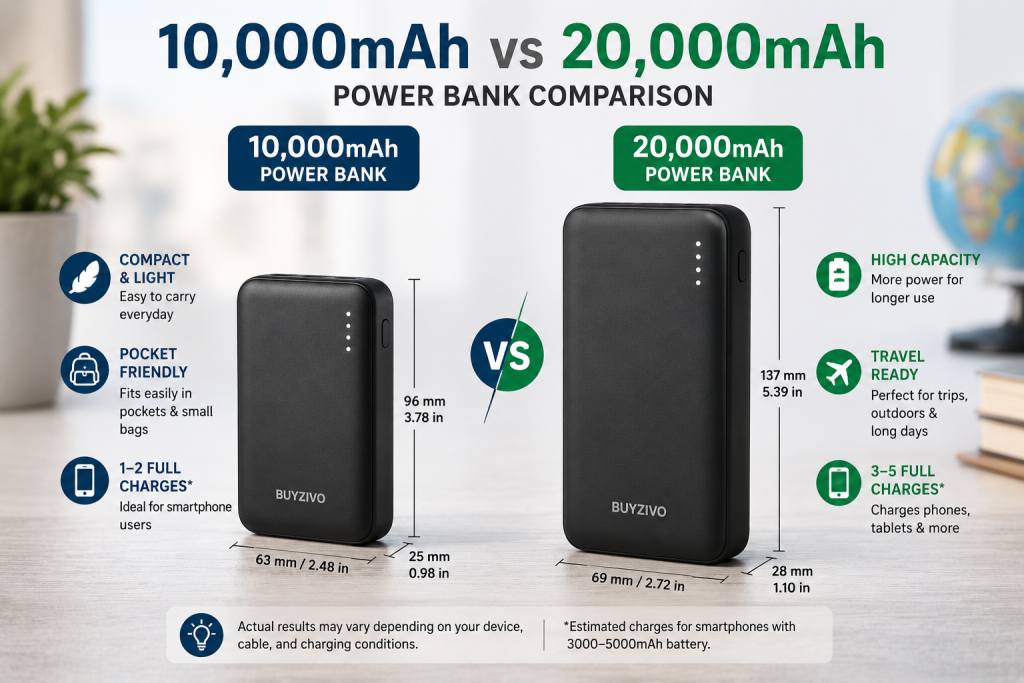
Choosing between a 10000mAh vs 20000mAh power bank is mainly a decision between portability and additional charging capacity.
A 10,000mAh model is usually easier to carry and is often enough for everyday phone charging. A 20,000mAh model provides roughly twice the stated battery capacity, making it more suitable for long trips, multiple devices, tablets, and demanding daily use. The trade-off is extra size, weight, recharge time, and often a higher price.
Capacity alone does not tell the whole story, however. Charging output, supported protocols, port selection, efficiency, battery voltage, and your device’s battery size all affect real-world performance.
This guide compares both capacities using the same practical criteria so you can choose the size that fits your routine.
Quick Answer
Choose a 10,000mAh power bank when you mainly charge one smartphone, value portability, and can recharge the power bank regularly.
Choose a 20,000mAh power bank when you travel frequently, spend long periods away from outlets, charge several devices, or need extra capacity for a tablet or compatible laptop.
For most everyday commuters, 10,000mAh offers the better balance. For extended travel and heavier use, 20,000mAh is usually more practical.
Key Takeaways
Key Takeaways
- A 10,000mAh power bank is generally better for pockets, small bags, commuting, and emergency phone charging.
- A 20,000mAh model offers more usable energy but is noticeably heavier and bulkier.
- Neither capacity delivers its full labeled mAh directly to your phone because voltage conversion and normal energy losses occur.
- Charging speed depends on wattage and protocol support, not capacity alone.
- Most standard 10,000mAh and 20,000mAh power banks are below the common 100Wh airline threshold, but they must normally remain in carry-on baggage.
- The right choice depends on how many devices you carry, how often you reach an outlet, and whether portability or endurance matters more.
10,000mAh vs 20,000mAh Power Bank: Quick Comparison
| Comparison point | 10,000mAh power bank | 20,000mAh power bank |
|---|---|---|
| Best use | Daily carry and emergency charging | Travel and heavy use |
| Portability | Easier to carry | Larger and heavier |
| Phone charging | Usually suitable for one or more top-ups | More full or partial charges |
| Multiple devices | Limited but possible | Better suited |
| Tablet use | Occasional | More practical |
| Laptop charging | Limited and model-dependent | More suitable if the output is high enough |
| Power bank recharge time | Usually shorter | Usually longer |
| Pocket friendly | Often | Rarely |
| Travel suitability | Excellent for light travel | Better for longer trips |
| Typical cost | Lower | Higher |
| Main advantage | Portability | Extended capacity |
| Main disadvantage | Fewer charges | Added weight and bulk |
The exact results depend on the power bank’s internal voltage, efficiency, output mode, your device, cable quality, and charging conditions.
What Does Power Bank Capacity Actually Mean?
A power bank’s capacity indicates how much electrical charge its internal battery cells are designed to store. It is normally shown in milliampere-hours, or mAh.
A 20,000mAh power bank has twice the labeled charge capacity of a 10,000mAh power bank. That does not mean it will always charge a particular phone exactly twice as many times.
The advertised capacity is generally measured at the internal battery-cell voltage, which is commonly around 3.6V or 3.7V. USB charging operates at a different voltage, and the power bank must convert energy before sending it to your device.
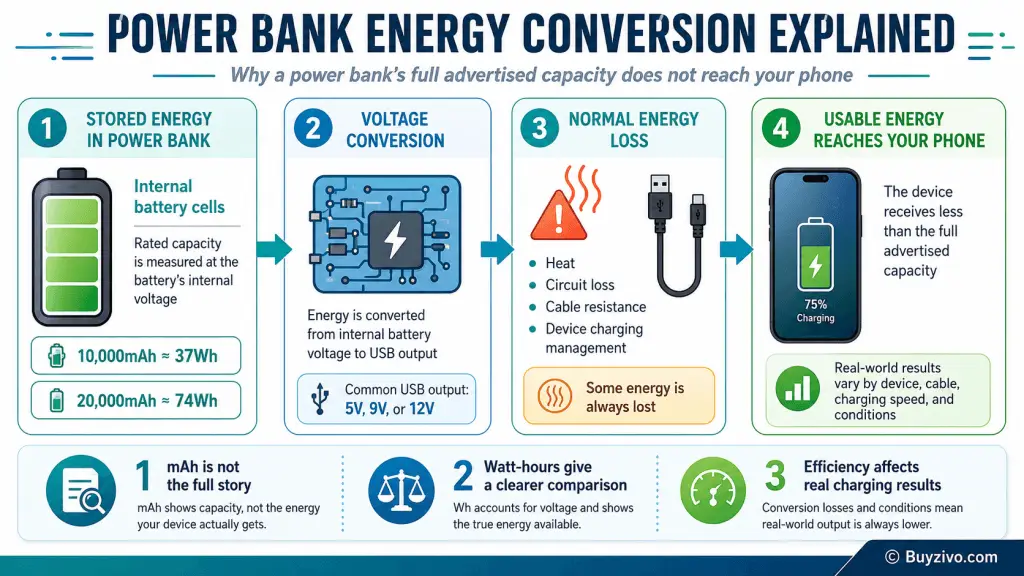
Some energy is lost during this process through:
- Voltage conversion
- Heat
- Internal circuitry
- Cable resistance
- Device charging management
- Wireless charging, when used
For this reason, dividing the power bank’s advertised mAh directly by your phone battery’s mAh will usually overestimate the number of complete charges.
Why Watt-Hours Are Useful
Watt-hours provide a better way to compare batteries operating at different voltages.
The basic formula is:
Watt-hours = ampere-hours × voltage
For example, a power bank labeled 10,000mAh at 3.7V contains approximately:
10Ah × 3.7V = 37Wh
A 20,000mAh model at the same voltage contains approximately:
20Ah × 3.7V = 74Wh
Always check the Wh rating printed on the power bank itself, particularly before flying. The actual rating can differ depending on the battery design and nominal voltage.
How Many Phone Charges Can You Expect?
There is no universal answer because phone battery sizes and charging efficiency vary.
A rough energy-based estimate is more useful than simply comparing mAh labels:
Estimated charges = usable power bank energy ÷ phone battery energy
Suppose your phone has a battery rated at approximately 19Wh.
A theoretical 37Wh power bank would contain enough stored energy for almost two charges before losses. In actual use, the total would be lower because energy is consumed during conversion and charging.
A theoretical 74Wh model would provide significantly more charging time, but again, you should not expect every stored watt-hour to reach the phone.
Other factors can reduce the result:
- Using the phone while it charges
- Poor-quality or damaged cables
- High temperatures
- Wireless charging
- Fast-charging conversion losses
- An aging power bank or phone battery
- Charging several devices simultaneously
Avoid buying a power bank based only on a claim such as “charges any phone three times.” Check which phone was used for that estimate and whether the claim comes from official documentation.
Portability: The Biggest Practical Difference
Portability is where the two capacities feel most different.
Current manufacturer examples show that compact 10,000mAh models may weigh around 200 to 250 grams, although design and features can push the figure higher or lower. Some 20,000mAh products weigh roughly 340 to more than 500 grams, depending on output, construction, display, cables, and internal hardware.
That difference matters more in daily use than it may seem on a specification sheet.
A 10,000mAh Model Is Easier To:
- Carry in a jacket pocket
- Fit into a small handbag
- Hold behind a phone while charging
- Carry during short commutes
- Pack as a lightweight backup
- Use at events, meetings, or day trips
A 20,000mAh Model Is Better Suited To:
- Backpacks
- Laptop bags
- Carry-on luggage
- Long train or bus journeys
- Outdoor trips
- Shared family charging
- Workdays involving several devices
Some slim 20,000mAh models are easier to pack than others, but doubling capacity usually requires a larger or denser battery.
Portability winner: 10,000mAh

Does a 20,000mAh Power Bank Charge Faster?
Not necessarily.
Capacity tells you how much energy the power bank stores. Charging wattage tells you how quickly it may deliver that energy.
A 10,000mAh power bank with a 30W USB-C Power Delivery output can charge a compatible phone faster than a 20,000mAh model limited to 10W or 15W.
When comparing products, check:
- Maximum output from each port
- USB Power Delivery support
- PPS support for compatible devices
- Maximum combined output
- Whether the output drops when multiple ports are used
- Required cable type
- Maximum input for recharging the power bank
A larger capacity can support charging for longer, but it does not automatically provide higher charging speed.
Charging-speed winner: Tie. Product specifications matter more than capacity.
Charging Multiple Devices
A 10,000mAh power bank can have multiple ports, but charging two or three devices will use its available energy quickly.
A 20,000mAh model is usually the better choice for charging combinations such as:
- A phone and wireless earbuds
- Two smartphones
- A phone and a tablet
- A phone, smartwatch, and earbuds
- A phone and a low-power laptop
Check the combined output before assuming that every connected device will receive the advertised maximum wattage. Many power banks split their available output across ports.
For example, a product advertised as having a 65W USB-C port may provide less than 65W from that port when another device is connected.
Multiple-device winner: 20,000mAh

Which Capacity Is Better for Travel?
Both can work well for travel, but they solve different needs.
Choose 10,000mAh for:
- Short flights
- City breaks
- Day tours
- Business meetings
- Lightweight packing
- A single smartphone
Choose 20,000mAh for:
- Long flights and airport delays
- Multi-day travel
- Limited access to wall outlets
- Several personal devices
- Sharing power with a companion
- Tablet or compatible laptop charging
Airline Rules You Need to Know
Power banks are treated as spare lithium batteries by major aviation authorities.
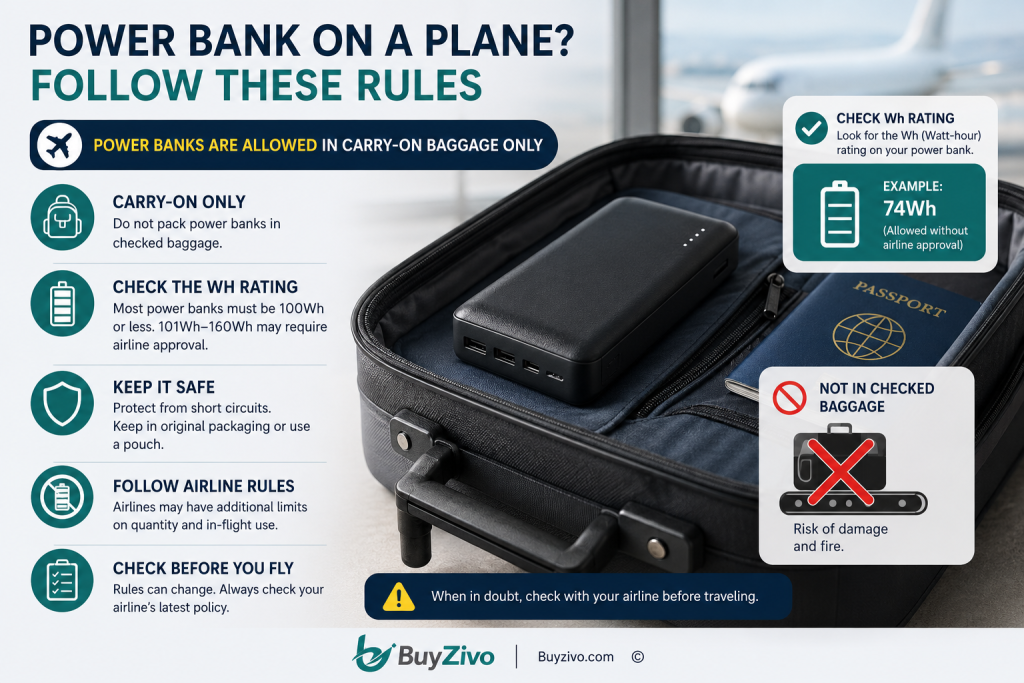
FAA guidance states that power banks must be carried in carry-on baggage, not checked baggage. Lithium-ion batteries are generally limited to 100Wh per battery without airline approval. Batteries between 101Wh and 160Wh may require airline approval and may be subject to quantity limits.
Current IATA passenger guidance also places power banks within carry-on battery rules. Airlines can apply stricter operational requirements, including limits on the number of power banks, where they may be stored, and whether they may be used or recharged during a flight.
A conventional 10,000mAh power bank is commonly around 36–38Wh, while a conventional 20,000mAh unit is commonly around 72–77Wh. Both are typically below 100Wh, but you must verify the exact Wh marking on your product.
Before flying:
- Check the Wh rating printed on the power bank.
- Pack it in carry-on luggage.
- Protect the ports against short circuits.
- Do not travel with a swollen, damaged, or recalled unit.
- Check the airline’s latest policy before departure.
- Follow cabin-crew instructions regarding storage and use.
Extended-travel winner: 20,000mAh
Light-travel winner: 10,000mAh
Recharge Time
A 20,000mAh power bank stores more energy and will generally take longer to recharge when both models use the same input wattage.
However, input speed can change the result significantly.
A 20,000mAh model with high-wattage USB-C input might recharge faster than an older 10,000mAh model limited to a low input rate.
Look for:
- USB-C input
- Maximum input wattage
- Whether the charger is included
- Whether a high-wattage cable is required
- Pass-through charging support, when relevant
- Estimated recharge time from the manufacturer
Also, remember that an input labeled “65W” is only useful when you connect a compatible charger and cable.
Typical recharge convenience winner: 10,000mAh
Battery Lifespan and Charging Cycles
A 20,000mAh power bank does not automatically have a longer service life.
Battery longevity depends on cell chemistry, temperature, charging management, manufacturing quality, storage conditions, and usage patterns.
A larger power bank may need to be recharged less frequently because it holds more energy. On the other hand, it may spend longer at high states of charge or be exposed to more heat when powering demanding devices.
To help protect either size:
- Avoid leaving it in a hot car
- Stop using it if it swells or becomes damaged
- Use compatible chargers and cables
- Keep the ports clean
- Follow the manufacturer’s storage instructions
- Avoid buying unbranded products with unclear specifications
- Check for applicable safety and transport documentation
Do not interpret a high capacity label as evidence of better cells or safer construction.
Price and Overall Value
A 10,000mAh power bank usually costs less than a comparable 20,000mAh model from the same product family. However, features can affect price more than capacity.
A premium 10,000mAh magnetic wireless model may cost more than a basic 20,000mAh wired model.
Compare the complete package:
- Capacity and Wh rating
- Maximum USB-C output
- Input speed
- Number of ports
- Supported charging standards
- Included cables
- Built-in cables
- Display or battery indicator
- Wireless charging
- Size and weight
- Warranty and support
- Safety documentation
Do not pay for a 20,000mAh when you only need a compact emergency charger. Equally, buying two small power banks may be less convenient or more expensive than choosing one suitable high-capacity model.
Budget and light-use winner: 10,000mAh
Capacity-per-purchase winner: Often 20,000mAh, depending on the model
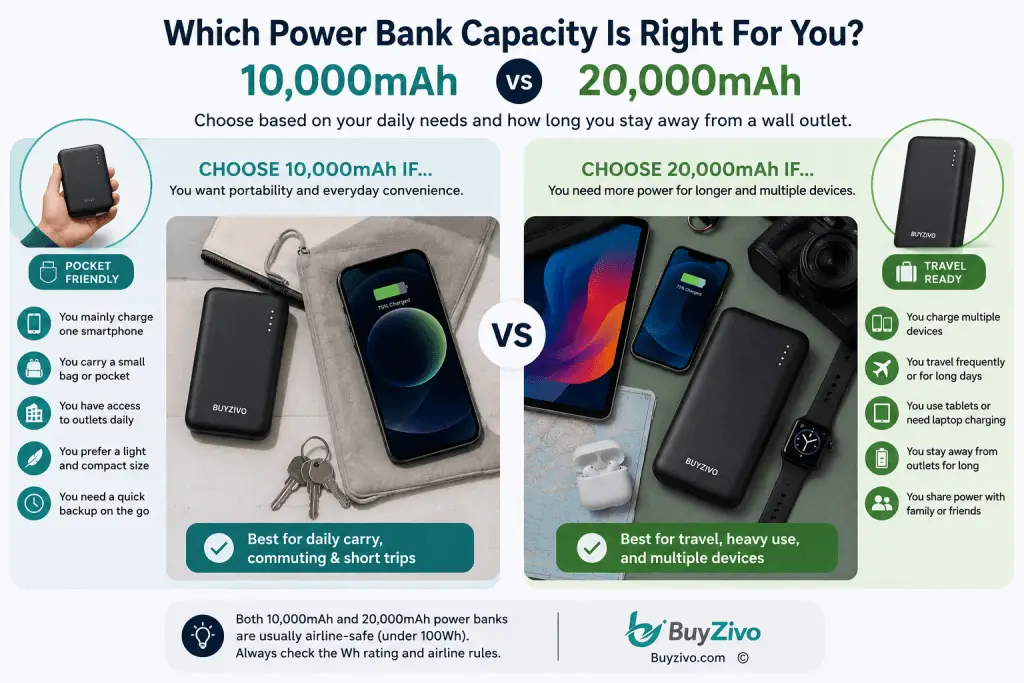
Choose a 10,000mAh Power Bank If…
A 10,000mAh model is probably the better choice when:
- You mainly charge one phone
- You have access to an outlet most days
- You want a power bank for emergencies
- You carry a small bag
- Weight matters more than maximum capacity
- You travel for a day rather than several days
- You prefer a magnetic or pocket-friendly design
- You do not regularly charge tablets or laptops
For many people, this is the most practical everyday capacity. It provides useful backup power without making the power bank inconvenient to carry.
Choose a 20,000mAh Power Bank If…
A 20,000mAh model makes more sense when:
- You travel frequently
- You charge more than one device
- You spend long days away from outlets
- You use your phone heavily for navigation or video
- You want to charge a tablet
- You need a compatible laptop charging
- You share the power bank with someone else
- You prefer fewer power-bank recharges
- You accept the added weight
A 20,000mAh product is less comfortable in a pocket but can be much more dependable during long trips or demanding workdays.
Common Buying Mistakes
Assuming 20,000mAh Means Faster Charging
Capacity and output wattage are separate specifications. Check both.
Expecting the Full Labeled Capacity
The advertised mAh refers to the internal battery system. Real-world delivery is lower because of voltage conversion and other losses.
Ignoring Weight
A 20,000mAh unit may seem portable online, but it feels heavy in a pocket or small bag. Check the exact dimensions and weight.
Buying Too Few Ports
A high-capacity model with only one useful output may not suit multiple-device charging.
Ignoring Combined Output
Power may be divided when several ports are active.
Choosing Capacity Over Compatibility
A large power bank is not useful if it does not support your phone’s preferred charging protocol or your laptop’s required wattage.
Forgetting the Power Bank’s Input Speed
Slow input can make a large-capacity unit frustrating to recharge.
Ignoring the Wh Label Before Flying
Airline rules are based primarily on watt-hours, not the marketing mAh number.
Final Verdict: 10,000mAh or 20,000mAh?
There is no universal winner in the 10000mAh vs 20000mAh power bank comparison.
A 10,000mAh power bank is the better everyday choice for most users who want a compact backup for one smartphone. It is easier to carry, generally quicker to recharge, and usually more affordable.
A 20,000mAh power bank is the better endurance choice for travelers, heavy phone users, families, and people carrying several devices. The added capacity is valuable when outlets are unavailable, but the extra size and weight should not be underestimated.
Use this simple decision rule:
- Choose 10,000mAh for daily portability.
- Choose 20,000mAh for extended independence from wall outlets.
After deciding on capacity, compare USB-C output, supported charging protocols, exact weight, recharge speed, and the power bank’s printed Wh rating before buying.
Frequently Asked Questions
Is a 20,000mAh power bank too big for everyday use?
Not necessarily, but it may be unnecessarily heavy when you only need an occasional phone top-up. It works better in a backpack or laptop bag than in a pocket.
Can a 10,000mAh power bank charge a phone twice?
It may provide around two charges for some phones and fewer for phones with larger batteries, but the result depends on battery energy, conversion efficiency, usage during charging, and the power bank’s design. Do not calculate the result by dividing the two mAh numbers alone.
Can a 20,000mAh power bank charge a laptop?
Some can, but capacity alone is not enough. The power bank must support the laptop’s required USB-C Power Delivery voltage and wattage. Check both devices’ official specifications.
Is a 20,000mAh power bank allowed on a plane?
A conventional 20,000mAh model is usually below 100Wh and is generally permitted in carry-on baggage. Confirm the Wh label and check the airline’s current policy because airlines may impose stricter rules.
Which capacity is better for an iPhone or Android phone?
The phone brand does not determine the ideal capacity. Consider the phone’s battery size, charging protocol, your daily usage, and how frequently you can recharge the power bank.
Is it better to buy two 10,000mAh power banks?
Two smaller units provide flexibility and redundancy, but they require managing and recharging two products. One 20,000mAh model is usually simpler, while two 10,000mAh units may be easier to divide between travelers.
Conclusion
The choice comes down to how you carry and use your devices.
Buy a 10,000mAh power bank when portability is your priority, and you mainly need reliable backup power for one phone. Buy a 20,000mAh power bank when you need longer runtime, multiple-device support, or dependable charging during extended travel.
Whichever capacity you choose, do not judge a power bank by mAh alone. Charging wattage, compatibility, input speed, port behavior, verified dimensions, safety information, and warranty support are equally important.
Choose your ideal capacity, then compare the latest specifications, price, and availability before purchasing.