Introduction
Fast charging has become a standard feature on modern smartphones, tablets, laptops, and accessories. Yet many people focus only on charging speed while overlooking something far more important: safety.
A charger advertised as “65W Fast Charging” or “100W USB-C PD” is not automatically safe. Two chargers with identical power ratings can differ significantly in build quality, electrical protection, and compliance with industry standards.
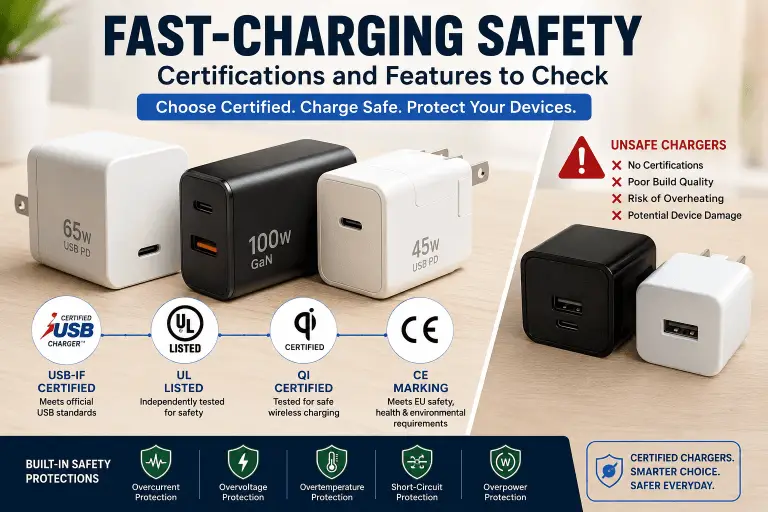
Fast charger safety certifications help identify products that have been evaluated against recognized requirements or comply with established specifications. These certifications, together with essential protection features, reduce the risk of overheating, electrical faults, and compatibility issues. However, not every logo printed on a charger means the same thing. Some indicate independent testing, while others simply show regulatory compliance or manufacturer declarations.
According to the USB Implementers Forum (USB-IF), products that pass its compliance program may display certified USB logos, indicating they meet applicable USB specifications. Similarly, UL Solutions tests products against specific safety standards, while CE marking is a manufacturer’s declaration that a product meets applicable European Union requirements rather than an independent certification.
This guide explains what charger certification marks and protection claims mean. If you are replacing a laptop adapter, use our replacement USB-C laptop charger checklist to match the computer’s charging connection, power profiles, cable and exact charger model.
Quick Answer
What should readers know about fast charger safety certifications?
The safest fast chargers combine recognized industry certifications with robust built-in protection circuits. Look for chargers that clearly state USB-IF certification for USB compliance where applicable, reputable third-party safety certifications such as UL Listing (when available for your region), genuine Qi certification for wireless chargers, and essential protections including overcurrent, overvoltage, overheating, and short-circuit protection. Remember that CE marking is a manufacturer declaration for the European market, not an independent certification, so it should not be treated as proof of third-party safety testing.
Key Takeaways
Fast charging speed alone does not guarantee safety.
USB-IF certification confirms compliance with official USB specifications for eligible products.
UL Listing indicates that a product has been evaluated against applicable safety standards.
CE marking is a regulatory conformity declaration, not an independently issued safety certification.
Qi-certified wireless chargers have been tested for compatibility with the Wireless Power Consortium's standards.
Built-in protection systems are just as important as external certifications.
Avoid chargers with vague claims such as "premium certified" or "100% safe" without verifiable evidence.
Buying from reputable manufacturers reduces the risk of counterfeit or poorly designed chargers.
Why Fast Charger Safety Matters
USB-IF’s USB Power Delivery overview explains that PD Revision 3.1 introduced support for up to 240W with the appropriate USB-C cable and connector requirements. This is a supported system maximum, not the output of every PD charger. Check the charger, cable and device specifications together.
Poorly designed chargers may suffer from inadequate insulation, unstable voltage regulation, low-quality internal components, or ineffective thermal management. These issues can lead to unreliable charging performance and, in extreme cases, create electrical safety risks.
While modern smartphones from companies such as Apple, Samsung, and Google include sophisticated charging management systems, the charger itself remains a critical part of the charging chain. Device protections cannot compensate for every hardware defect in an unsafe charger.
This is why recognized certifications and safety features matter. They provide additional confidence that the charger was designed and evaluated according to established technical requirements rather than relying solely on marketing claims.
What Are Fast Charger Safety Certifications?
A fast charger safety certification is not simply a logo printed on the packaging. Different marks represent different types of compliance, testing, or regulatory obligations.
Broadly speaking, charger markings fall into three categories:
| Type | Purpose | Example |
|---|---|---|
| Official industry certification | Confirms compliance with a technical standard through an established certification program | USB-IF Certified USB®, Qi Certified |
| Independent safety certification | Indicates testing by an independent organization against applicable safety standards | UL Listed |
| Regulatory conformity marking | Declares compliance with legal requirements in a specific market | CE Marking |
Understanding which category a logo belongs to helps consumers interpret marketing claims more accurately.
USB-IF Certification Explained
The USB Implementers Forum (USB-IF) is the organization responsible for developing and promoting USB technologies, including USB Type-C and USB Power Delivery.
The USB-IF Compliance Program evaluates products against applicable USB test requirements. Passing products are added to the Integrators List. Use of certified USB logos also requires the relevant trademark licence; a printed logo alone is not a verified product record.
USB-IF certification is particularly valuable because it focuses on interoperability and compliance rather than simply achieving high charging speeds. A certified charger is designed to communicate correctly with compatible devices, negotiate power safely, and follow standardized USB behavior.
According to USB-IF documentation, certified products help reduce compatibility issues that can arise from poorly implemented USB hardware.
Benefits of USB-IF Certified Chargers
- Verified compliance with USB specifications
- Better compatibility across supported devices
- Safer USB Power Delivery communication
- Reduced risk of incorrect voltage negotiation
- Greater confidence when using USB-C accessories from different brands
Important Limitation
Not every high-quality charger is USB-IF certified. Certification is voluntary, and some reputable manufacturers may choose not to certify every product. In such cases, buyers should evaluate the manufacturer’s reputation, published technical documentation, and other applicable safety certifications rather than assuming the product is unsafe.
UL Listed Charger Explained
When shopping for a fast charger, you may come across products labeled UL Listed or UL Certified. These marks are issued by UL Solutions, an independent safety science organization that evaluates products against applicable safety standards.
Unlike USB-IF certification, which focuses on USB technology compliance and interoperability, UL certification addresses applicable safety requirements. UL Solutions describes testing and certification for power supplies, including external wall-plug supplies within the relevant product and standard scope. Check that the certification record matches the exact charger model and the safety standard claimed.
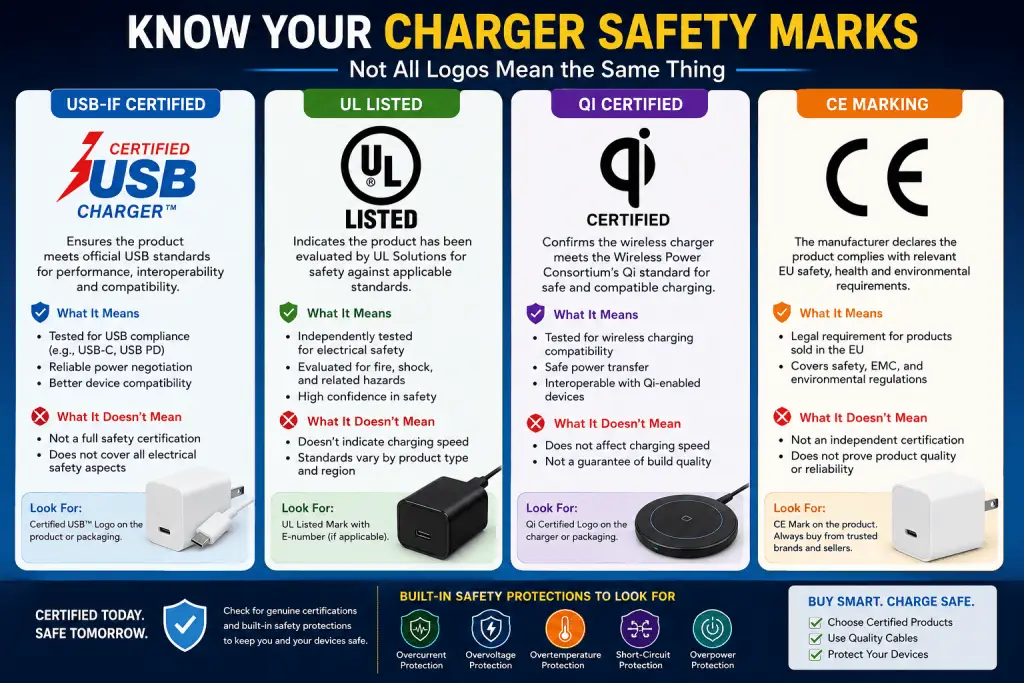
A UL mark indicates that the product met the requirements of the specific standard under which it was evaluated. It does not mean the charger is faster or universally better than every non-UL charger.
Why UL Listing Matters
Independent safety testing adds confidence that a charger has been evaluated beyond the manufacturer’s own claims.
Potential benefits include:
- Independent evaluation by a recognized safety organization
- Testing against applicable electrical safety standards
- Reduced risk of electrical hazards when the product is used as intended
- Greater confidence for consumers and retailers
Can You Trust Every UL Logo?
No.
Counterfeit products sometimes display fake certification marks. If you’re unsure, verify the product through the manufacturer’s official website or UL Solutions’ certification database when available.
Buying Tip
If a charger claims to be UL Listed but provides no documentation, no model number, and the manufacturer cannot verify the claim, treat it with caution.
Understanding CE Marking
CE marking is one of the most misunderstood symbols found on electronics.
Many shoppers assume it means a product has passed independent safety testing. That is not what CE marking represents.
The European Commission explains that affixing CE marking is the manufacturer’s declaration that the product meets applicable CE-marking legal requirements. It does not mean the EU or another authority has approved the product as safe. Requirements depend on the product and legislation that apply.
This distinction is important:
- CE marking is required by law for many products sold in Europe.
- It is not an independent third-party certification in itself.
Some products may involve a notified body depending on the applicable legislation, but for many chargers the manufacturer performs the conformity assessment and issues the declaration of conformity.
What CE Marking Does Tell You
A genuine CE mark indicates that the manufacturer declares the product meets applicable EU requirements.
It does not automatically confirm:
- Independent laboratory testing
- Premium quality
- Superior durability
- Better charging performance
Fake CE Marks
Unfortunately, counterfeit electronics sometimes display fake or misleading CE logos.
Buying from reputable brands and authorized retailers is one of the best ways to reduce this risk.
Qi Certification for Wireless Chargers
If you’re buying a wireless fast charger, one certification deserves special attention: Qi Certified.
Qi is the global wireless charging standard developed by the Wireless Power Consortium (WPC).
The WPC testing and certification guidance explains that a product must be Qi Certified before carrying the Qi logo. Certification covers the applicable wireless-charging requirements; verify the exact product through the database linked by the WPC.
Certification helps confirm that a wireless charger meets the relevant Qi specification and is designed to work correctly with compatible devices.
Why Qi Certification Matters
Wireless charging depends on precise communication between the charger and the device.
Poorly designed wireless chargers may experience issues such as:
- Inconsistent charging
- Reduced charging efficiency
- Excessive heat generation
- Compatibility problems
- Charging interruptions
Qi-certified products are tested for interoperability with supported devices, helping minimize these issues.
Should You Buy Only Qi-Certified Wireless Chargers?
Whenever practical, yes.
For wireless charging, Qi certification provides meaningful assurance that the charger follows the industry’s established standard.
USB Power Delivery (USB PD) Safety
USB Power Delivery (USB PD) is the fast charging protocol used by many modern smartphones, tablets, laptops, power banks, and USB-C accessories.
One of its biggest safety advantages is intelligent power negotiation.
Unlike older USB chargers that simply output a fixed voltage, USB PD allows the charger and connected device to communicate before higher power is delivered.
USB-IF describes USB PD as flexible power delivery that lets compatible devices negotiate their power needs. Available power still depends on the supported profiles of the charger, cable and device. Protocol support does not establish that every aspect of a product has passed independent electrical-safety testing.
This communication helps reduce the risk of applying an inappropriate voltage to a compatible USB PD device.
Benefits of USB PD Safety
- Intelligent power negotiation
- Dynamic voltage adjustment
- Automatic current management
- Broad compatibility across supported USB-C devices
- Power requirements negotiated between compatible devices
Does USB PD Prevent Every Problem?
No.
USB PD is designed with robust safety mechanisms, but the overall safety of the charging system also depends on:
- Charger quality
- USB-C cable quality
- Device design
- Proper implementation by the manufacturer
A poorly built charger or cable can still create problems even if it advertises USB PD support.
Essential Hardware Safety Features
Certifications are important, but they are only part of the picture.
A well-designed fast charger also includes multiple electronic protection systems that continuously monitor charging conditions.
Here are the features worth looking for.
Overcurrent Protection (OCP)
Overcurrent Protection limits the amount of electrical current flowing through the charger.
If the current exceeds a safe level because of a fault or abnormal condition, the charger reduces or interrupts power to help protect both itself and the connected device.
Overvoltage Protection (OVP)
Overvoltage Protection helps prevent the charger from delivering voltage beyond its intended operating range.
Without this safeguard, excessive voltage could damage sensitive electronic components.
Overtemperature Protection (OTP)
Fast charging naturally generates heat.
Quality chargers monitor internal temperatures and automatically reduce power output or stop charging if temperatures become too high.
This feature is especially important for compact, high-wattage GaN chargers.
Short-Circuit Protection (SCP)
Short-Circuit Protection detects abnormal electrical connections and rapidly shuts down power to reduce the risk of damage.
Although short circuits are uncommon during normal use, this protection is considered an essential safety feature.
Overpower Protection (OPP)
Some premium chargers include Overpower Protection.
If the charger is pushed beyond its designed power output, it limits or stops output to prevent overheating or internal damage.
Surge Protection
Electrical surges from unstable power sources can damage electronic devices.
While home surge protectors provide the first line of defense, some chargers also include circuitry that helps tolerate brief voltage spikes within their design limits.
Intelligent Temperature Monitoring
Modern fast chargers often include temperature sensors that continuously monitor internal components.
Instead of waiting for the charger to overheat, these systems can gradually reduce charging speed to maintain safer operating temperatures.
This approach helps balance charging performance with long-term reliability.
Comparison Table: Common Charger Safety Marks
| Mark | Type | Who Issues It? | What It Indicates | What It Does Not Guarantee |
|---|---|---|---|---|
| USB-IF Certified | Industry certification | USB Implementers Forum | Compliance with applicable USB specifications and interoperability | Overall product quality, durability, or electrical safety beyond the certification scope |
| UL Listed | Independent safety certification | UL Solutions | Evaluation against applicable electrical safety standards | Faster charging, better performance, or broader compatibility |
| CE Marking | Regulatory conformity marking | Manufacturer declaration | Declares compliance with applicable EU legislation | Independent third-party certification or superior product quality |
| Qi Certified | Industry certification | Wireless Power Consortium | Compliance with Qi wireless charging specifications | Faster charging than every non-certified charger or premium build quality |
How to Verify a Charger’s Safety Claims
Not every charger that claims to be “certified” has actually been evaluated by an independent organization. Some manufacturers use vague terms such as premium certified, advanced safety, or military-grade protection without explaining what those claims mean.
Before buying a fast charger, spend a few minutes verifying the information.
1. Check the Manufacturer’s Website
A reputable manufacturer usually publishes detailed product specifications, including:
- Supported charging standards (USB PD, PPS, QC, etc.)
- Safety features
- Certification information
- Model number
- Warranty details
If a product page provides little more than marketing slogans, proceed with caution.
2. Look for Official Certification Logos
Don’t rely solely on product photos.
Instead, check whether the manufacturer explicitly states certifications such as:
- USB-IF Certified (where applicable)
- UL Listed or UL Certified (if applicable)
- Qi Certified (for wireless chargers)
If the certification is important to you, verify it through the relevant organization’s database when available.
3. Verify the Brand
Established brands generally have stronger quality control and are more transparent about testing and certifications.
Well-known manufacturers in the charging accessories market include:
- Anker
- Belkin
- UGREEN
- Baseus
- Apple’s official chargers
- Samsung official chargers
- Google official chargers
This does not mean every product from these brands is automatically certified. Always check the specifications for the exact model.
4. Read the Product Label
A legitimate charger should clearly display information such as:
- Model number
- Input voltage
- Output voltage and current
- Maximum power rating
- Manufacturer details
- Applicable regulatory markings
Missing or poorly printed labels can be a warning sign.
5. Be Skeptical of Unrealistic Claims
Marketing phrases like these should raise questions:
- “200W charging for every phone”
- “Universal super fast charging”
- “100% safe guaranteed”
- “Military-grade safety”
- “Official certified technology” (without naming the certification)
Credible manufacturers explain which standards a charger supports and which certifications it has.
Buying Advice
Choosing a safe fast charger doesn’t have to be complicated. Focus on the features that genuinely matter instead of marketing buzzwords.
What Matters
Buy from Reputable Brands
Brands with established customer support, published documentation, and transparent specifications are generally a safer choice than unknown manufacturers.
Match the Charger to Your Device
Buying a 100W charger for a phone that only supports 25W charging won’t make it charge faster.
Instead, choose a charger that matches your device’s supported charging standard and maximum charging speed.
Even the safest charger cannot compensate for a poorly made cable.
Use a Quality USB-C Cable
For higher-power USB Power Delivery charging, use a cable rated for the required power and data specifications. USB-IF certified cables, where available, provide additional confidence in compatibility.
Consider Future Devices
If you plan to charge a tablet or laptop later, purchasing a higher-quality multi-port USB PD charger may be worthwhile, provided it matches your current and future needs.
What Doesn’t Matter
Many shoppers pay attention to features that sound impressive but rarely affect real-world safety.
Examples include:
- Fancy LED lighting
- Gaming branding
- Luxury packaging
- Extreme wattage you will never use
- Inflated marketing claims
These features don’t necessarily indicate a safer or better charger.
How to Compare Fast Chargers
When evaluating two chargers, compare the following factors:
| Feature | Why It Matters |
|---|---|
| USB PD support | Enables standardized fast charging for compatible devices |
| USB-IF certification | Indicates compliance with applicable USB specifications |
| UL Listing (where applicable) | Adds confidence through independent safety evaluation |
| Qi certification | Important for wireless chargers |
| Protection features | Helps guard against electrical faults |
| Build quality | Better materials can improve durability and thermal performance |
| Manufacturer support | Easier access to firmware updates, warranty, and customer service |
How to Avoid Marketing Tricks
Fast charger packaging often emphasizes speed while downplaying meaningful technical information.
Watch out for these common tactics.
Confusing “Fast Charging” with Safety
A charger can be fast but poorly designed.
Charging speed and electrical safety are separate considerations.
Using Generic Certification Language
If the packaging simply says “Certified” without naming the organization, ask:
Certified by whom?
If the answer isn’t clear, treat the claim cautiously.
Highlighting Maximum Wattage
The largest number on the box is often the most visible.
However, a higher wattage rating only benefits devices that can actually use that power.
Copying Premium Brand Designs
Counterfeit chargers sometimes imitate the appearance of well-known products.
Purchase from trusted retailers and verify the packaging and model number when possible.
Common Mistakes Buyers Make
Avoid these common errors when choosing a fast charger.
Buying the Cheapest Option
An unusually low price may reflect compromises in materials, quality control, or safety testing.
Ignoring the Cable
A damaged or low-quality cable can reduce charging performance and reliability, even when paired with a high-quality charger.
Assuming Every USB-C Charger Is the Same
USB-C is a connector type, not a guarantee of charging speed, protocol support, or safety.
Trusting Every Online Review
Some online reviews focus only on charging speed and overlook build quality, certifications, and long-term reliability.
Whenever possible, verify technical claims using official documentation.
Believing Every Logo
Not every symbol printed on a charger represents an official certification.
Understanding the difference between certifications, regulatory markings, and marketing graphics helps you make a more informed purchase.
Final Recommendation
A safe fast charger is more than a high wattage number or attractive packaging.
The best choices combine recognized standards, transparent documentation, robust safety protections, and a proven track record from reputable manufacturers.
When comparing chargers, prioritize:
- Support for the correct charging standard (such as USB PD)
- Relevant certifications where applicable
- Essential protection circuits
- High-quality USB-C cables
- Trusted manufacturers with clear technical documentation
Remember that no single logo guarantees a perfect product. The safest decision comes from evaluating the complete package rather than relying on one certification or marketing claim.
Frequently Asked Questions
Is CE marking the same as a safety certification?
No. CE marking is the manufacturer’s declaration that the product complies with applicable European Union requirements. It is not, by itself, an independently issued certification.
Does USB-IF certification mean a charger is completely safe?
USB-IF certification confirms compliance with applicable USB specifications and interoperability requirements. It does not evaluate every aspect of electrical safety, build quality, or durability.
Are expensive chargers always safer?
Not necessarily. Price alone does not determine safety. Look for transparent specifications, recognized certifications where applicable, built-in protection features, and reputable manufacturers.
Should I replace an old fast charger?
If your charger is physically damaged, overheats during normal use, has loose connectors, or no longer charges devices reliably, replacing it is generally the safer choice.
Do I need a USB-IF certified cable as well?
A quality cable is just as important as the charger. For USB-C Power Delivery, using a cable that meets the required specifications helps ensure reliable charging and compatibility. USB-IF certified cables can provide additional assurance where available.
Can a charger damage my phone battery?
Modern smartphones include battery management systems that regulate charging. However, poorly designed or defective chargers may still pose safety or reliability risks. Using a reputable charger and cable helps reduce those risks.
Official sources
For the certification distinctions in this article, see the linked USB-IF Compliance Program, USB PD overview, UL power-supply certification guidance, European Commission CE-marking explanation and WPC testing and certification pages. These explain the programs; they do not certify any particular charger recommended elsewhere on BuyZivo. Always verify the exact model.
Conclusion
Fast charging should never come at the expense of safety.
Understanding fast charger safety certifications allows you to separate meaningful technical standards from marketing language. USB-IF certification, UL Listing, Qi certification, and well-designed protection circuits each serve different purposes, while CE marking indicates regulatory conformity rather than independent certification.
The safest approach is to buy from reputable manufacturers, verify product specifications, use quality USB-C cables, and avoid chargers that make vague or unverifiable claims. A few extra minutes of research can help you choose a charger that delivers reliable performance while protecting your devices over the long term.
Next step: Explore BuyZivo’s related charging guides to learn how to choose the right charger, cable, and power bank for your devices.