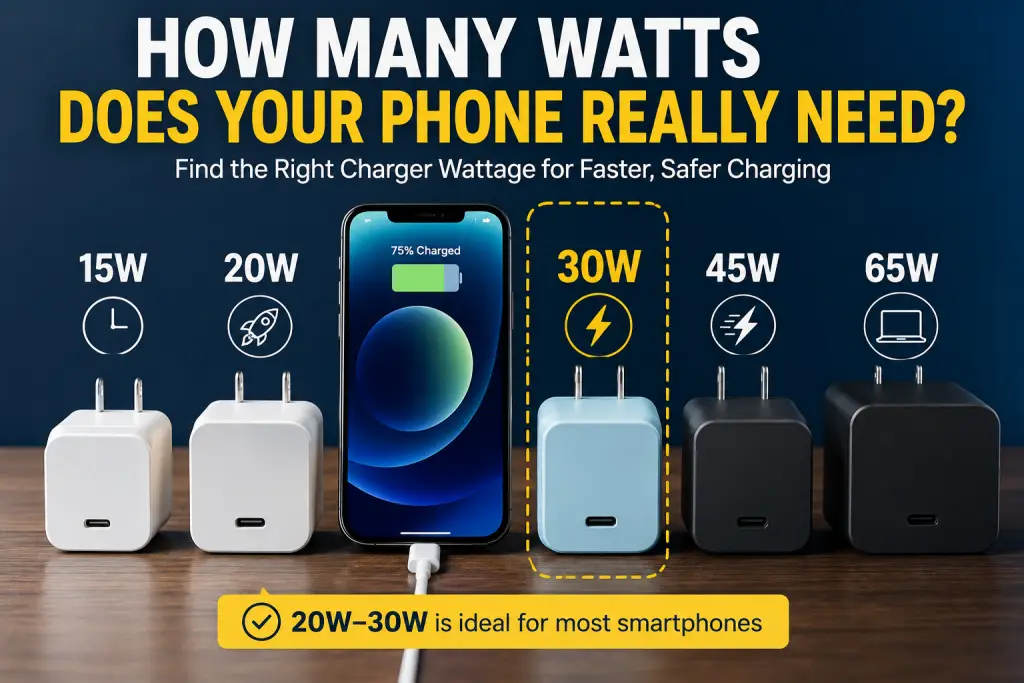
Choosing a phone charger should be simple, but wattage labels can make it confusing. One charger says 20W, another says 45W, and a compact laptop charger may advertise 65W or more.
So, How Many Watts Does Your Phone Really Need?
For most modern smartphones, a good-quality 20W to 30W USB-C charger is the most practical choice. However, the correct wattage depends on your phone’s charging limit, the charging protocol it supports, and the cable you use.
A higher number on the charger does not automatically mean your phone will charge faster. A 65W charger may work perfectly with a phone that accepts only 25W, but the phone will normally charge at no more than its supported rate.
This guide explains how to find the right wattage without overspending or choosing an incompatible charger.
Quick Answer
Here is a practical starting point:
User or device type Suggested charger wattage Older or basic phone 10W–18W Recent iPhone or mainstream Android phone 20W–30W Samsung phone supporting Super Fast Charging 25W or 45W, depending on the model Google Pixel phone Usually a 30W or higher USB PD PPS charger Phone with manufacturer-specific fast charging Match the brand’s required protocol and wattage One charger for a phone, tablet, and laptop 65W or higher multi-port USB-C charger These are buying ranges, not universal charging limits. Always verify the charging specifications for your exact phone model.
What Does Charger Wattage Mean?
A charger’s wattage tells you the maximum electrical power it can provide under supported conditions.
Watts are calculated using:
Watts = Volts × Amps
For example, a charging profile that provides 9 volts at 3 amps can deliver up to 27 watts.
However, the wattage printed on a charger is its maximum output, not a guarantee that every connected phone will receive that amount. The actual charging power depends on the charger, phone, cable, charging protocol, battery level, temperature, and current phone usage.
USB Power Delivery, commonly called USB PD, allows compatible USB-C devices and chargers to select an appropriate charging profile. The current USB PD specification supports power levels far beyond what most phones require, including up to 240W for suitable devices and cables.[1]
That does not mean a phone receives 240W. It means USB-C Power Delivery can support a wide range of products, from phones to high-performance laptops.
How Many Watts Charger Do I Need for My Phone?
The best charger is usually one that can meet or slightly exceed your phone’s maximum supported charging requirement while supporting the correct protocol.
10W to 18W: Suitable for Basic or Overnight Charging
A 10W to 18W charger can be enough when:
- You have an older phone.
- You mainly charge overnight.
- Charging speed is not important.
- Your phone does not support newer fast-charging standards.
The disadvantage is speed. Apple, for example, classifies lower-output wired charging as slower on supported iPhones, and recent models generally need a compatible USB-C Power Delivery adapter for faster charging.
An older USB-A charger may still charge a newer phone, but it may not deliver the phone’s best available charging speed.
20W: A Practical Minimum for Many Modern Phones
A good 20W USB-C Power Delivery charger is suitable for many current phones, particularly users who charge one device at a time.
Apple states that compatible iPhones can fast-charge with an appropriate USB-C adapter. The exact requirement and advertised charging time depend on the iPhone model.
A 20W charger is a sensible choice when:
- You use a compatible iPhone.
- Your Android phone supports approximately 18W to 20W charging.
- You want a small, affordable charger.
- You do not need to charge tablets or laptops.
Its main limitation is flexibility. Some newer Android phones and selected newer iPhones may benefit from more than 20W.
25W to 30W: The Best Range for Most Phone Buyers
For many people, 25W to 30W is the most balanced range.
It offers enough capacity for many modern phones without the extra size or cost of a much larger charger. It is also easier to reuse with earbuds, power banks, and smaller tablets.
Samsung’s 25W Super Fast Charging system is based on USB Power Delivery, while Google recommends USB PD and PPS-compatible power adapters for fast charging supported Pixel models.
Choose a 25W to 30W charger when:
- You own a recent Google Pixel.
- Your Samsung phone supports 25W charging.
- You want one compact charger for different phone brands.
- You want some capacity above a basic 20W charger.
- You plan to keep the charger after upgrading your phone.
Protocol support remains important. A generic 30W charger that lacks the profile required by your phone may not deliver the phone’s highest supported speed.
40W to 45W: Useful for Selected Fast-Charging Phones
A 40W or 45W charger makes sense when your exact phone model supports charging in that range.
Selected Samsung Galaxy models, for example, support 45W Super Fast Charging. Samsung specifies that the charger and cable must support the required charging mode, and its 45W setup may require a 5A USB-C cable.
A 45W charger may also be worthwhile if:
- You charge a compatible tablet.
- You want one charger for your phone and another small USB-C device.
- Your phone manufacturer specifically recommends 40W or 45W.
- You are buying a multi-port charger and need spare output capacity.
Do not assume every flagship phone supports 45W. Some models from the same brand may be limited to 25W or another rate.
65W and Above: Usually More Than a Phone Alone Needs
A 65W charger is normally unnecessary when it will only be used with one ordinary smartphone.
However, it can be a smart purchase when:
- You also charge a USB-C laptop.
- You charge a phone and tablet from one adapter.
- You want several USB-C ports.
- You frequently travel and prefer one charger.
- Your phone uses a proprietary system requiring unusually high power.
Check how a multi-port charger divides its output. A charger advertised as 65W may provide the full 65W through one port only. When two or three devices are connected, each port may receive less.
Why Charging Protocols Matter More Than the Printed Wattage
Wattage is only one part of compatibility.
Common charging technologies include:
- USB Power Delivery
- USB PD PPS, or Programmable Power Supply
- Qualcomm Quick Charge
- Manufacturer-specific fast-charging systems
USB Power Delivery
USB PD is a broadly used charging standard for USB-C devices. It supports multiple voltage and current profiles, allowing compatible products to select an appropriate power level.
For a general-purpose phone charger, USB PD support is more useful than a high wattage number with no clear protocol information.
USB PD PPS
PPS allows compatible chargers to adjust voltage and current more precisely during charging.
Google lists PPS adapters rated at 30W or more among the recommended options for supported Pixel phones. Samsung also uses USB PD-based charging for its Super Fast Charging system.
For recent Pixel or Samsung models, choosing a USB PD PPS charger is often safer than assuming any charger with the correct wattage will provide the expected fast-charging mode.
Proprietary Fast Charging
Some Android manufacturers use brand-specific charging systems. These may require:
- A compatible branded or licensed adapter
- A specific cable
- A particular voltage and current profile
- Support built into the phone
A standard USB PD charger may still charge such a phone, but possibly at a lower speed.
Check the official specifications or support documentation for your exact model. Do not rely only on a retailer’s claim that a charger is “universally fast.”
Will a Higher-Wattage Charger Damage My Phone?
A compatible, properly made higher-wattage charger should not force its full rated output into the phone.
For example, connecting a phone that supports 25W charging to a compatible 65W USB-C PD charger does not normally make the phone accept 65W. The phone, charger, and cable work within mutually supported charging conditions.
Qualcomm similarly explains that device manufacturers design phones and batteries for specific charging levels. A Quick Charge adapter can also charge a non-Quick Charge device, but the special fast-charging benefits may not be available.
The larger concern is not excess advertised wattage by itself. More practical risks include:
- Poorly made or counterfeit chargers
- Missing safety protections
- Damaged plugs or cables
- Unsupported charging protocols
- Excessive heat
- Moisture or debris in the charging port
- Misleading certification claims
Choose products from identifiable manufacturers, check applicable regional safety information, and avoid adapters with unclear specifications.
Charging Speed Is Not Constant: How Many Watts Does Your Phone Really Need
A phone does not usually charge at its maximum supported wattage from 0% to 100%.
Charging power may decrease as the battery fills. Temperature can also cause a phone to reduce or pause charging. Apple documents that compatible iPhones charge more quickly during the earlier portion of charging and slow down later to manage heat and battery stress.
Samsung similarly advises that very high or low temperatures can slow charging.
Real-world charging can also be slower when:
- You are gaming while charging.
- The screen remains bright.
- You are recording video.
- The phone is performing updates.
- The charger is powering several devices.
- The battery or phone is too warm.
- The charging port or connector is damaged.
This is why a 30W charger does not necessarily deliver exactly 30W throughout the entire session.
Do You Need a Special Cable?
Possibly.
The cable must support the connection, current, and charging standard required by the phone and charger. A weak, damaged, or incompatible cable can prevent fast charging even when the adapter has enough wattage.
Pay particular attention when buying:
- A 45W Samsung charger requiring a 5A cable
- A USB-C laptop charger above standard phone power levels
- A charger with more than 60W output
- A long or very thin cable
- A cable with no stated power rating
Samsung’s documentation for 45W Super Fast Charging specifically identifies the need for a suitable 5A cable in supported setups.
For normal 20W to 30W phone charging, a properly specified USB-C cable from a reputable manufacturer is usually sufficient. Still, confirm the cable rating rather than judging it by appearance.
Common Charger-Buying Mistakes
Buying the Highest Wattage Available
A 100W charger will not make a 20W phone charge at 100W. Extra wattage is useful only if you need additional ports, laptop compatibility, or future flexibility.
Ignoring the Charging Protocol
A charger may advertise 45W but fail to activate your phone’s fastest charging mode because it lacks USB PD PPS or the required proprietary protocol.
Reusing an Inadequate Cable
The charger and phone may be compatible, but the cable can still restrict charging.
Assuming Every Model From a Brand Charges the Same Way
Charging capability can vary between standard, Plus, Pro, Ultra, Fold, and budget versions of a phone.
Expecting Maximum Speed Near 100%
Charging normally slows as the battery fills. A charger may be working correctly even when the final 10% to 20% takes longer.
Choosing Only by Size or Price
Very small chargers can be convenient, but output distribution, temperature management, protocol support, plug quality, and warranty also matter.
Practical Charger Decision Framework
Before buying, follow these steps.
Step 1: Check Your Phone’s Official Charging Information
Look at the manufacturer’s product specifications or support page. Search for:
- Maximum wired charging power
- Recommended adapter wattage
- USB PD support
- PPS support
- Proprietary charging requirements
- Required cable rating
Step 2: Match the Protocol
Choose the charging technology before focusing on the maximum wattage.
For example, a 30W USB PD PPS charger may be more useful for a compatible Pixel or Samsung phone than a 45W charger that does not support PPS.
Step 3: Select Enough Wattage
Choose a charger that meets or slightly exceeds the phone’s requirement.
- Phone supports 20W: choose 20W or 30W.
- Phone supports 25W: choose 25W or 30W with the correct protocol.
- Phone supports 45W: choose a compatible 45W charger and cable.
- Phone and laptop use the same charger: consider 65W or more.
Step 4: Consider How Many Devices You Charge
For one phone, a single-port adapter is usually enough.
For a phone, watch, earbuds, tablet, or laptop, a multi-port charger may reduce clutter. Check the per-port wattage and output distribution when all ports are in use.
Step 5: Verify the Cable and Safety Information
Confirm the cable’s supported power, connector type, and charging protocol. Buy from a seller with clear product details, warranty information, and a reasonable return policy.
Final Recommendation
For most buyers asking how many watts charger do I need, the practical answer is:
Choose a reputable 25W to 30W USB-C Power Delivery charger with PPS support, unless your phone’s manufacturer specifies something different.
Choose 20W if you use a compatible phone with modest charging requirements and want a small, inexpensive adapter.
Choose 45W when your phone officially supports it, and you have the required cable.
Choose 65W or more when the charger will also power a tablet, laptop, or several devices. Do not buy extra wattage solely because you expect it to override your phone’s charging limit.
The correct charging protocol and cable are just as important as the number printed on the charger.
Frequently Asked Questions
Can I use a 65W charger with a 25W phone?
A compatible 65W USB-C PD charger can normally be used with a phone that accepts 25W. The phone should draw only a mutually supported amount of power. It will not automatically charge at 65W.
Is a 20W charger enough for an iPhone?
A 20W USB-C Power Delivery charger is suitable for fast charging many iPhone models. However, newer models may support faster charging with a higher-output adapter. Check Apple’s current charging guidance for your exact model.
Is a 30W charger better than a 20W charger?
A 30W charger is more flexible and may charge a compatible phone faster. It will not provide a meaningful speed improvement when the phone cannot accept more than 20W.
Does fast charging damage the battery?
Fast charging creates more demanding thermal conditions than very slow charging, but compatible phones include charging controls designed for their supported power levels. Heat remains an important factor, so avoid charging in very hot environments and stop using damaged or unusually hot charging equipment.
Why is my phone charging slowly with a powerful charger?
Possible causes include an incompatible charging protocol, an inadequate cable, high temperature, heavy phone use, a nearly full battery, power sharing between charger ports, or dirt and moisture in the charging port.
How can I find my phone’s maximum charging wattage?
Check the official technical specifications, support documentation, or charger recommendation for the exact model. Retail listings and unofficial specification websites may contain errors, so confirm important compatibility details with the manufacturer.
Conclusion: How Many Watts Does Your Phone Really Need
Charger wattage is not a simple case of “more is better.” Your phone has a charging limit, and reaching its best available speed requires the correct charger, protocol, cable, temperature, and operating conditions.
For most modern phones, 20W to 30W is enough. Selected models benefit from 40W or 45W, while 65W and higher chargers make more sense for multi-device or laptop use.
Check your phone’s official specifications first. Then buy enough compatible wattage for your actual needs instead of paying for capacity your phone cannot use.