Introduction
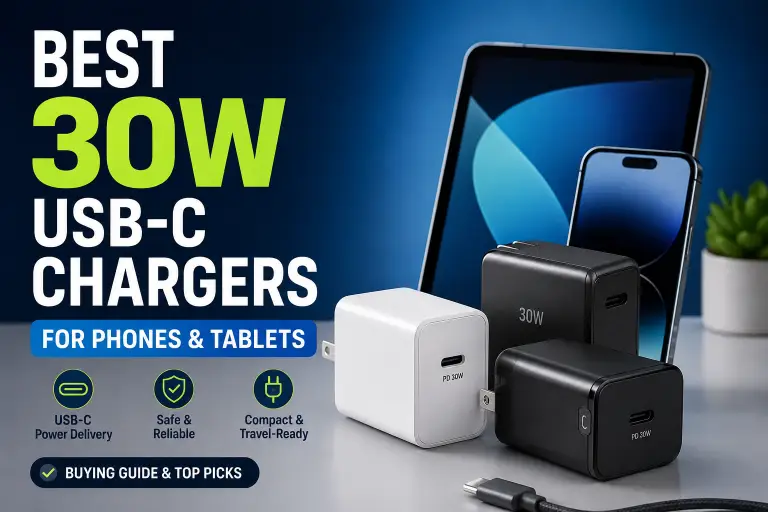
A 30W USB-C charger remains one of the most useful compact charging options for phones, tablets, earbuds, and other everyday USB-C devices. But buying one based on wattage alone is a mistake.
USB Power Delivery support, PPS compatibility, the charger’s available voltage profiles, your device’s own charging limit, plug design, and size can matter more than the difference between two products that both say “30W.”
For most buyers, the Anker 511 Charger (Nano 3) 30W is our best all-around choice because it combines a compact design with 30W output and PPS support. The Belkin BoostCharge USB-C PD 3.0 PPS 30W is another particularly strong option for buyers who want clearly documented PD and PPS specifications.
Apple users who prefer a first-party accessory should consider the Apple 30W USB-C Power Adapter, while Pixel owners have a straightforward first-party option in the Google 30W USB-C Power Charger.
There is one important limitation: 30W is no longer enough to achieve Apple’s fastest advertised wired charging speed on the iPhone 17, iPhone 17 Pro, and iPhone 17 Pro Max. Apple specifies a 40W-or-higher adapter for its roughly 20-minute 50% fast-charge claim on those models.
Best 30W USB-C Chargers at a Glance
| Charger | Maximum Output | PPS | Ports | Best For |
|---|---|---|---|---|
| Anker 511 Charger (Nano 3) | 30W | Yes | 1 USB-C | Best overall |
| Belkin BoostCharge USB-C PD 3.0 PPS 30W | 30W | Yes | 1 USB-C | Broad phone compatibility |
| Google 30W USB-C Power Charger | 30W | Yes | 1 USB-C | Pixel users |
| UGREEN Nexode 30W | 30W | Supported fast-charging protocols | 1 USB-C | Compact GaN alternative |
| Apple 30W USB-C Power Adapter | 30W | Not advertised as a PPS charger | 1 USB-C | Apple-focused buyers |
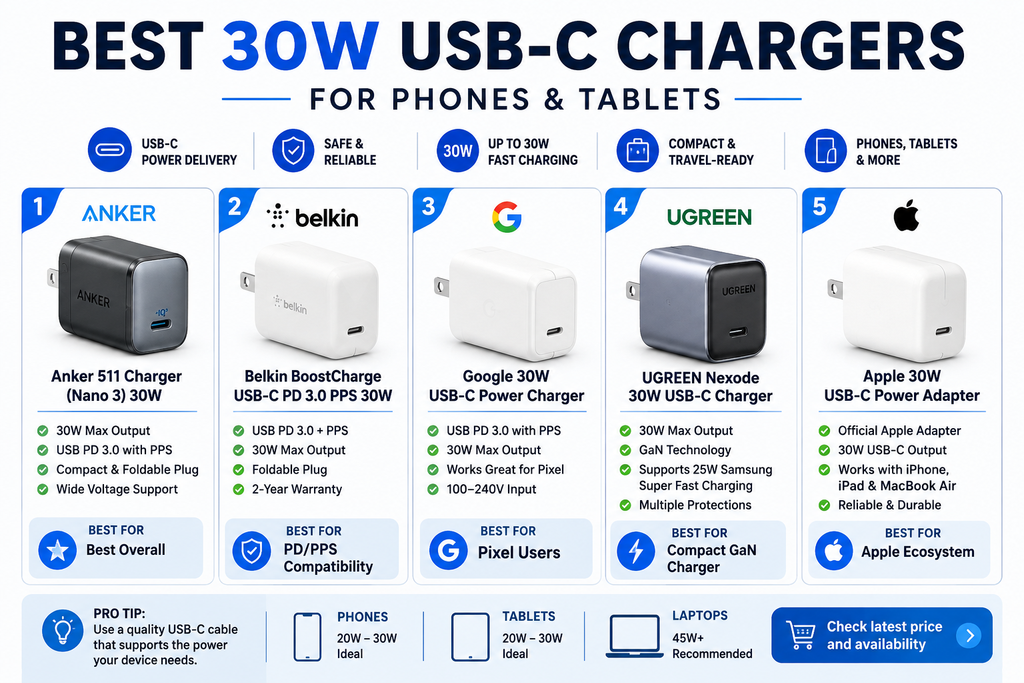
Prices and availability change, so compare the current listing and regional specifications before purchasing.
1. Anker 511 Charger (Nano 3) 30W — Best Overall
The Anker 511 Charger (Nano 3) gets the top recommendation because its documented charging profiles make it more versatile than a basic fixed-profile USB PD adapter.
Anker specifies outputs including:
- 5V/3A
- 9V/3A
- 15V/2A
- 20V/1.5A
- PPS up to 30W
That combination gives the charger a maximum output of 30W while adding PPS support for compatible devices.
The US version also uses a foldable plug, while Anker notes that plug construction differs for UK and EU variants.
Why we like it
- 30W maximum output
- USB-C
- PPS support
- Compact design
- Broad voltage range
- Suitable for phones, tablets, and other USB-C devices
Trade-offs
The single USB-C port means it cannot charge a phone and another accessory simultaneously. Buyers who regularly carry several devices may be better served by a multi-port 45W or 65W charger.
Best for
Buyers who want one small 30W PD/PPS charger for several different device brands.

2. Belkin BoostCharge USB-C PD 3.0 PPS 30W — Best PD/PPS Alternative
Belkin’s 30W USB-C PD 3.0 PPS charger is an excellent choice when transparent charging specifications are a priority.
Belkin documents the WCA005 with standard USB PD outputs of:
- 5V/3A — 15W
- 9V/3A — 27W
- 15V/2A — 30W
It also supports PPS, with programmable ranges extending up to 30W.
That makes it a particularly sensible choice for a mixed-device household where the charger may move between iPhones, Galaxy phones, tablets, and other USB-C hardware.
Why we like it
- USB PD support
- PPS support
- 30W maximum output
- Foldable plug on the documented model
- Two-year limited warranty listed by Belkin
- Clear manufacturer specifications
Trade-offs
It is still a single-port charger. If two-device charging matters more than minimum size, consider moving to a higher-powered dual-port model.
Best for
Buyers who value well-documented PD/PPS compatibility and a mainstream accessory brand.

3. Google 30W USB-C Power Charger — Best for Pixel Users
Google’s own 30W adapter is the simplest recommendation for buyers who want a first-party charger for Pixel and other USB-C devices.
Google specifies USB Power Delivery 3.0 with PPS, with these outputs:
- 20V/1.5A
- 15V/2A
- 5V or 9V/3A
- PPS ranges up to 30W
Maximum power is 30W.
That PPS support is important. Instead of treating “30W” as the entire specification, Pixel buyers should look for the charging protocol their device expects.
Google also lists 100–240V input, making the adapter electrically suitable for common international mains-voltage ranges when paired with the appropriate physical plug arrangement.
Why we like it
- First-party Google accessory
- USB PD 3.0
- PPS
- 30W maximum output
- Clearly documented electrical specifications
Trade-offs
It has only one USB-C port, and buyers outside Google Store markets may find third-party alternatives easier to purchase.
Best for
Pixel owners who prefer a straightforward first-party PD/PPS charger.

4. UGREEN Nexode 30W USB-C Charger — Best Compact GaN Alternative
The UGREEN Nexode 30W is another compact single-port option.
UGREEN advertises 30W output and a GaN-based design. The manufacturer also lists compatibility with a broad range of iPhones, Galaxy phones, Pixel devices, iPads, and other USB-C products.
UGREEN specifically advertises support for 25W Galaxy Super Fast Charging on this model, which makes it more interesting than a generic 30W adapter with poorly documented protocol support.
Why we like it
- 30W output
- Compact GaN design
- Single USB-C port
- Broad advertised device compatibility
- Manufacturer-listed protection features
Trade-offs
UGREEN’s regional product pages and SKUs can vary, so check the exact model and electrical specifications on the listing you intend to purchase rather than assuming every “Nexode 30W” listing is identical.
Best for
Buyers looking for a small GaN charger that can cover common phone and tablet charging duties.

5. Apple 30W USB-C Power Adapter — Best First-Party Apple Option
Apple’s 30W USB-C Power Adapter is the obvious first-party option for buyers who primarily use Apple hardware.
Apple lists it as compatible with numerous iPhone and iPad models and also recommends the adapter for several MacBook Air generations.
It is a simple one-port USB-C adapter without the multi-device features offered by larger chargers.
Why we like it
- First-party Apple accessory
- 30W USB-C output class
- Wide Apple-device compatibility
- Suitable for supported iPhones and iPads
- Can also serve compatible MacBook Air models
Trade-offs
Apple does not position this adapter as a PPS-focused Galaxy/Pixel charger, so buyers who regularly switch between ecosystems have more flexible alternatives.
There is another increasingly important limitation.
For the iPhone 17, iPhone 17 Pro, and iPhone 17 Pro Max, Apple now specifies a 40W-or-higher adapter to achieve its fastest advertised wired result of up to 50% in around 20 minutes.
A 30W charger can still be useful with those phones, but it is no longer the right choice if maximum wired charging speed is the goal.
Best for
Apple-focused users who want a genuine Apple USB-C power adapter rather than the smallest or most feature-rich third-party charger.

What Should Buyers Know About the Best 30W USB-C Charger?
The best 30W USB-C charger should support USB Power Delivery, provide the charging profiles required by your device, and ideally include PPS when you use compatible Samsung Galaxy, Google Pixel, or other PPS-based devices.
Do not assume that a phone will consume 30W simply because the charger can supply 30W. USB-C charging is negotiated between the charger and device, and the phone controls how much power it accepts.
For many phones and tablets, 30W is an excellent balance between size and charging capability. For devices designed around 40W, 45W, 65W, or higher charging, however, a 30W adapter can become the bottleneck.
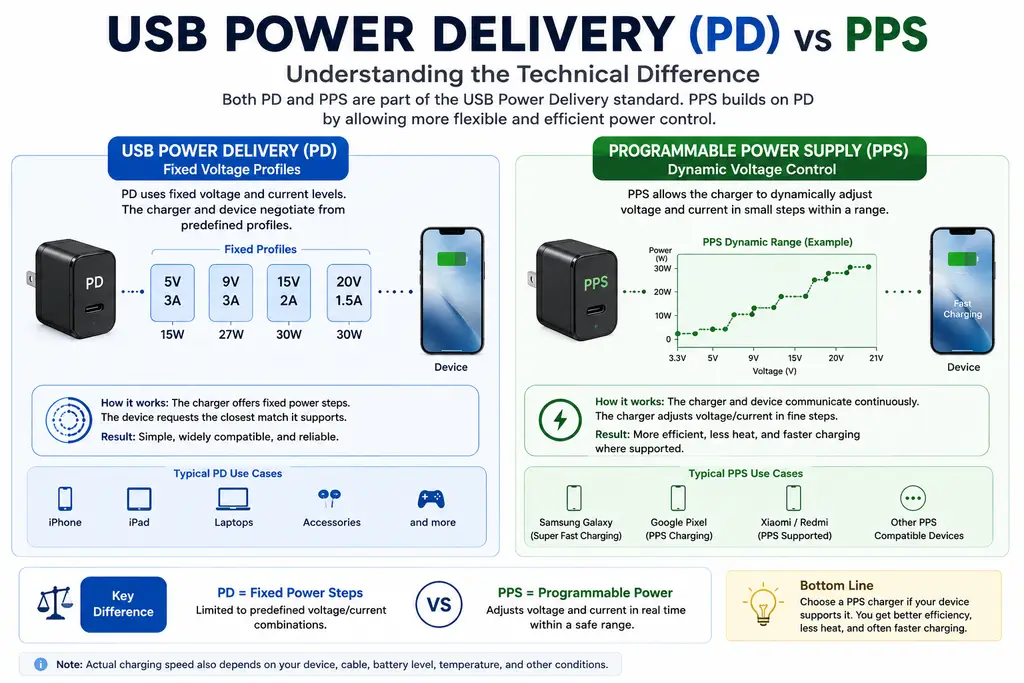
USB PD vs PPS: Why the Difference Matters
USB Power Delivery is the foundation of modern USB-C fast charging.
A compatible device and charger negotiate an appropriate voltage and current rather than forcing the charger to deliver its maximum rated wattage continuously.
PPS — Programmable Power Supply — adds finer voltage/current adjustment.
That matters particularly for devices whose fast-charging systems depend on PPS.
This is why two adapters labelled “30W USB-C” are not automatically equivalent.
One might provide conventional PD profiles only, while another provides both PD and PPS.
For buyers who switch among Apple, Samsung, and Google devices, PD + PPS is generally the more flexible specification to look for.
Is 30W Enough for an iPhone?
For many iPhones, yes.
Apple states that fast charging requires an appropriate USB-C Power Delivery adapter. However, the latest generation makes the answer more model-dependent.
The iPhone 17e and iPhone Air can reach Apple’s advertised 50% in around 30 minutes with a 20W-or-higher adapter.
The iPhone 17, iPhone 17 Pro, and iPhone 17 Pro Max, however, require a 40W-or-higher adapter for Apple’s faster approximately 20-minute 50% claim.
So if you’re buying specifically for an iPhone 17-series model that supports the higher charging rate, read:
>>20W vs 30W Charger: Which One Should You Choose?
and consider whether stepping above 30W makes more sense.
For older compatible iPhones, a quality 30W PD charger remains a practical choice.
Is a 30W Charger Good for Samsung Galaxy Phones?
It depends on the model and, importantly, PPS support.
Samsung’s Galaxy S25, for example, supports 25W Super Fast Charging, while the Galaxy S25+, S25 FE, and S25 Ultra support charging up to 45W according to Samsung’s current documentation.
That means a suitable 30W PPS charger can be a logical match for a 25W-class Galaxy phone, but it cannot replace a proper 45W solution when you want the maximum supported charging capability of a 45W Galaxy model.
For higher-power devices, see:
>>45W vs 65W Charger: Which Is Better?
Is 30W Enough for a Tablet?
Often, but not universally.
Apple lists its 30W USB-C Power Adapter as compatible with numerous iPad and iPad Pro models. Other USB-C tablets may also operate normally from a 30W PD charger.
The important distinction is between compatibility and maximum charging performance.
A tablet capable of accepting more than 30W may charge from a 30W adapter while taking longer than it would with an appropriately rated higher-power charger.
Check the tablet manufacturer’s recommended charging specification before purchasing solely on wattage.
What About Laptops?
A 30W charger can power or charge some low-power USB-C laptops, and Apple itself lists its 30W adapter for several MacBook Air models.
But that does not make 30W a universal laptop recommendation.
For a laptop, especially one used while charging, 45W, 65W, 100W, or more may be more appropriate.
If your charger needs to cover both a phone and a laptop, start here instead:
>>Best USB-C Cables for Fast Charging
How to Choose a 30W USB-C Charger
1. Look for USB Power Delivery
For modern USB-C devices, PD should be the baseline rather than an optional bonus.
2. Check PPS support
PPS becomes particularly relevant when buying for compatible Galaxy and Pixel devices.
Do not infer PPS support merely from “30W” or “PD” on a product title. Verify it in the manufacturer’s specifications.
3. Check your device’s maximum charging capability
Buying a 30W adapter for a 25W phone is very different from buying one for a device designed around 45W or 65W charging.
Higher charger wattage does not automatically force excessive power into a properly designed USB-C PD device. Compatible equipment negotiates charging requirements.
4. Don’t ignore the cable
The charger is only half of the connection.
Use a suitable USB-C cable from a reputable manufacturer and check its power capability when moving into higher-power charging categories.
See:
>>Best USB-C Cables for Fast Charging
5. Decide whether one port is enough
The biggest weakness of most ultra-compact 30W chargers is simple: one port.
If you routinely charge a phone, tablet, watch, earbuds, or power bank at the same time, carrying multiple 30W adapters makes little sense.
A compact multi-port 45W or 65W charger may be a better travel solution.
6. Treat safety claims carefully
Terms such as “safe charging” should not be confused with independent certification.
Manufacturer protection features, regulatory declarations, USB-IF compliance/certification, and independent safety certification are related but different concepts.
Look for transparent manufacturer documentation and applicable safety approvals for your market rather than relying on vague marketplace badges.
30W vs 20W: Is the Upgrade Worth It?
A 20W charger is sufficient for many phones, particularly devices that cannot meaningfully use additional power.
A 30W model becomes more attractive when you want:
- More headroom for compatible phones
- Better tablet flexibility
- PPS support on an appropriate model
- One charger for several USB-C device types
- Compatibility with certain low-power laptops
- More flexibility for accessories such as MagSafe charging
The correct choice depends on the device rather than the bigger number.
Read the full comparison:
>>20W vs 30W Charger: Which One Should You Choose?
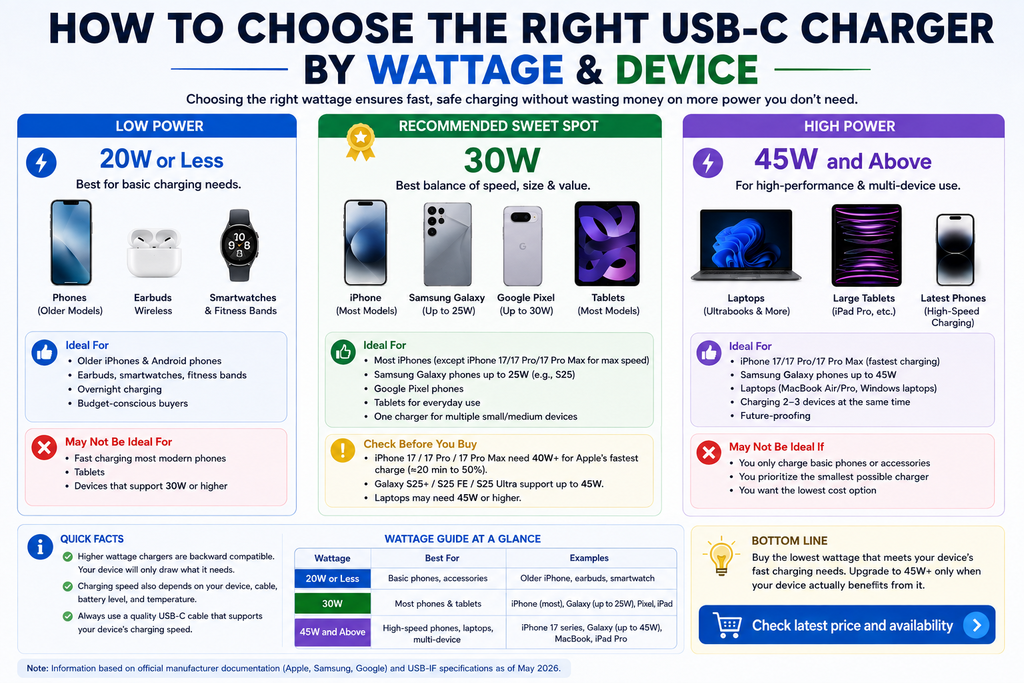
When You Should Buy 45W or 65W Instead
Skip the 30W category if your main device is designed to benefit substantially from more power.
A higher-wattage charger makes more sense for:
- iPhone 17/17 Pro/17 Pro Max owners seeking Apple’s fastest advertised wired charging
- Galaxy models supporting 45W charging
- USB-C laptops
- Larger tablets with higher charging requirements
- Multi-port charging
- Buyers who want more future headroom
A good 65W GaN charger can often replace separate phone, tablet, and laptop adapters.
FAQ
Is a 30W USB-C charger safe for a 20W phone?
With standards-compliant USB-C Power Delivery equipment, the device negotiates the power it requires. A 30W charger does not continuously force 30W into a phone simply because 30W is printed on the adapter.
Does a 30W charger charge every phone at 30W?
No. Charging speed depends on the phone’s charging limit, supported protocols, charger profiles, cable, battery level, temperature, and other conditions.
Do I need PPS?
Not for every device. However, PPS is worth prioritizing if you use compatible Samsung Galaxy or Google Pixel devices, and it makes a 30W charger more versatile across ecosystems.
Is 30W better than 20W for iPhone?
It depends on the iPhone. Many models can fast-charge perfectly well from a 20W-or-higher USB PD adapter. Newer models complicate the comparison: Apple’s iPhone 17, 17 Pro, and 17 Pro Max require 40W or higher for Apple’s fastest advertised wired charging result.
Can I charge an iPad with a 30W charger?
Yes, many iPads are compatible with 30W USB-C charging. Apple lists numerous iPad models as compatible with its 30W adapter. Actual charging performance depends on the particular iPad.
Can a 30W charger charge a laptop?
Some low-power USB-C laptops can use 30W, including MacBook Air models Apple lists as compatible with its 30W adapter. For broader laptop use, however, 45W or 65W is generally a more flexible category.
Final Verdict
For a phone-first charging setup, 30W remains one of the most practical compact USB-C charger classes.
Our best all-around recommendation is the Anker 511 Charger (Nano 3) 30W because its documented output profiles and PPS support give it broad usefulness without moving into a larger laptop-oriented charger.
The Belkin BoostCharge USB-C PD 3.0 PPS 30W is an excellent alternative with particularly clear PD/PPS documentation.
Choose the Google 30W USB-C Power Charger if you prefer a first-party Pixel solution, and the Apple 30W USB-C Power Adapter if your devices are predominantly from Apple.
But don’t buy 30W simply because it sounds like the ideal phone-charging number.
For a 25W-class Galaxy phone, a compatible 30W PPS charger can make excellent sense. For an iPhone 17-series model capable of Apple’s faster 40W-class charging, a 30W adapter is already below the maximum-speed tier. And for laptops or multi-device charging, 45W or 65W may be the smarter long-term purchase.
The best 30W USB-C charger is therefore not the one with the biggest compatibility list. It is the one whose PD/PPS capabilities actually match the devices you own.