Introduction
Buying the best charger for iPhone is no longer as simple as choosing any 20W USB-C adapter.
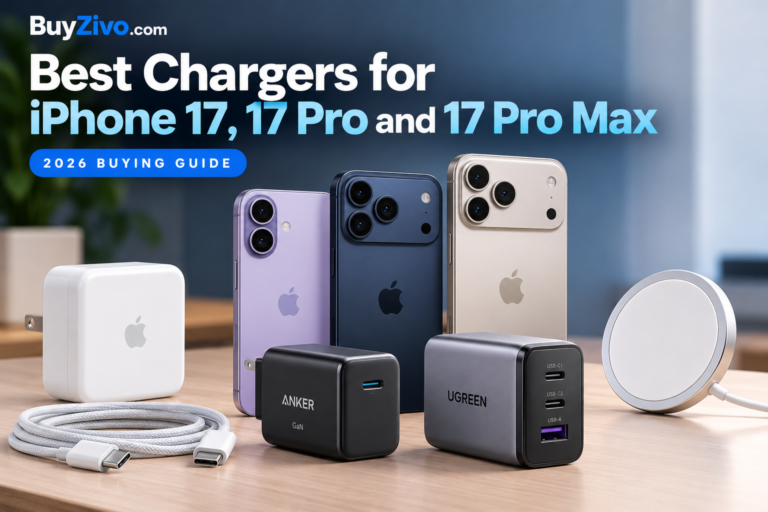
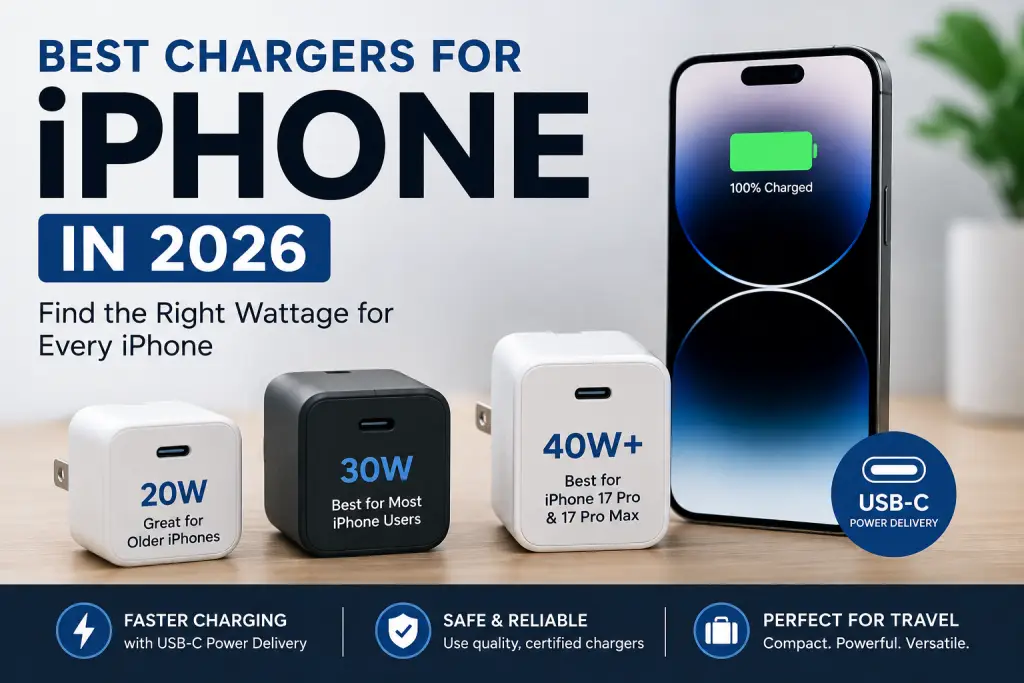
A 20W charger remains a practical choice for many older iPhones, but Apple’s newer models have changed the equation. The iPhone 17, iPhone 17 Pro, and iPhone 17 Pro Max can take advantage of a 40W-or-higher USB-C power adapter for Apple’s fastest stated wired charging performance. Meanwhile, a compact 30W charger remains an excellent middle ground for many iPhone owners, especially if you also charge an iPad, AirPods, or other USB-C devices.
The key is matching the charger to your iPhone rather than simply buying the adapter with the largest wattage number.
Our Recommended iPhone Chargers
| Charger | Output | Ports | Best for |
|---|---|---|---|
| Apple 40W Dynamic Power Adapter with 60W Max | 40W dynamic, up to 60W | 1 USB-C | iPhone 17/17 Pro users prioritizing speed |
| Anker Nano Charger (30W) | 30W | 1 USB-C | Best compact everyday option |
| Apple 20W USB-C Power Adapter | 20W | 1 USB-C | Simple option for many older iPhones |
| Apple 35W Dual USB-C Port Compact Power Adapter | 35W total | 2 USB-C | Charging two Apple devices |
| Belkin BoostCharge Dual Wall Charger 42W | 42W total | USB-C + USB-A | Mixed-device households |
These chargers serve different purposes. There is no reason to buy the highest-wattage option automatically.
1. Apple 40W Dynamic Power Adapter with 60W Max — Best for iPhone 17 and iPhone 17 Pro
Apple’s 40W Dynamic Power Adapter with 60W Max is the most straightforward recommendation for owners of the iPhone 17, iPhone 17 Pro, and iPhone 17 Pro Max who want Apple’s current fast-charging target.
Apple says the adapter can dynamically deliver up to 60W and specifically pairs it with the iPhone 17 series for fast charging. Apple states that compatible iPhone 17, 17 Pro, and 17 Pro Max models can reach up to 50% charge in around 20 minutes under its specified test conditions.
Why we recommend it
The biggest advantage is certainty. You do not have to interpret third-party specifications or wonder whether the adapter has enough output for Apple’s newer charging requirements.
It also provides more headroom than the traditional 20W iPhone charger, making it more useful for other USB-C devices.
Trade-offs
It is unnecessary if you own an older iPhone and simply want routine overnight charging. It also has only one USB-C port, and the charging cable is sold separately.
Best for: iPhone 17, 17 Pro, and 17 Pro Max owners who prioritize maximum supported wired charging performance.
Pros
- Designed by Apple
- Suitable for the newest higher-power iPhone charging requirements
- Up to 60W dynamic output
- Works with other USB-C devices
Cons
- Single port
- Cable sold separately
- More charger than many older iPhones require

2. Anker Nano Charger (30W) — Best Compact iPhone Charger
For buyers who prioritize portability, the Anker Nano Charger (30W) is one of the most balanced options.
Anker specifies a maximum 30W USB-C output and lists standard USB-C output profiles including 5V/3A, 9V/3A, 15V/2A, and 20V/1.5A. It also supports PPS.
Its dimensions are approximately 1.12 × 1.12 × 1.39 inches, making it particularly attractive for travel, office bags, or crowded power strips.
Why 30W makes sense
A 30W charger gives you useful headroom over a basic 20W adapter without moving into much larger laptop-class chargers.
It is particularly attractive if you use your charger with more than just an iPhone. Tablets, power banks, and other USB-C accessories may be able to make use of the additional output.
The important exception is the newest iPhone 17, 17 Pro, and 17 Pro Max. Apple’s stated approximately 20-minute 50% fast-charge target calls for a 40W-or-higher adapter, so a 30W charger should not be purchased specifically to achieve that target.
Best for: Most users who want a small, versatile USB-C charger rather than maximum iPhone 17-series charging performance.
Pros
- Very compact
- 30W USB-C output
- USB PD/PPS support
- Useful for multiple types of portable USB-C devices
Cons
- Only one USB-C port
- Not the choice for Apple’s fastest stated iPhone 17/17 Pro charging target
3. Apple 20W USB-C Power Adapter — Best Simple Charger for Older iPhones
Apple’s 20W USB-C Power Adapter remains relevant despite the arrival of higher-powered iPhones.
Apple says iPhone 8 and later models support fast charging when paired with an appropriate USB-C power source, although the precise charging capability varies by model.
For iPhone 15 and earlier, Apple also specifies a 20W-or-higher USB-C adapter for up to 15W charging with the appropriate MagSafe Charger.
Who should buy it?
The 20W Apple adapter makes sense when simplicity matters more than versatility.
If you own an older compatible iPhone and only need to charge your phone, paying extra for a substantially higher-output charger may provide little practical benefit.
It is also a sensible replacement for someone who specifically prefers an Apple-branded power adapter.
Where it falls short
A 20W charger provides limited headroom for larger USB-C devices and is not sufficient for Apple’s fastest stated charging target on the iPhone 17, iPhone 17 Pro, and iPhone 17 Pro Max.
Best for: Older iPhones, straightforward phone charging, and buyers who prefer an Apple-branded adapter.
Pros
- Simple single-device solution
- Apple-branded
- Supports fast charging on compatible iPhones
- Widely compatible across Apple’s iPhone lineup
Cons
- Limited output compared with 30W–40W alternatives
- Single USB-C port
- Less useful for higher-power devices
4. Apple 35W Dual USB-C Port Compact Power Adapter — Best for Two Apple Devices
Many people do not need more charging bricks. They need fewer.
Apple’s 35W Dual USB-C Port Compact Power Adapter gives you two USB-C connections from one wall outlet. That makes it useful for combinations such as an iPhone and Apple Watch, iPhone and AirPods, or iPhone and another small USB-C device.
The important detail is that the adapter’s available power is shared when two devices are connected.
That distinction matters because a label such as “35W” does not mean that every connected device receives 35W simultaneously.
Why choose it?
Its biggest advantage is convenience rather than maximum iPhone charging speed.
For a nightstand or travel kit, replacing two individual adapters with one dual-port charger can be more useful than chasing the fastest possible charging time.
Trade-offs
Power sharing makes it less appropriate when maximum charging performance for one demanding device is the priority.
Best for: Apple users regularly charging two devices from one outlet.
Pros
- Two USB-C ports
- Convenient for iPhone plus accessories
- Compact design
- Reduces the number of wall adapters needed
Cons
- Power is shared between connected devices
- Not intended primarily for maximum iPhone 17 Pro charging performance
5. Belkin BoostCharge Dual Wall Charger 42W — Best USB-C + USB-A Option
Not every household has moved completely to USB-C.
The Belkin BoostCharge Dual Wall Charger 42W combines a USB-C port capable of up to 30W with a USB-A port capable of up to 12W, for up to 42W total output.
Belkin specifies USB-C PD 3.0 and PPS support. The manufacturer also lists compatibility with numerous iPhone generations, including current models.
This combination makes the charger particularly useful when you have a modern USB-C iPhone cable but still own an Apple Watch cable, accessory, or another device that uses USB-A.
The key limitation
The 42W number is the charger’s combined output.
Its USB-C port itself is rated for up to 30W. Therefore, it should not be confused with a single-port 40W+ charger intended to meet Apple’s fastest stated charging target for iPhone 17, 17 Pro, or 17 Pro Max.
Best for: Users who still need both USB-C and USB-A.
Pros
- USB-C plus USB-A
- 30W maximum USB-C output
- USB PD 3.0 and PPS
- Useful for mixed old and new charging accessories
Cons
- 42W is combined output, not 42W from USB-C
- Larger than some single-port chargers
- Not ideal if maximum iPhone 17-series speed is your priority
How Much Wattage Does an iPhone Charger Need?
This is where buying advice has changed.
For years, 20W was the easy recommendation for iPhone fast charging. It is still useful, but it is no longer the universal answer.
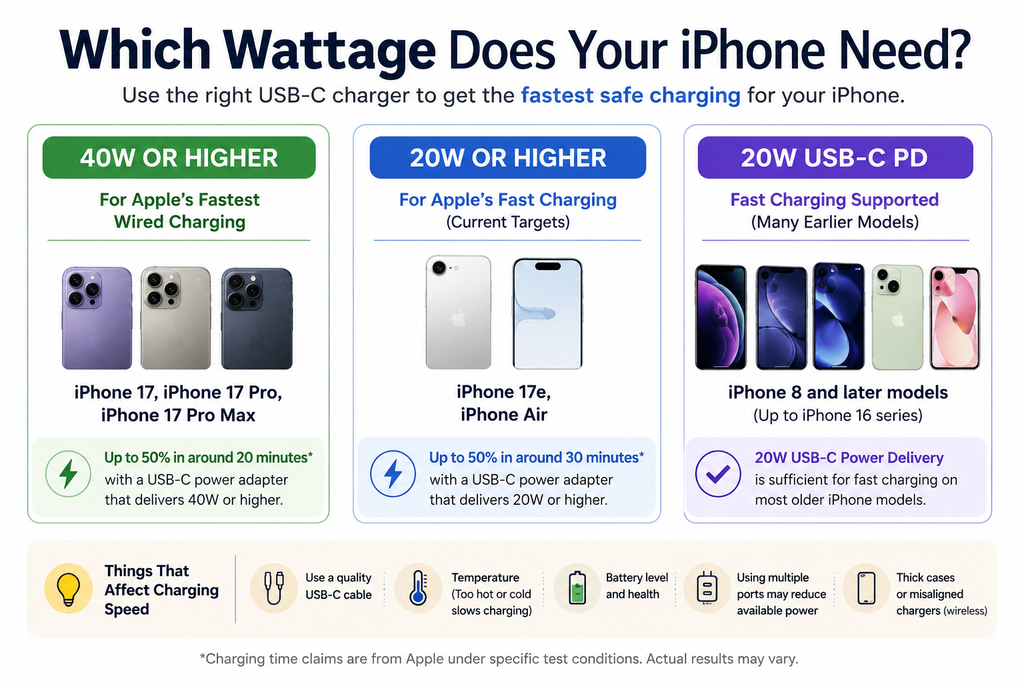
Apple currently states that iPhone 8 and later support fast charging with an appropriate USB-C power source. For iPhone 15 and later, wired charging uses USB-C; earlier fast-charge-capable iPhones use a USB-C-to-Lightning cable.
For the newest generation, the requirements differ further:
- iPhone 17e and iPhone Air: Apple specifies 20W or higher for its stated fast-charge target.
- iPhone 17, iPhone 17 Pro, iPhone 17 Pro Max: Apple specifies 40W or higher for charging to approximately 50% in around 20 minutes.
- Many earlier iPhones: 20W USB-C PD remains sufficient for fast charging, although exact performance varies by model.
This is why shopping only by wattage can be misleading.
Is a 30W Charger Better Than a 20W Charger for iPhone?
Sometimes—but not because your iPhone is forced to absorb 30W.
USB Power Delivery allows the charger and device to negotiate appropriate power. Using a higher-capacity compliant USB-C charger does not mean the charger continuously pushes its full rated wattage into the phone.
A 30W charger is particularly worthwhile when:
- You want one charger for your iPhone and other USB-C devices.
- You frequently travel.
- You may upgrade devices later.
- The size and price difference from a 20W charger is small.
A 20W charger remains perfectly reasonable when your iPhone does not benefit meaningfully from more power and you only intend to charge the phone.
Can You Use a 65W or 100W Charger With an iPhone?
Yes, provided it is a properly designed, standards-compliant USB-C Power Delivery charger.
A 65W charger does not automatically deliver 65W into an iPhone. The phone and charger negotiate the appropriate charging profile.
That makes a higher-wattage charger useful when you want one adapter for an iPhone, iPad, MacBook, or other USB-C hardware.
But buying 100W solely to charge an iPhone usually makes little sense. You may pay more and carry a larger adapter without making the phone charge proportionally faster.
USB-C vs Lightning: Which Cable Do You Need?
Your iPhone generation determines the cable.
iPhone 15 and later: Use a USB-C-to-USB-C cable for wired charging.
Earlier fast-charge-compatible iPhones: Use a USB-C-to-Lightning cable with a compatible USB-C power adapter.
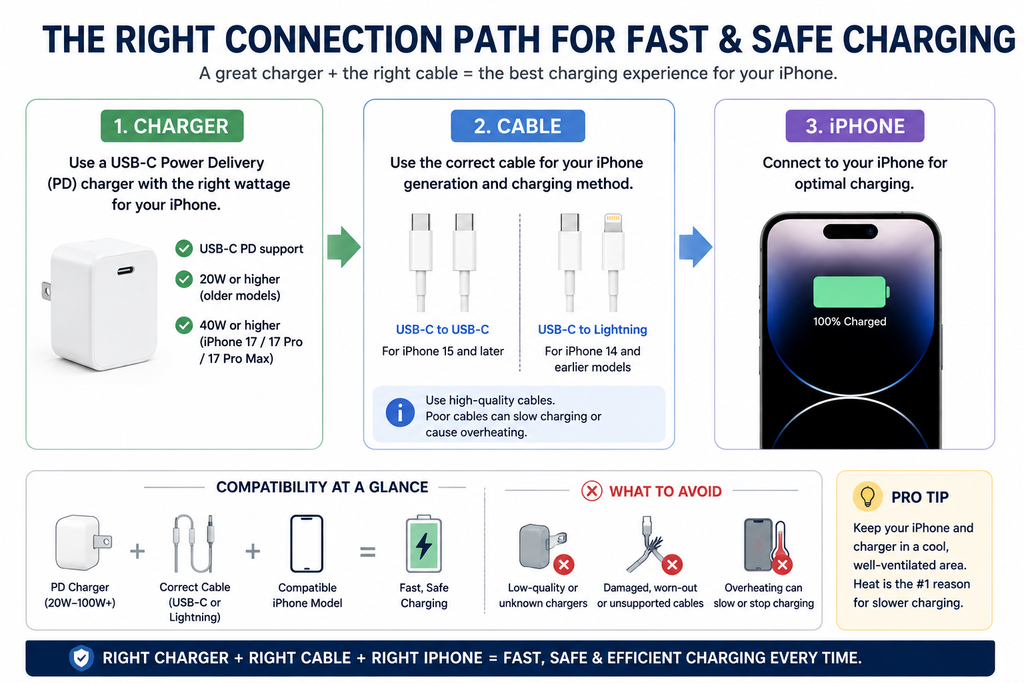
The cable is easy to overlook. Buying an excellent USB-C charger will not help if the cable does not have the correct connectors or is damaged.
For a deeper explanation of cable specifications, see:
>> USB-C Cable Specifications Guide
What About MagSafe Charging?
MagSafe has different power requirements from wired charging.
For iPhone 15 and earlier, Apple specifies a 20W-or-higher compatible USB-C adapter for up to 15W with the appropriate MagSafe Charger.
For newer generations, MagSafe charging can require more adapter power for higher wireless charging performance. Apple currently recommends a 30W-or-higher USB-C adapter for fast wireless charging on supported iPhone 16-and-later configurations.
Wireless charging also tends to be more sensitive to alignment, accessories, and heat than plugging in a cable.
If maximum charging speed is your priority, wired USB-C remains the simpler benchmark.
What to Look for When Buying an iPhone Charger
USB Power Delivery
For fast wired charging, USB Power Delivery is more important than a huge wattage number.
Apple specifically supports USB-C Power Delivery for faster wired charging. Avoid chargers whose listings advertise vague terms such as “super fast” without clearly stating their charging standards and output specifications.
The output of each port
Multi-port chargers frequently advertise their total wattage.
A “65W charger,” for example, may provide 65W only when one particular port is used alone. Connect a second device and the available power may be redistributed.
Check the manufacturer’s port-by-port specifications.
Your charging cable
Use a properly made cable appropriate for your iPhone.
A worn connector, damaged insulation, incorrect cable type, or poor-quality cable can turn a good charger into a frustrating charging setup.
>> USB-C Cable Specifications Guide
Safety information
Do not treat a logo or vague “certified safe” statement as proof of every possible safety claim.
Look for reputable manufacturers that clearly publish electrical specifications, warranty information, and relevant compliance or independent testing information.
Certification, regulatory compliance, and manufacturer safety features are related concepts, but they are not interchangeable.
Size and number of ports
A tiny single-port charger makes sense for a pocket or travel bag.
At a desk, a larger two- or three-port charger may be more useful because it can replace several adapters.
The best charger is therefore not always the smallest or most powerful one.
Frequently Asked Questions
What is the best charger for iPhone?
For the iPhone 17, iPhone 17 Pro, and iPhone 17 Pro Max, a reputable 40W-or-higher USB-C charger is the best choice if you want Apple’s fastest stated wired charging target. For many earlier iPhones, a quality 20W–30W USB-C PD charger remains sufficient.
Is a 20W charger enough for an iPhone?
For many iPhones, yes. Apple supports fast charging across numerous older models with compatible USB-C power adapters. However, 20W is no longer enough for the fastest stated wired charging performance of the iPhone 17, 17 Pro, and 17 Pro Max.
Is 30W safe for an iPhone?
A properly designed USB-C PD 30W charger is suitable for compatible iPhones. The charger and phone negotiate the required power rather than forcing the charger’s full maximum output into the phone.
Will a 65W charger damage my iPhone?
A standards-compliant USB-C PD charger can be used with an iPhone even if its maximum capacity is higher than the phone needs. The iPhone draws negotiated power rather than automatically receiving the charger’s maximum rating.
Do I need an Apple charger?
No. Apple states that compatible third-party USB-C power adapters supporting USB Power Delivery can fast-charge iPhones. The important factors are compatibility, proper specifications, build quality, and appropriate safety/compliance credentials.
Does a faster charger hurt iPhone battery health?
Higher charger wattage by itself does not mean the phone continuously charges at that maximum power. The iPhone manages charging based on factors including battery state and temperature. Charging may slow when the device becomes too warm or cold.
Final Verdict
For most buyers, the best charger for iPhone is the lowest-power reputable USB-C PD charger that comfortably covers the phone and the other devices you actually plan to charge.
For an iPhone 17, 17 Pro, or 17 Pro Max, a 40W-or-higher USB-C adapter now makes sense when maximum wired charging speed is the goal. Apple’s 40W Dynamic Power Adapter with 60W Max is the straightforward first-party option.
For many other iPhone users, the Anker Nano 30W offers an excellent balance of size and useful power. If you simply need a dependable adapter for an older iPhone, Apple’s 20W USB-C Power Adapter remains sufficient for many setups.
Choose a dual-port model when convenience matters more than maximum single-device output, and do not pay for 65W or 100W unless you also plan to charge tablets, laptops, or other higher-power USB-C hardware.
The wattage printed on the charger is only the starting point. USB PD support, per-port output, your iPhone model, and the correct cable matter more.