Introduction
Choosing the best wireless charger is harder than comparing wattage printed on a box. Your phone, charger, power adapter, case, temperature, and coil alignment all affect the power that actually reaches the battery.
What should readers know about the best wireless charger? Choose a model that is officially Qi or Qi2 certified, supports the charging profile of your phone, aligns reliably, and includes—or clearly specifies—the required power adapter. A 25W label does not guarantee that every phone will receive 25W. For many people, a well-matched 15W charger is a better purchase than a more powerful but incompatible model.
This is a research-based buying guide. BuyZivo has not conducted hands-on charging benchmarks for the products below. Recommendations are based on Wireless Power Consortium records, official support documents, and manufacturer specifications.
Quick Answer
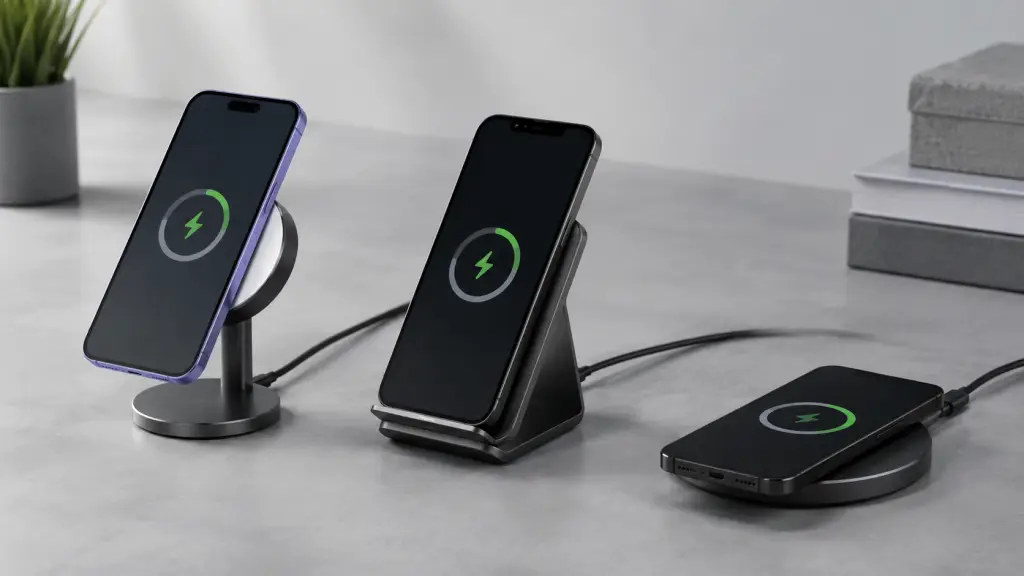
There is no single wireless charger that is best for every phone. Apple’s MagSafe Charger is a sensible single-device choice for compatible iPhones, while Google’s Pixelsnap Charger is the straightforward magnetic option for the Pixel 10 family. Samsung’s Wireless Charger Duo better suits Galaxy phone, Galaxy Watch and Galaxy Buds users.
For travel or an Apple multi-device setup, consider a certified foldable Qi2 station from Belkin or Anker. Always check your exact phone model, the charger’s certification record and whether the necessary USB-C power adapter is included.
Key Takeaways
- Qi certification covers interoperability and specified safety requirements; it does not make every charger equally fast.
- Original Qi, Qi2 15W, and Qi2 25W are different charging levels.
- Magnetic alignment is one of Qi2’s most useful improvements.
- A phone only draws the charging power it supports under current conditions.
- Standard Qi charging remains useful for older iPhones, Galaxy phones, Pixel phones and wireless earbuds.
- Cases containing metal, magnets in the wrong position or card holders can interrupt charging and increase heat.
- Multi-device stations are convenient but may have separate compatibility rules for the phone, watch and earbuds sections.
- Wired USB-C charging is usually the more practical option when minimum charging time matters.
How Does a Wireless Charger Work?
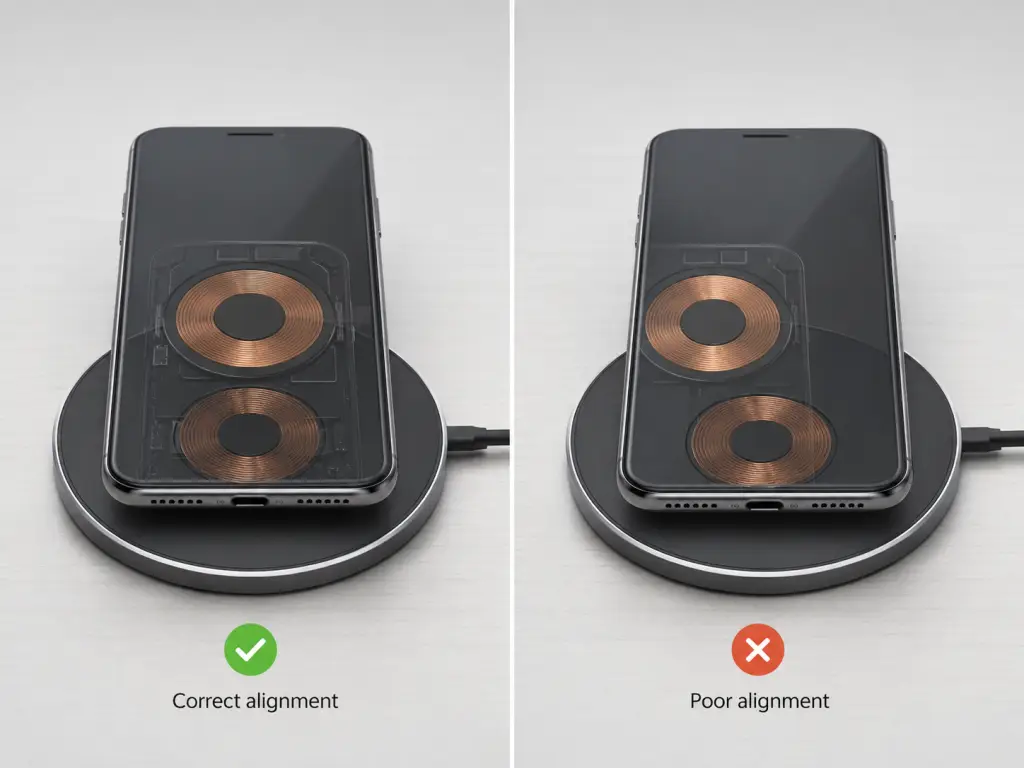
A wireless charger transfers energy between a transmitter coil in the charger and a receiver coil inside the phone. The two coils need to be close and reasonably well aligned.
Poor alignment wastes energy and can produce extra heat. A traditional charging pad relies on careful placement, while a magnetic Qi2 charger physically guides a compatible phone into the intended position.
Wireless charging is convenient rather than completely wireless. The pad or stand still needs a cable and power adapter connected to an electrical outlet or suitable USB-C power source.
Qi, Qi2 and MagSafe Explained
What is a Qi wireless charger?
Qi is the wireless-charging standard managed by the Wireless Power Consortium, or WPC. A product listed in the WPC database has completed the applicable certification process and receives a certification ID.
The WPC advises shoppers to verify products in its official database rather than trusting an unsupported “Qi compatible” statement. Compatibility wording is a manufacturer claim; it is not proof of certification.
What is a Qi2 charger?
Qi2 added standardized magnetic alignment through its Magnetic Power Profile. The original Qi2 profile supports up to 15W, while the newer Qi2 25W specification raises the available maximum to 25W for compatible combinations.
The higher figure remains conditional. A Qi2 25W charger cannot make a 15W phone accept 25W, and an unsuitable power adapter can limit the entire setup.
Some Android phones use the “Qi2 Ready” designation. This means the phone may require a specific approved magnetic case or accessory to provide the complete certified Qi2 experience. Check the phone manufacturer’s documentation and the WPC database before assuming bare-phone magnetic compatibility.
Is MagSafe the same as Qi2?
They overlap, but the names are not interchangeable. MagSafe is Apple’s magnetic accessory and charging system, while Qi2 is an industry standard managed by the WPC.
Current Apple MagSafe Chargers can also carry official Qi2 certification. Older MagSafe and Qi2 products may support different maximum charging rates, so the product generation and part number matter.
Wireless Charger Comparison
The following comparison uses the same criteria for every product. Charging figures are manufacturer-stated maximums, not BuyZivo test results.
| Product | Best suited to | Phone charging claim | Design | Power arrangement | Main limitation |
|---|---|---|---|---|---|
| Apple MagSafe Charger | Compatible iPhones and AirPods | Up to 25W on supported iPhones | Magnetic puck | Requires a suitable USB-C adapter | Stand and adapter are not built in |
| Google Pixelsnap Charger | Pixel 10 family and other compatible Qi2 devices | Up to 25W on supported devices | Magnetic puck | USB-C power source required | Maximum differs by Pixel model |
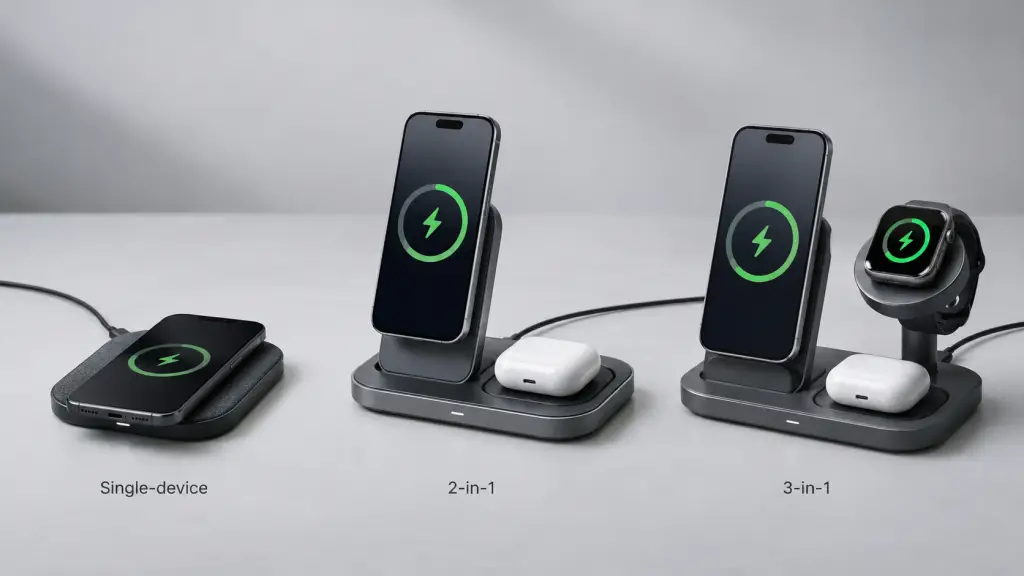
| Samsung Wireless Charger Duo EP-P5400 | Galaxy phone, Watch and Buds users | Up to 15W for supported phones | Dual flat pad | Versions with an adapter are available | Watch side is not a second phone pad |
| Belkin UltraCharge 2-in-1 Foldable | iPhone and Qi earbuds users | Up to 25W on compatible Qi2 devices | Foldable magnetic stand and earbud pad | Check regional package contents | No integrated Galaxy or Pixel Watch charger |
| Anker 3-in-1 Cube with Qi2 | iPhone, Apple Watch and AirPods users | Up to 15W | Compact foldable cube | Check package contents by market | Primarily designed around Apple devices |
| Belkin UltraCharge Pro 3-in-1 Dock | Permanent Apple desk or bedside setup | Up to 25W on compatible devices | Weighted phone, watch and earbud dock | 45W supply listed with Apple retail version | Large and excessive for phone-only charging |
Availability, package contents and product revisions can differ between countries. Confirm the full model number before ordering.
Recommended Wireless Chargers
Apple MagSafe Charger: Best simple choice for compatible iPhones
Based on Apple’s current documentation, the latest MagSafe Charger is certified for Qi2 25W and Qi charging. Apple states that it can provide up to 25W when used with a supported iPhone and an appropriate 30W-or-higher USB-C adapter.
This puck is compact and gives compatible iPhones reliable magnetic alignment. It can also charge Qi-capable AirPods cases and older supported iPhones, although charging behavior and speed vary by device.
Pros
- Official Apple and Qi2 25W support
- Accurate magnetic placement on compatible iPhones
- Available with a 1-metre or 2-metre cable
- Simple to pack and use
Cons
- Power adapter is a separate consideration
- Does not hold the phone upright by itself
- Older iPhones may charge below the advertised maximum
- Less convenient for non-magnetic Android phones
Recommended for: iPhone owners who want a compact, single-device charger and do not need a watch or earbud station.

Google Pixelsnap Charger: Best direct option for Pixel 10 users
Google’s Pixelsnap Charger uses Qi2 magnetic technology and carries an official charging claim of up to 25W. The actual rate depends on the Pixel model: Google lists up to 25W for the Pixel 10 Pro XL, while other Pixel 10 models have lower wireless-charging limits.
It is the clearest magnetic option for a recent Pixel because Google documents the phone and charger together. Other Qi2 devices may also work, but buyers should confirm their model’s charging profile.
Pros
- Designed around the Pixel 10 series
- Qi2 magnetic alignment
- Up to 25W with supported hardware
- Compact puck format
Cons
- Not every Pixel 10 model accepts 25W
- Older Pixel phones may not attach magnetically
- A suitable USB-C power source is still required
- Offers no separate watch or earbud position
Recommended for: Pixel 10 owners who want Google’s first-party magnetic charger.

Samsung Wireless Charger Duo EP-P5400: Best for a Galaxy ecosystem
Samsung rates the EP-P5400 phone area for up to 15W Fast Wireless Charging with supported devices and power sources. The second area is intended for compatible Galaxy Watch and Galaxy Buds products.
That distinction matters: the smaller right-hand section is not a second full phone-charging pad. Samsung also states that compatible Apple mobile devices are limited to 7.5W on this model.
Pros
- Charges a phone and compatible Galaxy accessory together
- Up to 15W support for suitable Galaxy devices
- Flat design works without magnetic attachment
- Adapter-included versions exist in some regions
Cons
- Second area cannot charge another phone
- Slower for iPhones than current Qi2 options
- Placement is less automatic than magnetic alignment
- Watch compatibility is centered on Galaxy models
Recommended for: Samsung users who regularly charge a Galaxy phone and Galaxy Watch or Buds together.

Belkin UltraCharge 2-in-1 Foldable: Best for travel with earbuds
Belkin documents this foldable model as a Qi2 25W charger with a separate 5W pad for AirPods or other compatible wireless-charging earbuds. It folds down for transport and can hold the phone at a viewing angle.
The design is more versatile than a plain puck without requiring a full three-device dock. Its additional USB-C output can power a compatible watch charging puck, but the watch puck may be sold separately.
Pros
- Certified Qi2 25W phone charging
- Dedicated 5W earbud area
- Foldable stand design
- Useful in portrait or landscape orientation
Cons
- Watch charging may require another accessory
- Maximum speed requires compatible phone and input power
- More expensive and bulkier than a single pad
- Check package contents in your country
Recommended for: Travellers who carry a magnetic Qi2 phone and wirelessly charging earbuds.

Anker 3-in-1 Cube with Qi2: Best compact Apple travel station
The Anker 3-in-1 Cube combines a Qi2-certified 15W iPhone surface with dedicated Apple Watch and AirPods charging positions. Its folding cube shape takes up less luggage space than most fixed three-device docks.
Its main strength is consolidation, not the highest current phone wattage. A newer 25W station may be faster with a compatible iPhone, but this 15W cube remains practical for devices that cannot use 25W anyway.
Pros
- Charges three Apple devices
- Qi2-certified 15W phone charging
- Compact folding construction
- Adjustable phone angle
Cons
- Limited to 15W for the phone
- Watch section is designed for Apple Watch
- Not the best fit for Galaxy or Pixel Watch owners
- Package contents can vary by sales region
Recommended for: Apple users who value compact packing more than the newest 25W charging profile.

Belkin UltraCharge Pro 3-in-1 Dock: Best permanent Apple charging station
Belkin’s current UltraCharge Pro dock combines Qi2 25W phone charging with dedicated Apple Watch and AirPods positions. The version listed by Apple includes a 45W USB-C power supply and a 1.5-metre cable.
A weighted, adjustable dock is easier to use one-handed than a loose puck. It also occupies more room and makes little financial sense if you only need to charge a phone.
Pros
- Qi2 25W support for compatible phones
- Charges three Apple devices at once
- Stable weighted base
- Power supply included with the Apple-listed package
Cons
- Primarily an Apple ecosystem product
- Less portable than a foldable charger
- Unnecessary for phone-only users
- Compatibility still varies by device generation
Recommended for: iPhone, Apple Watch and AirPods owners building a fixed bedside or office setup.

Compatibility: Check the Phone Before the Charger
Start with the exact model number of your phone. Do not assume that every device within an iPhone, Galaxy, or Pixel family supports the same wireless standard or maximum rate.
For example, Apple lists the iPhone 15 Pro Max for up to 15W over Qi2, while newer supported iPhones can reach 25W with suitable equipment. Google likewise specifies different Pixelsnap maximums across the Pixel 10 range.
Many Galaxy phones support Qi wireless charging but lack built-in Qi2 magnets. A magnetic case can help the phone attach to a stand, but adding magnets does not automatically change its charging protocol or increase its accepted wattage.
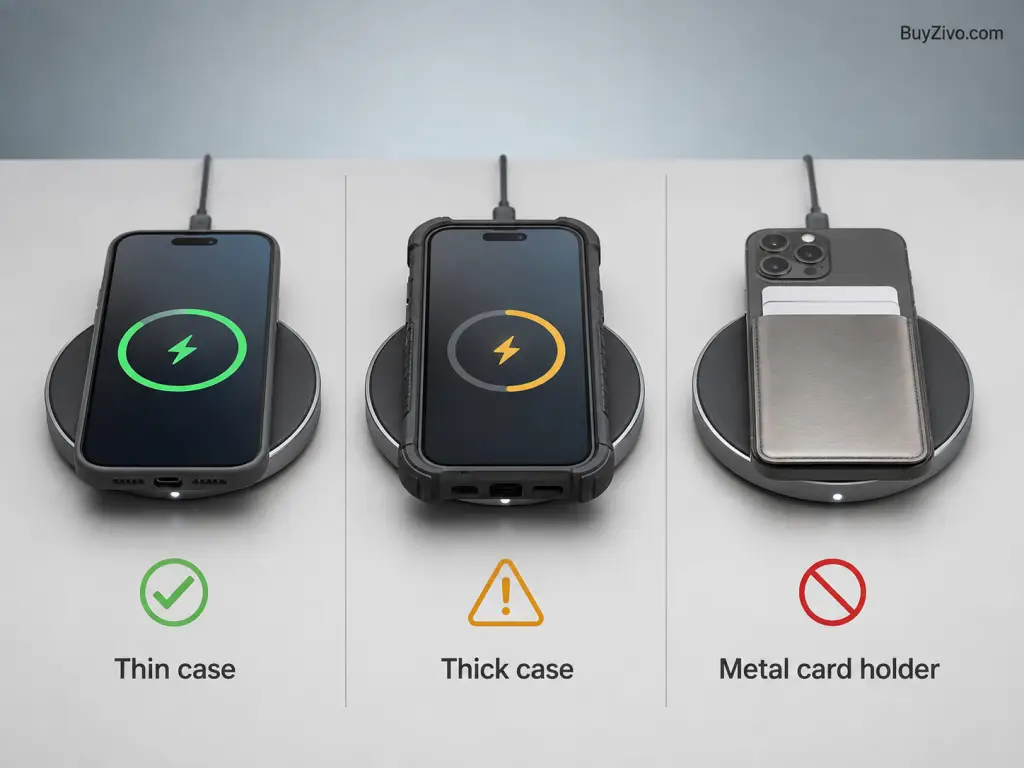
Cases should be thin enough for the charger and correctly designed around the charging coil. Metal plates, card wallets, and poorly positioned magnetic rings can prevent charging or create unwanted heat.
Wireless Charging Speed: Why the Box Is Not the Whole Story
“Up to 25W” describes a maximum under supported conditions. It is not a promise of continuous 25W input throughout a complete charge.
Phones reduce power as the battery fills and may slow or pause charging when temperatures rise. Screen use, navigation, gaming, room temperature and background activity can also change the observed rate.
The power adapter matters as well. A charger may require a particular USB-C Power Delivery voltage profile or minimum input wattage. Using an old 10W adapter with a modern 25W pad will not produce 25W wireless charging.
For an urgent top-up, use a suitable wired USB-C charger. Wireless charging is usually better suited to regular desk, bedside and overnight use.
Wireless-Charging Safety
Wireless charging normally produces some warmth. Excessive heat, repeated interruptions, unusual smells, physical swelling or a damaged cable are reasons to stop using the equipment.
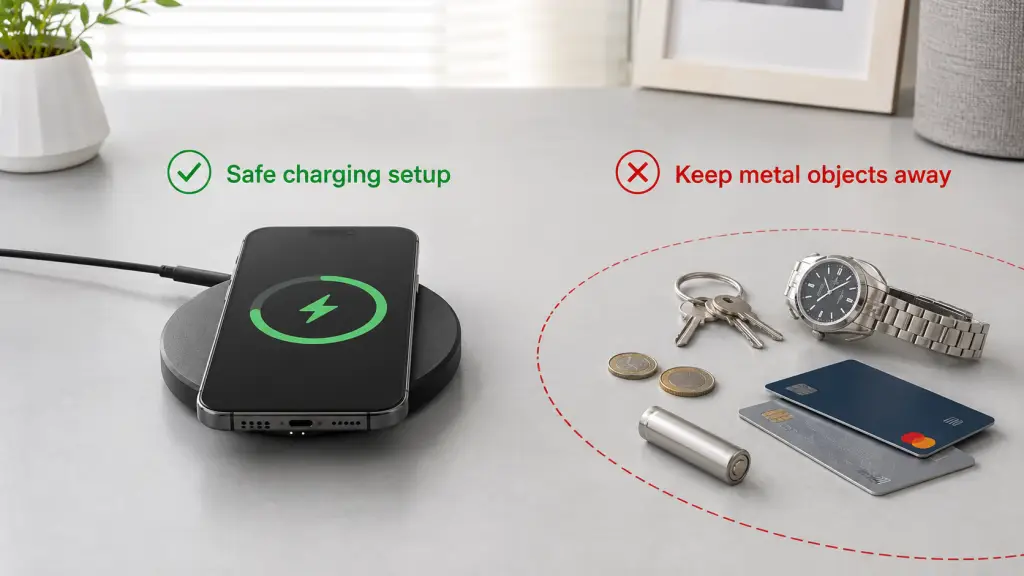
Apple advises keeping the phone, charger and power adapter in a ventilated area. It also warns against placing keys, coins, batteries, jewellery or other metallic objects between the device and charging surface.
Samsung similarly advises removing foreign objects, cards, holders and incompatible magnetic accessories. If the phone or charger becomes unusually hot, disconnect it and allow it to cool before investigating the case, alignment and power source.
Certification, marking and claims are different
- Qi or Qi2 certification: Issued under the WPC certification program. Verify the model in the WPC product database.
- UL certification: Indicates that UL Solutions evaluated the product against identified requirements. Verify the model and mark through UL’s official resources.
- Regulatory marking: A mark such as CE relates to the manufacturer’s declaration that applicable European requirements are met. CE is not an independently issued product certification.
- Manufacturer claim: A statement such as “25W compatible” or “advanced temperature protection.” Treat it as a claim unless the manufacturer provides verifiable certification or test details.
A charger can be Qi certified without being UL certified, and the two programs address different questions. Qi focuses on the relevant wireless-power specification and interoperability requirements; electrical safety certification covers applicable safety standards.
Buying Advice
What matters
Your phone’s supported standard: Confirm whether it uses Qi, Qi2 15W, Qi2 25W, MagSafe or a manufacturer-specific fast-charging mode.
Verified certification: Search the exact product or certification ID in the WPC database. Similar product names can cover several revisions.
Reliable alignment: Magnetic Qi2 chargers make positioning easier. For a conventional charging pad, a non-slip surface and clearly marked coil area help.
The supplied power system: Check the required USB-C input, cable and adapter. An included adapter reduces uncertainty, particularly with multi-device stations.
Physical format: Pads are unobtrusive, stands keep notifications visible, and foldable stations suit travel. A stand may be inconvenient for unusually large camera modules or nonstandard cases.
Accessory compatibility: Apple Watch, Galaxy Watch and Pixel Watch charging systems are not interchangeable merely because the station can charge a Qi phone.
What matters less
A very high input wattage does not prove that more power reaches the phone. Decorative LEDs, vague cooling language, and large lists of “protection systems” should not outweigh certification and documented compatibility.
The number of coils can make placement easier on a large pad, but more coils do not automatically increase the phone’s maximum charging rate.
How to compare products
- Find the official wireless-charging specification for your exact phone.
- Decide whether you need a pad, stand, travel charger or multi-device dock.
- Verify the charger in the WPC certified-product database.
- Confirm the phone-side maximum, not only the charger’s advertised output.
- Check whether the cable and correct power adapter are included.
- Review case, watch and earbud compatibility separately.
- Compare local availability, return terms and warranty information from the seller.
How to avoid marketing tricks
Be cautious when a listing says “Qi2 compatible” but does not say “Qi2 certified.” Search for the product in the WPC database instead of relying on a marketplace image of a logo.
Ignore speed comparisons without test conditions. Different phones, starting charge levels, temperatures and power adapters can make percentage-based claims misleading.
A phrase such as “15W/20W/25W” may describe the charger’s theoretical modes rather than what your phone will receive. Look for an explicit compatibility table from the phone or charger manufacturer.
Which design suits you?
- Phone only: Choose a compact certified puck, pad or stand.
- iPhone with Apple Watch and AirPods: Consider a verified 3-in-1 Apple-focused station.
- Galaxy phone with Galaxy Watch or Buds: Samsung’s Duo layout is the more direct match.
- Pixel 10: A Pixelsnap or appropriately certified Qi2 charger provides magnetic alignment.
- Frequent travel: Use a foldable model with a removable or replaceable USB-C power adapter.
- Mixed household: A standard Qi pad is broadly useful, but each device may charge at a different rate.
Common Wireless-Charger Buying Mistakes
Buying by wattage alone
The highest printed number is only useful when the phone, charger, cable and adapter support the same profile. Compatibility should come first.
Treating all magnetic chargers as Qi2
A magnetic ring proves only that magnets are present. It does not prove Qi2 certification or 15W/25W charging.
Assuming every watch uses Qi
Smartwatches often use brand-specific charging hardware. Check the exact watch series before buying a multi-device station.
Reusing an unsuitable power adapter
An underpowered or incompatible adapter can cause slow or intermittent charging. Follow the charger manufacturer’s stated input requirements.
Charging through cards or metal accessories
Credit cards, magnetic holders and metal plates should not sit between the phone and charger. Remove them before charging.
Ignoring heat and damaged components
Do not continue using a frayed cable, cracked adapter or charger that repeatedly becomes excessively hot. Replacement is more appropriate when physical damage or persistent overheating is present.
Final Recommendation and Verdict
The right choice depends on the devices you own, so the evidence does not support naming one universal winner.
For a compatible iPhone, Apple’s current Qi2 25W MagSafe Charger is the simplest first-party option. Pixel 10 owners should consider Google’s Pixelsnap Charger, while Galaxy users who also own a Galaxy Watch or Buds gain more practical value from Samsung’s Wireless Charger Duo.
Belkin’s foldable 2-in-1 and Anker’s 3-in-1 Cube make sense when travel and accessory charging matter. A fixed three-device dock is worth considering only if you will regularly use all its charging positions.
Frequently Asked Questions
Is a Qi2 charger better than a Qi charging pad?
Qi2’s magnetic alignment is easier to position and can support faster 15W or 25W profiles with compatible phones. A standard Qi charging pad remains useful for older or non-magnetic devices and may cost less.
Can one wireless charger work with iPhone and Android?
Yes, if both phones support the charger’s Qi profile. Charging speed and magnetic attachment can differ, so universal compatibility does not mean identical performance.
Will a 25W charger damage a 15W phone?
A properly certified and compatible system negotiates the available power rather than forcing 25W into the phone. Use a reputable charger and the required power adapter, and stop using damaged or abnormally hot equipment.
Does wireless charging damage battery health?
Wireless charging produces heat, and sustained high temperatures are undesirable for lithium-ion batteries. Modern phones manage charging power and temperature, but users should keep the setup ventilated and remove cases that cause excessive heat.
Can I leave my phone on a wireless charger overnight?
Modern compatible phones manage charging when the battery fills. Use certified equipment on a firm, ventilated surface, and do not cover the phone or charger with bedding or place it under your body.
Why does my phone charge slowly on a wireless charger?
Common causes include poor coil alignment, a thick or metal-containing case, an underpowered adapter, high temperature, background phone use, or an unsupported fast-charging profile.
Do I need a special case for Qi2?
An iPhone or Android phone with built-in Qi2 magnets does not normally need a case, although a Qi2-compatible case can add protection. A Qi2 Ready Android phone may require a specific approved magnetic case, so consult its official documentation.
Is CE proof that a wireless charger was independently certified?
No. CE is a regulatory marking based on the manufacturer’s declaration of conformity with applicable European requirements. It should not be described as an independently issued certification.
Conclusion
The best wireless charger is the one that matches your phone’s certified charging profile, stays correctly aligned, and comes with a suitable power source. Extra wattage and multiple charging positions provide little value when your devices cannot use them.
Confirm your exact phone and accessory models, verify certification, and inspect the included cable and adapter before ordering. Then check the latest price and availability from an authorized or reputable seller.