This article may contain affiliate links. If you purchase through them, BuyZivo may earn a commission at no extra cost to you. Our recommendations are based on research, official documentation, and practical buying considerations rather than sponsored placements.
⚡ Quick Summary
Best for: Travelers who want enough portable capacity for phones, tablets, and potentially USB-C laptops without moving to an oversized battery pack.
Main recommendation: The Anker Power Bank (20K, 87W, Built-In USB-C Cable) offers the strongest balance for most travelers. Choose the UGREEN Nexode 130W or Anker Prime 220W when higher-power laptop charging is a priority.
Important: Don’t choose by 20,000mAh capacity alone. Compare single-port USB-C output, USB PD/PPS support, Wh rating, weight, input/recharge speed, ports, and cable requirements. Power banks must be carried in carry-on baggage under FAA/TSA rules.
Research basis: Current official manufacturer specifications plus USB-IF USB Power Delivery documentation, FAA/TSA battery-travel guidance, and UL power-bank safety information.
Table of Contents
Introduction
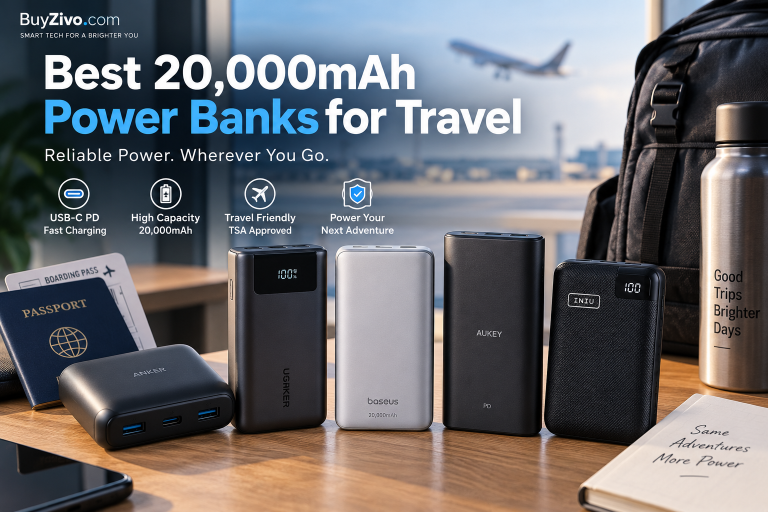
A 20,000mAh power bank is one of the most practical sizes for travel. It gives you substantially more reserve power than a compact 5,000mAh or 10,000mAh battery without moving into the bulk of the largest laptop-focused packs.
But capacity alone does not tell you which model to buy.
Two power banks can both say “20,000mAh” on the box while offering very different charging experiences. One may top out around 30W and make sense mainly for phones and tablets. Another can deliver 100W or 140W over USB-C and become a useful backup for compatible laptops.
For most travelers, our best-balanced choice is the Anker Power Bank (20K, 87W, Built-In USB-C Cable). It combines 20,000mAh capacity, up to 65W from its USB-C connection, 87W total output, three charging connections, and a built-in USB-C cable without reaching the price or weight of the highest-powered options.
If laptop charging is your priority, however, the UGREEN Nexode Power Bank 20000mAh 130W or Anker Prime Power Bank (20K, 220W) makes more sense.
Quick Picks
Power Bank
Best For
Capacity
Max Single-Port Output
Key Advantage
Anker Power Bank (20K, 87W)
Best overall
20,000mAh
65W USB-C
Built-in cable + balanced output
UGREEN Nexode 20K 130W
Best for laptops
20,000mAh / 72Wh
100W USB-C
Strong laptop charging
Anker Prime 20K 220W
Best premium
20,100mAh / 72.36Wh
140W USB-C
Very high output
Anker Zolo 20K 30W
Best for phones
20,000mAh
30W
Built-in USB-C cable
Baseus Blade HD 100W
Best slim design
20,000mAh
100W
Flat laptop-friendly design
Short answer: If you mainly charge phones, you do not need a 100W+ power bank. If you regularly travel with a USB-C laptop, paying for 65W–140W USB-C output can make a meaningful difference.
What Should You Look for in the Best 20,000mAh Power Bank?
Start with the devices you actually carry.
For a phone-focused travel kit, roughly 30W USB-C output can already be enough for many modern smartphones. For tablets and ultraportable laptops, 45W–65W becomes more useful. For higher-powered USB-C laptops, a 100W or 140W-capable output gives you considerably more flexibility.
USB Power Delivery is particularly important because it allows compatible USB devices to negotiate the power they require rather than treating every USB connection as a fixed charging source.
Modern USB PD specifications can support far more power than a typical power bank needs; USB-IF says USB PD can scale up to 240W with the appropriate USB-C implementation.
That does not mean a 240W-rated cable will make a 30W power bank charge at 240W. The actual charging rate is constrained by the power bank, connected device, charging protocol, cable, temperature, and other system conditions.
1. Anker Power Bank (20K, 87W, Built-In USB-C Cable) — Best Overall
The Anker 20K 87W is the model we would start with for a typical traveler who wants one battery for a phone, tablet, and a USB-C laptop without buying an unusually expensive high-output power bank.
Anker specifies a 20,000mAh capacity and 87W total output. The built-in USB-C cable or USB-C port can deliver up to 65W, while the USB-A connection provides another option for older accessories.
It weighs about 431g and measures approximately 157.5 × 73.5 × 26mm.
Why we like it
The built-in USB-C cable solves a small but genuine travel problem: forgetting the cable that makes the battery useful.
A 65W USB-C ceiling is also a sensible middle ground. It is considerably more capable than phone-oriented 20W–30W power banks while avoiding the size, weight, and cost associated with some 100W+ models.
Pros
20,000mAh capacity
Up to 65W from USB-C
87W total output
Built-in USB-C cable
USB-C and USB-A connectivity
More portable than several premium high-output alternatives
Cons
65W may be insufficient for some high-performance laptops at full load
Heavier than smaller phone-only power banks
Built-in cables are convenient, but unlike a detachable cable they cannot simply be replaced independently if damaged
Best for
Travelers carrying a mix of phones, tablets, handheld devices, and moderate-power USB-C laptops.
2. UGREEN Nexode Power Bank 20000mAh 130W — Best for Laptop Travelers
The UGREEN Nexode 20K 130W moves further into laptop territory.
Its primary USB-C port supports up to 100W output, while the second USB-C port supports up to 30W and the USB-A port up to 22.5W. UGREEN lists a 130W combined maximum output, 65W USB-C input, 20,000mAh / 72Wh capacity, and support for USB PD and PPS among several charging protocols.
The trade-off is portability.
UGREEN lists the unit at approximately 476g, so this is not a pocket-friendly phone battery. It makes more sense in a backpack beside a laptop.
Why we like it
The 100W USB-C output is the key advantage. If your laptop can charge over USB-C at higher wattages, this gives you more headroom than a typical 30W or 65W power bank.
Its display is also more informative than a basic four-LED battery indicator.
Pros
100W maximum USB-C output
130W combined output
20,000mAh / 72Wh capacity
Two USB-C ports plus USB-A
USB PD and PPS support
65W input
Detailed display
Cons
Approximately 476g
No built-in charging cable
High output is unnecessary if you only charge a phone
You need an appropriately rated USB-C cable to make full use of 100W charging
Best for
Travelers carrying USB-C laptops, tablets, phones, or multiple higher-power devices.
3. Anker Prime Power Bank (20K, 220W) — Best Premium 20K Power Bank
The Anker Prime 20K 220W sits at the performance end of this category.
Anker lists 20,100mAh / 72.36Wh capacity, up to 140W from USB-C, 220W total output, and up to 100W USB-C input. It has two USB-C connections and one USB-A port.
The important distinction is between single-port output and total output. A 220W total rating does not mean one connected device receives 220W. Anker specifies up to 140W from USB-C.
At approximately 510g, it is also heavier than our overall recommendation.
Why we like it
This is the option for travelers whose portable battery needs look more like a mobile workstation than a phone backup.
The 140W USB-C output can be useful with compatible higher-power laptops, while the large total power budget gives it more flexibility when several devices are connected.
Pros
140W maximum USB-C output
220W total output
20,100mAh capacity
100W maximum USB-C recharging
Two USB-C ports plus USB-A
Detailed charging information
Strong fit for laptop-heavy setups
Cons
Approximately 510g
Premium pricing
Overkill for phone-only users
Full 140W operation requires an appropriate 5A USB-C cable and compatible device
Best for
Power users, creators, business travelers, and anyone regularly carrying a high-power USB-C laptop.
4. Anker Zolo Power Bank (20K, 30W, Built-In USB-C Cable) — Best for Phone Travel
Not everyone needs laptop-class output.
The Anker Zolo 20K offers 30W-class USB-C output, a 20,000mAh battery, USB-C connectivity, USB-A, and a built-in USB-C cable.
Its output profiles also include PPS support, which makes it more relevant to compatible modern smartphones than capacity alone would suggest.
Why we like it
It focuses on what many travelers actually need: plenty of battery capacity, reasonable smartphone charging performance, and one less cable to remember.
Spending substantially more for 100W+ output provides little benefit if your travel kit consists of a phone, earbuds, smartwatch, and perhaps a tablet.
Pros
20,000mAh capacity
Built-in USB-C cable
Up to 30W output
PPS support
Additional USB-C and USB-A connections
Better fit for phone-focused users than an expensive laptop power bank
Cons
Only 20W maximum USB-C input
Not our choice for higher-powered laptops
Lower output than the other performance-focused picks
Best for
Phone-first travelers who prioritize capacity and convenience over laptop charging.
5. Baseus Blade HD 100W 20000mAh — Best Slim Power Bank for a Laptop Bag
Most 20,000mAh batteries are thick rectangular blocks. The Baseus Blade HD takes a different approach.
Baseus specifies a 20,000mAh battery, 100W maximum output, four charging ports — two USB-C and two USB-A — and a body measuring roughly 5.27 × 5.27 × 0.7 inches.
It weighs approximately 445g.
Why we like it
The broad, thin design can work well in a laptop compartment because it behaves more like a slim electronics accessory than a thick battery brick.
It is also capable of much higher USB-C output than a phone-oriented 20K model.
Pros
100W maximum output
20,000mAh capacity
Two USB-C and two USB-A ports
Thin design
Approximately 445g
Suitable for compatible laptops and mobile devices
Cons
Wide shape may be awkward for pockets
Four ports matter less if you normally charge only one device
Older design than some newer premium alternatives
Best for
Laptop-bag travelers who prefer a flat power bank rather than a thick vertical design.
How the Five Power Banks Compare
Model
Capacity
Max USB-C / Single-Port Output
Ports / Connections
Approx. Weight
Anker 20K 87W
20,000mAh
65W
Built-in USB-C + USB-C + USB-A
431g
UGREEN Nexode 130W
20,000mAh / 72Wh
100W
2× USB-C + USB-A
476g
Anker Prime 20K
20,100mAh / 72.36Wh
140W
2× USB-C + USB-A
510g
Anker Zolo 20K
20,000mAh
30W
Built-in USB-C + USB-C + USB-A
—
Baseus Blade HD
20,000mAh
100W
2× USB-C + 2× USB-A
445g
Specifications can vary by market or revision. Verify the exact model number before purchasing.
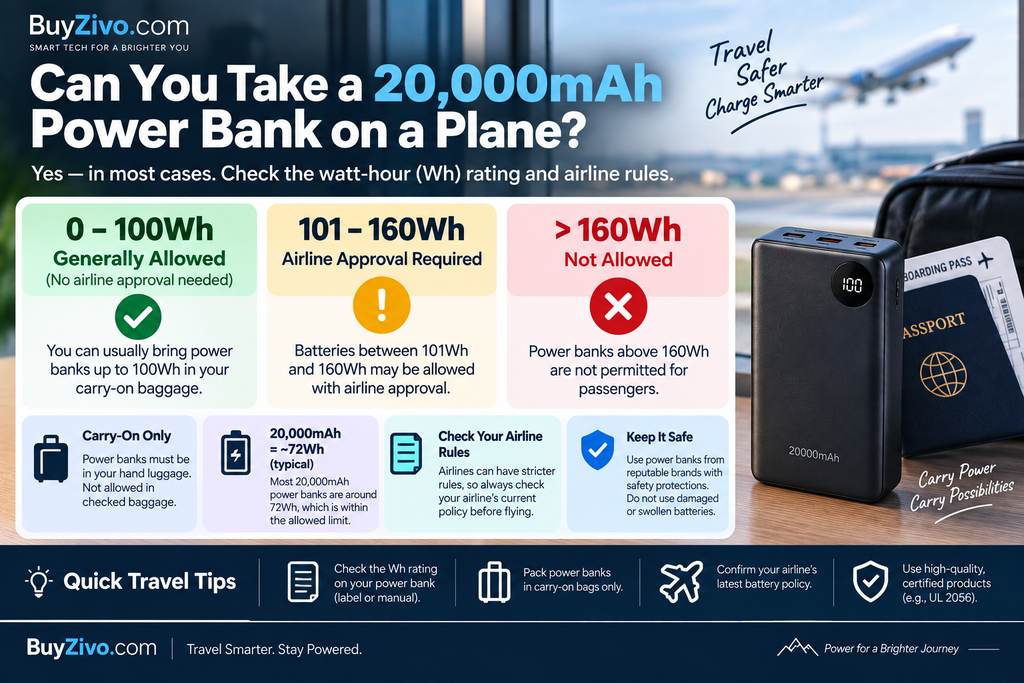
Is a 20,000mAh Power Bank Allowed on a Plane?
Usually, yes — but check the watt-hour rating, not just the mAh number.
The FAA permits rechargeable lithium batteries rated 0–100Wh on passenger aircraft under its general battery rules. Batteries between 101Wh and 160Wh require airline approval, while batteries above 160Wh are prohibited for passengers.
Power banks are treated as spare lithium batteries and must be carried in carry-on baggage, not checked baggage.
Airlines may impose stricter policies, so checking your carrier’s current rules before departure is still important.
Why mAh alone is not the airline specification
Air-travel battery rules are expressed in watt-hours.
The FAA gives this calculation:
Wh = volts × amp-hours
Because 20,000mAh equals 20Ah, the Wh figure depends on the battery’s nominal voltage.
Do not assume every product labeled “20,000mAh” has exactly the same Wh rating. Check the Wh value printed on the power bank or its official documentation.
For example, UGREEN lists its Nexode 20K 130W at 72Wh, while Anker lists the Prime 20K 220W at 72.36Wh.
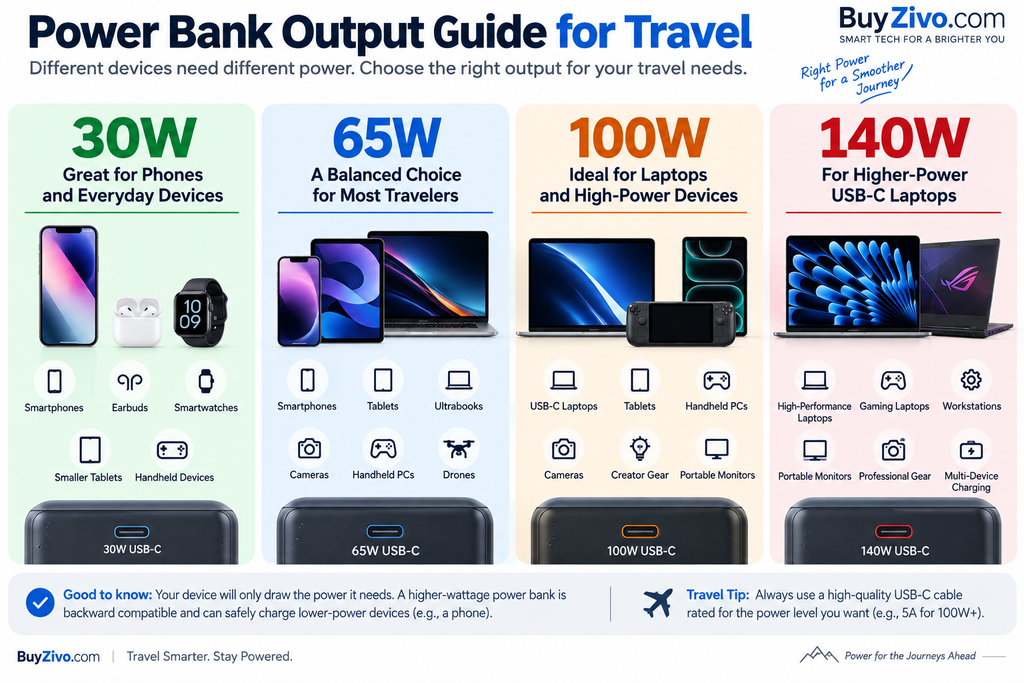
30W vs 65W vs 100W vs 140W: Which Do You Need?
Higher wattage is useful only when the connected device can take advantage of it.
Around 30W: phones and smaller devices
A good choice if you mainly carry:
Smartphones
Earbuds
Smartwatches
Smaller tablets
Other low-to-moderate-power USB devices
Around 65W: balanced travel setup
This is a useful middle ground for:
Smartphones
Tablets
Many USB-C ultrabooks
Handheld gaming devices
Mixed travel setups
Around 100W: laptop-focused travel
Worth considering when your compatible laptop can accept substantially more than 45W–65W or when you want greater charging headroom.
140W: higher-power USB-C laptops
This class makes sense only if your hardware can actually negotiate the higher USB PD power level.
A higher number on the power bank does not force extra power into a device. Compatible USB PD devices negotiate supported power levels.
A 100W or 140W power bank paired with the wrong cable can prevent you from reaching the advertised charging level.
For higher USB-C power levels, use a cable explicitly rated for the power you intend to carry.
USB-IF’s current USB Power Delivery framework extends as high as 240W with suitable USB-C hardware and cables. That makes cable capability particularly important once you move beyond basic phone charging.
For example, Anker specifically says the Prime 20K requires a 5A cable for its maximum 140W output.
Why You Won’t Get the Full 20,000mAh at Your Phone
A common source of disappointment is expecting a 20,000mAh power bank to deliver exactly 20,000mAh into another device.
That is not how real power transfer works.
The advertised battery capacity is associated with the cells inside the power bank. Delivering power through USB requires voltage conversion, and the power bank itself consumes some energy during that process. The receiving device also has its own charging losses.
That means usable output will be lower than a simplistic calculation based only on the two advertised mAh figures.
This is one reason watt-hours and actual charging requirements are more informative than comparing mAh alone.
What About Safety Certifications?
Avoid treating vague phrases such as “certified safe” as proof of a specific independent certification.
UL 2056 is a dedicated standard covering power banks. UL describes it as addressing areas including electrical and fire-safety risks for standalone portable USB charging products.
But the existence of a safety standard does not mean every power bank has been independently certified to it.
When a seller claims UL certification or another third-party certification, verify that claim for the exact product/model rather than assuming it applies to the whole brand.
Also avoid using a power bank that is swollen, physically damaged, unusually hot, wet, recalled, or otherwise compromised.
Should You Buy 10,000mAh or 20,000mAh for Travel?
Choose 10,000mAh when low weight and pocketability matter most.
Choose 20,000mAh when you want:
More reserve power between outlets
Multiple phone charges
Better support for tablets
Practical laptop backup
Enough capacity for long flights, train journeys, or multi-device days
The trade-off is simple: 20K power banks are noticeably heavier.
Several laptop-capable models in this guide weigh around 430–510g, before adding cables and chargers.
For a minimalist day trip, that can be excessive. For a long travel day with a laptop and phone, it can be worth carrying.
For most people, we recommend the Anker Power Bank (20K, 87W, Built-In USB-C Cable). Its combination of 20,000mAh capacity, 65W USB-C charging, 87W total output, and integrated cable is better balanced for travel than chasing the largest wattage number.
Choose the UGREEN Nexode 20K 130W if laptop charging is more important and you want 100W USB-C output without moving to the most expensive category.
Choose the Anker Prime 20K 220W if charging performance matters more than price or weight. Its 140W single-port USB-C capability makes it the strongest performance option here.
The Anker Zolo 20K 30W is the more sensible choice for phone-focused travelers, while the Baseus Blade HD 100W stands out if you want a flatter design for a laptop bag.
The best 20,000mAh power bank is therefore not necessarily the model with the highest output. It is the one whose output, ports, weight, and charging protocols match the devices you actually travel with.
Frequently Asked Questions
What is the best 20,000mAh power bank for travel?
For a balanced travel setup, the Anker Power Bank (20K, 87W, Built-In USB-C Cable) is our top recommendation because it combines 20,000mAh capacity, up to 65W USB-C output, 87W total output, and an integrated USB-C cable. For higher-power laptop charging, consider a 100W+ model instead.
Can a 20,000mAh power bank charge a laptop?
Yes, if both the laptop and power bank support compatible USB-C charging. Capacity alone does not determine laptop compatibility. Check the power bank’s USB-C output profiles and your laptop’s charging requirements.
Can a 20,000mAh power bank charge a laptop?
Yes, if both the laptop and power bank support compatible USB-C charging. Capacity alone does not determine laptop compatibility. Check the power bank’s USB-C output profiles and your laptop’s charging requirements.
Is 20,000mAh too large for air travel?
Not inherently. Airline battery rules are based primarily on watt-hours rather than the marketing mAh figure. FAA guidance generally permits rechargeable batteries up to 100Wh, while power banks must be transported in carry-on baggage. Always check the Wh marking and your airline’s current policy.
Can I put a power bank in checked luggage?
No under FAA/TSA rules for spare lithium batteries. Power banks and portable chargers containing lithium-ion batteries must be carried in carry-on baggage.
Is a 100W power bank better than a 30W power bank?
Only when your devices benefit from the extra output. For a smartphone, a 100W power bank may offer little charging-speed advantage over a well-matched lower-output model. For a USB-C laptop, the additional output can be much more useful.
Do I need a special cable for a 100W or 140W power bank?
You need a USB-C cable rated appropriately for the required power. Higher-power USB-C charging can require 5A-rated cable capability. Check both the power bank and cable specifications instead of assuming every USB-C cable is equivalent.
How many times will 20,000mAh charge my phone?
There is no universal number. It depends on the phone battery, voltage conversion, charging efficiency, cable losses, temperature, and how the phone is used while charging. Dividing 20,000mAh directly by your phone’s battery capacity will overestimate real-world charging.
Final Verdict
Best overall: Anker Power Bank (20K, 87W, Built-In USB-C Cable)
Best for laptops: UGREEN Nexode Power Bank 20000mAh 130W
Best premium: Anker Prime Power Bank (20K, 220W)
Best for phones: Anker Zolo Power Bank (20K, 30W, Built-In USB-C Cable)
Best slim design: Baseus Blade HD Laptop Power Bank 100W 20000mAh
For most travelers, 65W-class USB-C output is the practical sweet spot. Move to 100W or 140W when a laptop or other high-power USB-C device gives you a specific reason to do so.
Before purchasing, verify the exact model, output specifications, Wh rating, cable requirements, current availability, and your airline’s battery policy.
Views:505
About the Author
Hi, I'm Arif Hossen, founder of BuyZivo. I research and write about mobile accessories, including chargers, power banks, earbuds, cables, and other everyday tech essentials. My goal is to help readers make informed buying decisions with honest reviews, comparisons, and practical guides.